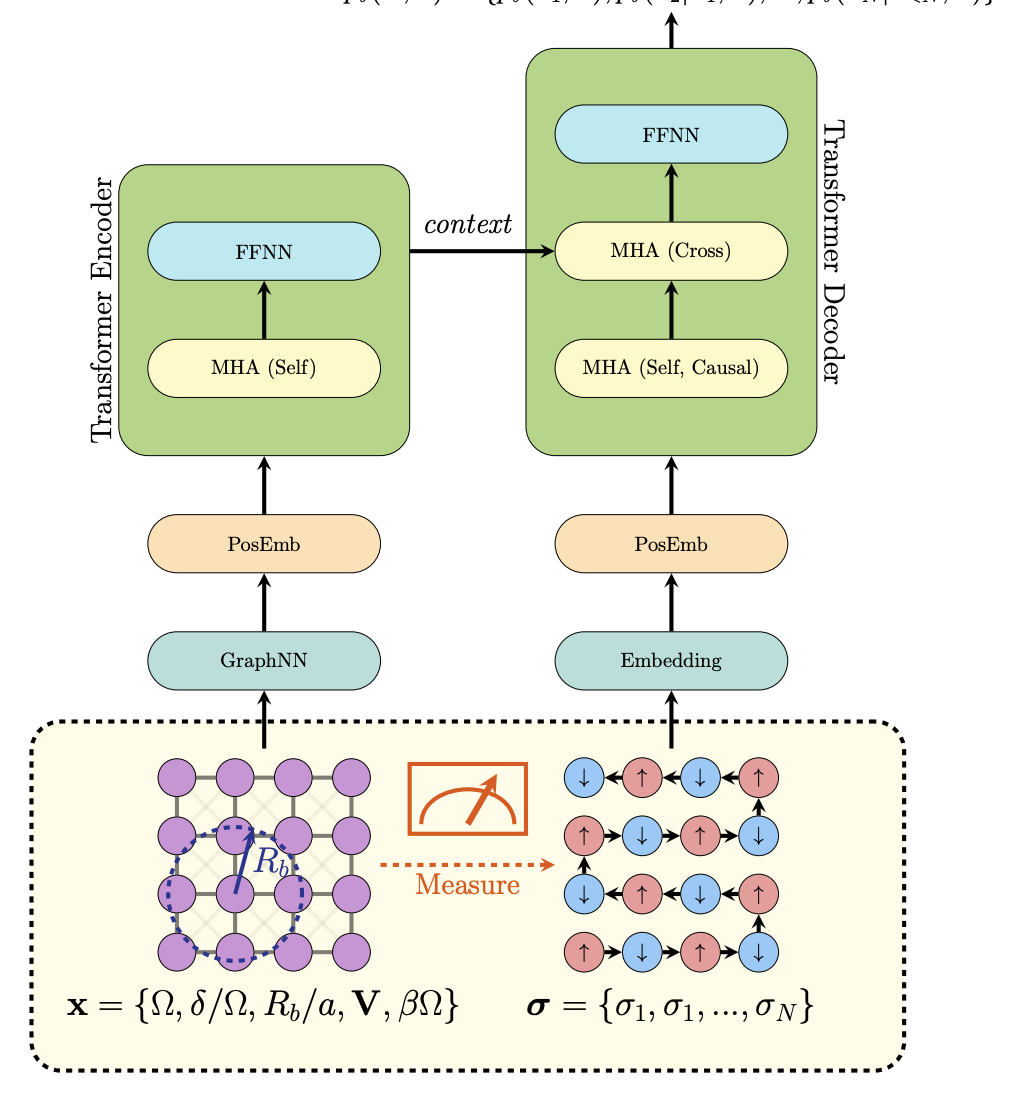
Researchers have made significant progress in developing a new type of artificial intelligence model that can simulate the behavior of quantum systems. The team, used a transformer architecture to create a model that can learn from data and make predictions about complex quantum phenomena. The model was trained on synthetic data, but the researchers believe it could be adapted to work with real-world experimental devices.
The study showed that the model can accurately predict the behavior of small quantum systems, but struggles with larger systems. However, the researchers propose modifications to the architecture that could allow it to represent more complex states and scale up to larger systems.
The team used a single NVIDIA A100 GPU to train the model over 85 hours, demonstrating the potential for larger models to make highly accurate predictions about quantum behavior. The research has implications for the development of quantum computers and could lead to breakthroughs in fields such as materials science and chemistry.
Companies involved in the work include NVIDIA, while organizations supporting the research include the Natural Sciences and Engineering Research Council of Canada, the Perimeter Institute for Theoretical Physics, and the Kavli Institute for Theoretical Physics.
The authors are exploring the application of transformer
The authors are exploring the application of transformer models, commonly used in natural language processing, to simulate the behavior of quantum systems. Specifically, they’re investigating how well these models can reproduce physical estimators (quantities that describe the system’s properties) in various scenarios.
Here are the key takeaways:
- Pure and positive quantum states: When the quantum state is pure, real, and positive, the transformer model can accurately reproduce physical estimators. This is demonstrated using Rydberg atom arrays governed by a specific Hamiltonian equation.
- Mixed states and thermal noise: However, when the quantum state is no longer pure (i.e., it’s mixed or thermally noisy), the model’s ability to interpret the output breaks down. The authors propose modifying the decoder architecture to represent density matrices or other mathematical constructs that can handle noisy states.
- Scaling potential: The transformer model shows signs of generalization when trained on smaller systems and applied to larger ones, but it hasn’t yet reached its full potential. The authors believe that training models with more data on diverse lattice sizes will lead to systematic improvements in performance.
- Future directions: To further improve the model’s capabilities, the authors suggest exploring alternative token representations (e.g., using patches of qubits), increasing the number of trainable parameters, and leveraging larger datasets and computational resources.
The study’s results are promising, and the authors
The study’s results are promising, and the authors envision a future where significantly larger transformers can make highly accurate predictions about quantum systems, even in regimes where no data is currently available. They also propose training these models on real experimental data, which could lead to a new type of foundation model that generates predictions for unseen input settings.
Overall, this research has the potential to revolutionize our understanding and simulation of quantum systems, with implications for fields like quantum computing and materials science.
External Link: Click Here For More