
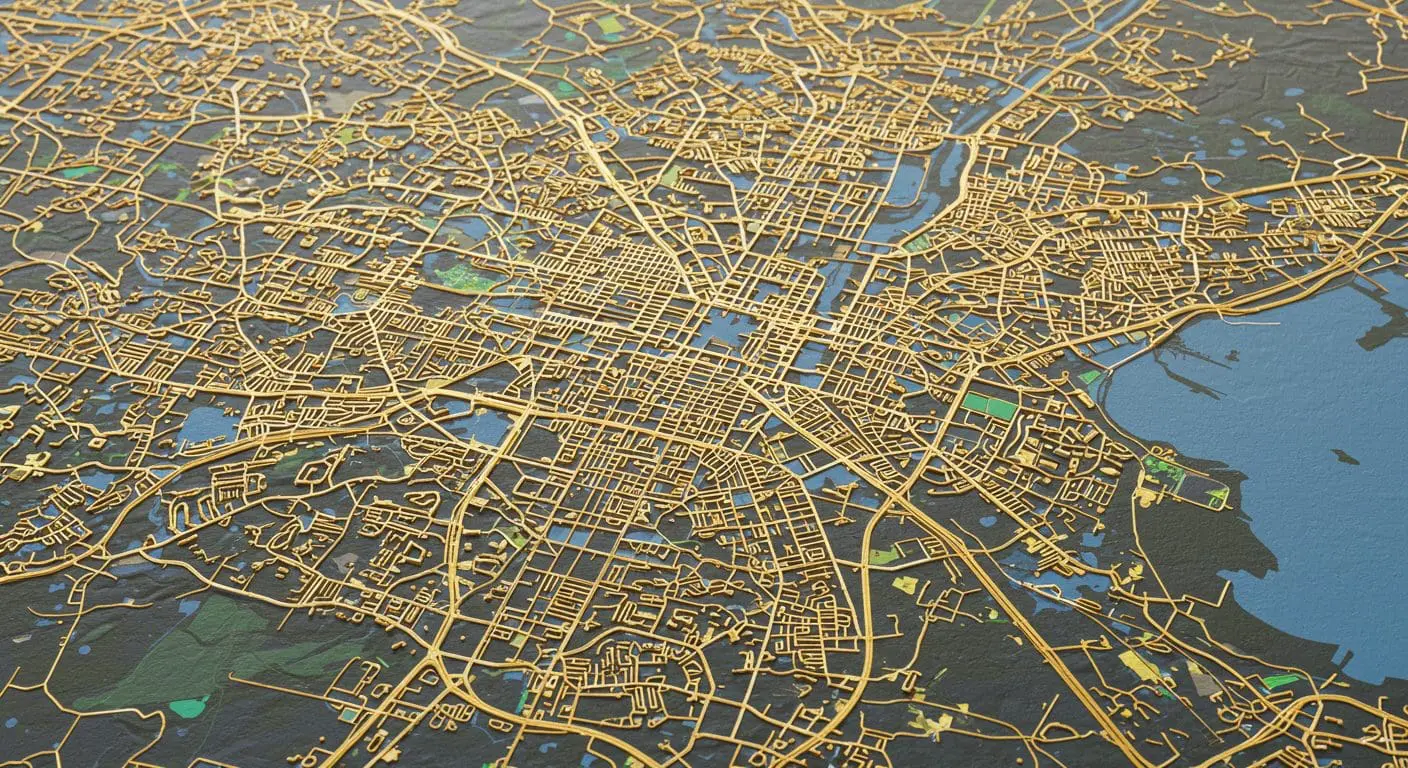
Research analysing Harbin streets reveals moderate vehicular access aids commerce, but excessive on-street parking diminishes walkability and retail pricing. Perceived greenery and cleanliness correlate with user satisfaction, while street width influences the impact of vehicle presence, demonstrating the utility of AI-assisted urban analysis.
The relationship between the physical environment and local economic health is a longstanding area of urban research. Recent work investigates how subtle street-level characteristics influence commercial performance and public perception within Chinese cities. Haotian Lan, utilising a novel analytical framework, explores this dynamic in Harbin, China, through the study titled ‘Parking, Perception, and Retail: Street-Level Determinants of Community Vitality in Harbin’. The research integrates artificial intelligence – specifically large multimodal models – with spatial analysis to quantify the impact of factors such as parking density, greenery, and street cleanliness on both retail success and user satisfaction.
Assessing Urban Commercial Vitality via AI-Driven Image Analysis
Commercial success within contemporary cities depends on a complex interplay of accessibility, environmental quality, and pedestrian experience, necessitating advanced analytical techniques. This study presents an interpretable, image-based framework to examine how street-level features – including parked vehicle density, greenery, cleanliness, and street width – impact retail performance and user satisfaction within Harbin, China. We leverage street view imagery and a multimodal model (VisualGLM-6B) to construct a Community Commercial Vitality Index (CCVI) from data sourced from Meituan and Dianping, subsequently analysing its relationship with spatial attributes extracted via GPT-4-based perception.
Contemporary urban planning increasingly recognises the importance of pedestrian-centric design, acknowledging that thriving commercial districts require more than efficient transport networks. Researchers are actively exploring the connections between the built environment and economic activity, seeking design principles that foster robust local economies.
Our methodology begins with the acquisition of extensive street view imagery, providing a comprehensive visual record of the urban landscape. We then employ VisualGLM-6B – a large multimodal model capable of processing both image and text data – to extract key spatial attributes from these images, including parked vehicle density, green space extent, and street cleanliness. These features are combined with data from Meituan and Dianping – online platforms providing information on local businesses and user reviews – creating a dataset for analysis.
The construction of the CCVI represents a key element of this work, providing a robust metric for assessing the health of local commercial districts. We carefully selected indicators reflecting both economic performance (e.g., business density, revenue) and user satisfaction (e.g., ratings, reviews), weighting them based on relative importance. This index serves as a valuable tool for urban planners, enabling them to track changes over time and evaluate interventions.
Our findings reveal that vehicular accessibility exerts a conditional influence on retail performance. Moderate vehicle presence correlates with enhanced commercial access, suggesting convenient parking can attract customers. However, excessive on-street parking diminishes walkability and negatively impacts both user satisfaction and shop-level pricing, particularly on narrow streets.
Perceived greenery and cleanliness consistently correlate with increased user satisfaction, suggesting environmental quality plays a crucial role in shaping the urban experience. While their direct impact on shop pricing remains weak, these amenities enhance the aesthetic appeal of the streetscape, creating a more pleasant atmosphere for pedestrians.
The moderating effect of street width further clarifies these relationships, indicating that spatial configuration significantly influences how vehicle presence impacts commercial outcomes. Narrow streets are particularly vulnerable to the negative effects of excessive parking, while wider streets can accommodate more vehicles without significantly impacting walkability.
This research validates an innovative methodological approach, successfully integrating AI-assisted image perception – utilising models such as VisualGLM-6B and GPT-4 – with established urban morphological analysis. This multimodal framework allows for the construction of a robust and reliable metric for assessing the health of local commercial districts. The ability to automatically extract meaningful information from street view imagery opens up new possibilities for urban analysis.
Future work should focus on expanding the geographical scope of this analysis, incorporating data from diverse urban contexts to assess the generalisability of these findings. Investigating the applicability of this methodology in cities with different transportation systems, urban morphologies, and cultural contexts will be crucial for establishing its broader relevance. Longitudinal studies are also needed to investigate the causal relationships between street-level interventions and changes in commercial performance.
Furthermore, exploring the potential of incorporating additional data sources, such as social media activity and mobile phone data, could provide a more comprehensive understanding of urban dynamics. Analysing how people interact with the built environment in real-time could reveal valuable insights into their preferences and behaviours.
The integration of AI and urban analysis represents a promising avenue for future research, offering the potential to create more sustainable, equitable, and livable cities. By leveraging the power of artificial intelligence, we can gain a deeper understanding of the complex forces that shape our urban environments and develop innovative solutions to address the challenges facing our cities.
This study’s findings have significant implications for urban planners and policymakers, providing actionable insights for creating more vibrant and sustainable commercial districts. Investing in pedestrian-friendly infrastructure, prioritising green space, and implementing effective parking management strategies are crucial steps towards creating a more livable and prosperous urban environment. By embracing data-driven decision-making and leveraging the power of artificial intelligence, we can create cities that are not only economically vibrant but also environmentally sustainable and socially equitable.
👉 More information
🗞 Parking, Perception, and Retail: Street-Level Determinants of Community Vitality in Harbin
🧠 DOI: https://doi.org/10.48550/arXiv.2506.05080