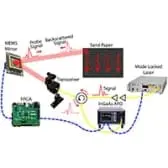
Researchers at Stevens Institute of Technology have made a breakthrough in giving artificial intelligence (AI) the ability to feel and measure surfaces, opening up new possibilities for medical, manufacturing, and other applications. Led by physics professor Yong Meng Sua and Center for Quantum Science and Engineering Director Yuping Huang, the team has developed a quantum-lab setup that combines a photon-firing scanning laser with new algorithmic AI models.
This innovative system can accurately discern an object’s topography by detecting and processing speckle noise, a type of flaw in imagery, using carefully trained AI to interpret its characteristics as valuable data. The researchers tested their method on 31 industrial sandpapers with surfaces of varying roughness, achieving an accuracy of within 4 microns, comparable to the best industrial profilometer devices currently used. This technology has far-reaching potential, including detecting skin cancers and improving manufacturing quality control.
Measuring Surfaces with AI: A Quantum Leap Forward
The ability to measure surfaces and distances with high accuracy is crucial in various fields, including medicine, manufacturing, and more. Researchers at Stevens Institute of Technology have made a significant breakthrough in this area by developing an AI-based system that can “feel” surfaces, leveraging advances in quantum science and engineering.
Accurate Metrology for Medicine and Manufacturing
The system, devised by physics professor Yong Meng Sua and his team, combines a photon-firing scanning laser with new algorithmic AI models trained to discern differences among various surfaces. This innovative approach enables accurate metrology, which is essential in medicine for detecting skin cancers and in manufacturing for quality control of components. The team’s method has demonstrated an impressive root-mean-square error (RMSE) of about 4 microns, comparable to the best industrial profilometer devices currently used.
Harnessing Quantum Interactions with AI
The system works by pulsing a specially created beam of light at a surface, which returns reflected and back-scattered photons carrying speckle noise. Instead of considering this noise detrimental to clear imaging, the Stevens group’s system detects and processes these artifacts using an AI trained to interpret their characteristics as valuable data. This allows the system to accurately discern the topography of the object. As Yuping Huang, CQSE Director, notes, “Quantum interactions provide a wealth of information, and using AI to quickly understand and process it is the next logical step.”
Applications in Medicine and Manufacturing
The new method could be particularly useful in detecting skin cancers, where mistakes are often made by human examiners who confuse similar-looking but harmless conditions with potentially fatal melanomas. The system’s ability to measure tiny differences in mole roughness could differentiate between these conditions. In manufacturing, the system’s capability to measure extremely small distances could mean the difference between a perfect part and a tiny defect that could eventually cause a dangerous mechanical failure.
Enriching LiDAR Technology
The Stevens team’s method also has implications for LiDAR technology, which is already widely implemented in devices such as autonomous cars, smartphones, and robots. By enriching these capabilities with surface property measurement at very small scales, the system could significantly enhance their functionality. As Huang concludes, “Our method opens up new possibilities for a range of applications, from medicine to manufacturing and beyond.”
External Link: Click Here For More