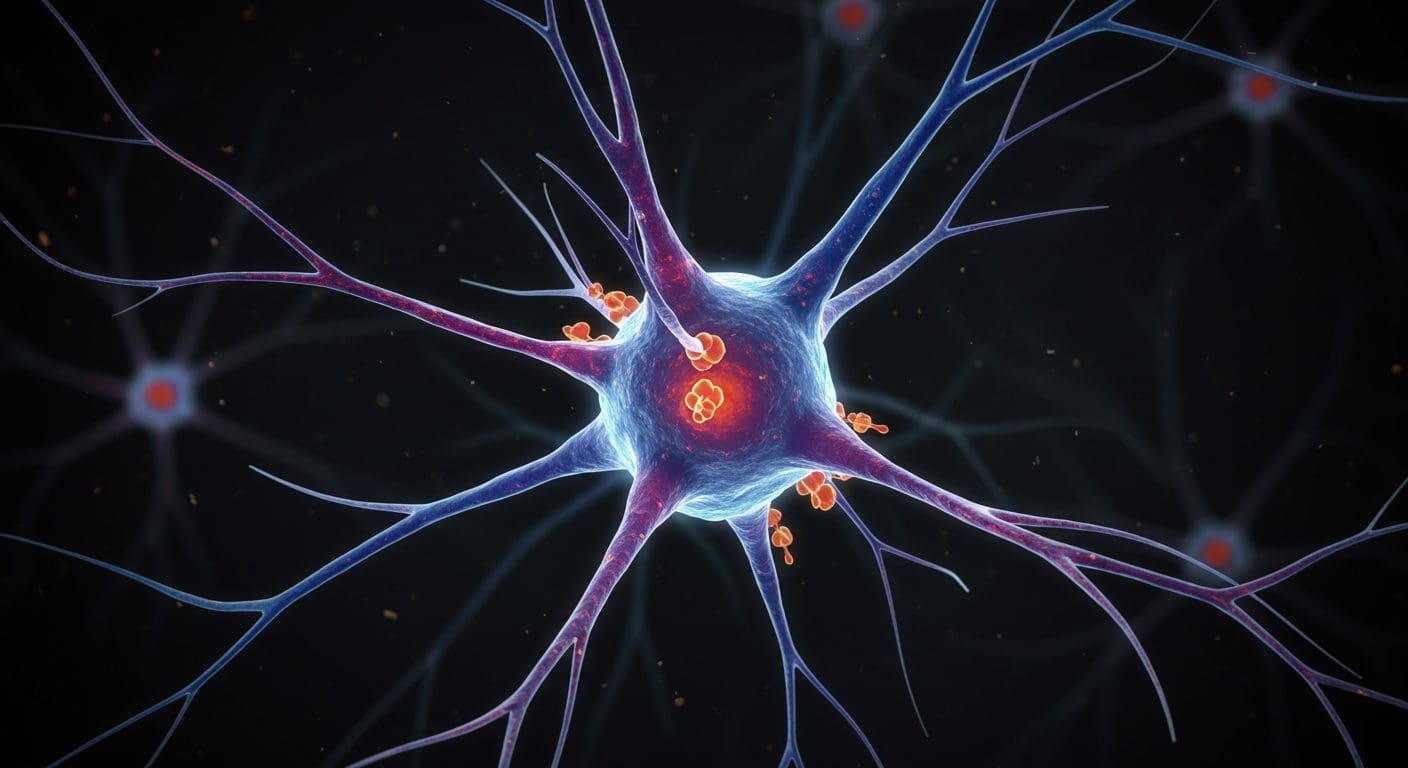
Researchers developed NOBLE, a neural operator framework that efficiently generates synthetic neuron models exhibiting realistic variability. Trained on biophysical data, NOBLE predicts neural dynamics and surpasses conventional modelling approaches in speed and scalability, validated against experimental data and enabling exploration of brain circuits.
Understanding the intricate behaviour of neurons remains central to deciphering brain function, yet accurately modelling their diversity presents a significant challenge. Current approaches struggle to reconcile the limited availability of experimental data with the inherent variability observed in neuronal responses. Researchers are now applying machine learning techniques to overcome these limitations, and a new framework, NOBLE – Neural Operator with Biologically-informed Latent Embeddings – offers a computationally efficient method for generating synthetic neurons that accurately reflect observed biological dynamics. This work, detailed in a recent publication, is the result of a collaboration between Luca Ghafourpour (ETH Zürich), Valentin Duruisseaux, Bahareh Tolooshams, and Anima Anandkumar (California Institute of Technology), alongside Philip H. Wong and Costas A. Anastassiou (Cedars-Sinai Medical Center).
Novel Framework Generates Diverse and Efficient Neuron Models
Researchers have developed a new neural operator framework, NOBLE (Neural Operator for Biologically-realistic LEarning), capable of generating diverse and computationally efficient neuron models. The approach addresses limitations found in both detailed biophysical modelling – which is computationally expensive – and existing deep learning techniques, often lacking biological plausibility.
NOBLE learns a mapping between readily interpretable neuron features and the resulting somatic voltage response to injected current. This allows the framework to capture the non-linear dynamics essential to neuronal behaviour. Unlike traditional methods that simulate neuron function through complex differential equations, NOBLE operates by learning the relationship between input and output, offering a significant reduction in computational burden.
A key innovation lies in NOBLE’s use of a continuous, frequency-modulated embedding of neuron features. This enables the prediction of distributions of neural dynamics that accurately reflect the trial-to-trial variability observed in experimental data. The framework generates models by interpolating within this embedding space, effectively ‘filling in’ the gaps between known data points to create new, plausible neuron behaviours. Researchers demonstrated the framework’s ability to explore the latent space of neuron models, sampling new models within a defined neighbourhood of threshold current ($I_{thr}$) and slope ($s_{thr}$), ensuring generated models are distinct from the training data and represent a broader range of neuronal properties.
The study establishes a clear relationship between input current amplitude and neuronal response, identifying a threshold between 0 and 0.05 nanoamperes (nA) where neurons transition from non-spiking to spiking behaviour. Accurate capture of this threshold is critical for realistic modelling. Computational efficiency was improved through subsampling techniques, achieving a ten-fold reduction in demands while maintaining model accuracy – a vital optimisation for scaling up model generation and enabling simulations of larger, more complex neural circuits.
Analysis focused on the framework’s ability to accurately represent key electrophysiological features. Fifteen features were extracted and analysed, including after-hyperpolarisation (AHP) depth, action potential (AP) amplitude, and time-to-first-spike, using the Electrophysiological Feature Extraction Library (eFEL). This rigorous analysis confirms the biological fidelity of the generated models.
NOBLE achieves a substantial speedup compared to traditional numerical solvers, potentially facilitating improved understanding of neuronal composition, brain circuit architecture, and broader applications within neuroAI – the intersection of neuroscience and artificial intelligence.
Researchers validated NOBLE by initially training the framework on data from biophysically realistic models and subsequently validating against real experimental data. This demonstrates the framework’s ability to extrapolate beyond the training dataset and generalise to unseen data. Visualisation of the latent space representation, defined by parameters ($I_{thr}$, $s_{thr}$), illustrates the neighbourhood considered during interpolation experiments, highlighting the framework’s ability to generate models within a defined range of neuronal properties.
Future research will focus on expanding the framework to incorporate more complex neuronal properties and network dynamics, further enhancing its ability to simulate realistic brain function. The team plans to investigate the integration of additional data modalities, such as synaptic plasticity and neuromodulation, to create even more comprehensive and accurate models of neuronal behaviour. This work aims to provide a powerful tool for neuroscientists and engineers to explore the complexities of the brain and develop innovative therapies for neurological disorders.
👉 More information
🗞 NOBLE — Neural Operator with Biologically-informed Latent Embeddings to Capture Experimental Variability in Biological Neuron Models
🧠 DOI: https://doi.org/10.48550/arXiv.2506.04536