The rapid development of generative artificial intelligence presents both opportunities and challenges for the future of work, prompting crucial questions about its impact on employment and economic structures. R. Maria del Rio-Chanona from University College London, Ekkehard Ernst and Rossana Merola from the International Labour Organisation (ILO), along with Daniel Samaan and Ole Teutloff from the University of Oxford and University of Copenhagen, comprehensively review existing theory and evidence to address these concerns. Their work synthesises insights from economic models, quantitative analyses of job exposure, and empirical studies including randomised controlled trials and analyses of digital labour platforms. This research demonstrates substantial productivity gains from AI adoption, ranging from 15 to 60 percent in controlled settings, while also revealing a complex picture of how these technologies affect workers with varying skill levels and a growing trend of substitution between human labour and machines in certain tasks, ultimately offering a nuanced understanding of AI’s transformative potential.
Given the ongoing debate, the effects of artificial intelligence on employment and the macroeconomy remain unresolved. This review synthesises theory and empirical evidence at three levels to address this complex issue, tracing the evolution of thought from aggregate production frameworks to more nuanced task- and expertise-based models and organisational perspectives. Subsequently, it quantitatively reviews and compares measures of AI exposure across jobs and occupations, revealing a convergence towards impacts on high-wage jobs. Finally, the review assembles evidence of AI’s impact on employment, drawing on data from randomised controlled trials, field experiments, and digital trace data such as online labour platforms and software repositories, complemented by survey data.
Quantifying Occupation Susceptibility to AI Automation
Quantifying Job Exposure to AI Automation
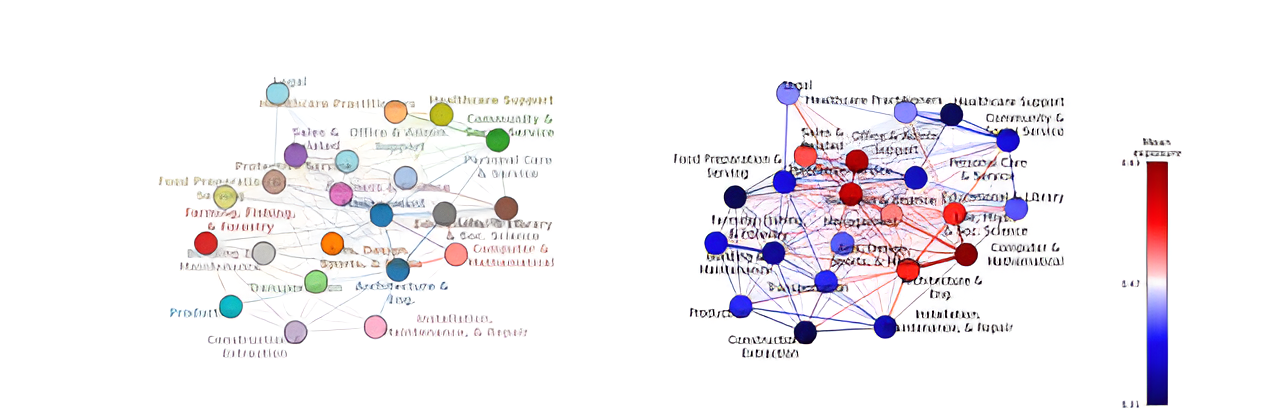
This research investigates how susceptible different occupations are to AI-driven automation and develops a robust methodology for assessing this exposure. Researchers utilise a combination of original data analysis, existing datasets like the International Standard Classification of Occupations and Chinese Standard Classification of Occupations, and large language models to quantify the extent to which AI could perform tasks within various occupations. The analysis of data from both the US and China provides insights into how AI exposure patterns may differ across different labour markets, reinforcing the robustness of their findings. A crucial component of this work is a four-dimensional rubric used to classify tasks based on their complexity, assessing knowledge requirements, goal definition and success criteria, task interdependence, and resource and context requirements. A task is considered complex if it meets high-complexity criteria in at least three of these four dimensions, allowing researchers to differentiate between tasks easily automated and those requiring more sophisticated cognitive abilities.
AI Boosts Skilled Labor Productivity Significantly
This work synthesises current understanding of how generative AI impacts the economy, focusing on both theoretical frameworks and empirical evidence. Researchers traced the evolution of production models, moving from broad aggregate views to more detailed task- and expertise-based analyses. Quantitative reviews of AI exposure measures across occupations reveal a convergence towards high-wage jobs, suggesting a disproportionate impact on skilled labour. Experiments, including randomised controlled trials and field studies, demonstrate substantial productivity gains, ranging from 20 to 60 percent in controlled settings and 15 to 30 percent in real-world applications.
Differential Productivity Gains Across Skilled Labor
Notably, novice workers tend to benefit more from large language models when performing simple tasks, while the impact on skilled workers across complex tasks remains more nuanced. Analysis of digital trace data, such as online labour platforms and software repositories, reveals a substitution between human workers and machines in areas like writing and translation, alongside a rising demand for AI-related skills. Further investigation of platform payment records and administrative data indicates a decrease in demand for novice jobs, particularly in areas complementary to AI technologies. The research highlights that AI reorganises tasks by shifting responsibilities between humans and machines, improving efficiency through both intensive and extensive margin effects, and can both augment existing worker capabilities and automate tasks previously performed by humans.
AI Impacts Labour Markets, Boosts Productivity
Synthesizing AI’s Overall Impact on Labor Markets
This research synthesises current understanding of how generative AI impacts the labour market, building from established economic frameworks to analyse emerging empirical evidence. The team traced the evolution of automation studies, moving from broad production models to task-based analyses, and then systematically reviewed existing measures of occupational exposure to AI. A key finding is convergence among these exposure measures, consistently indicating that high-wage jobs are most susceptible to AI’s influence. Further investigation, incorporating data from randomised controlled trials, field experiments, and large-scale digital traces, reveals substantial productivity gains associated with AI adoption, ranging from 20 to 60 percent in controlled settings and 15 to 30 percent in field experiments.
While novice workers often benefit from AI assistance with simpler tasks, the impact on skilled workers remains more nuanced. Digital trace data suggest some substitution of human labour in areas like writing and translation, alongside a growing demand for AI-related skills, and recent studies indicate a decline in demand for novice jobs. The authors acknowledge limitations in current research, including a focus on simple tasks in experimental settings and a limited diversity of language models studied, and suggest future research should address these gaps and explore how exposure to AI translates into actual substitution, productivity gains, or changes in expertise levels.
🗞 AI and jobs. A review of theory, estimates, and evidence
🧠 ArXiv: https://arxiv.org/abs/2509.15265