

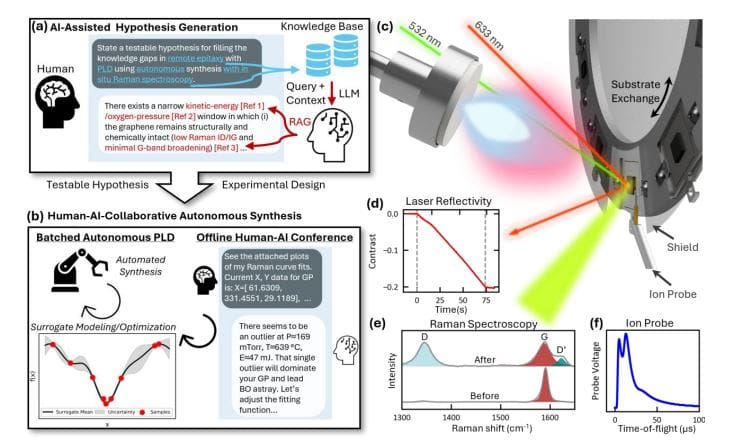
The creation of advanced materials often demands extensive experimentation, but scientists are increasingly turning to artificial intelligence to accelerate discovery, and a new study demonstrates a significant step forward in this field. Asraful Haque, Daniel T. Yimam, and Jawad Chowdhury, along with colleagues at the Center for Nanophase Materials Sciences, Oak Ridge National Laboratory, present a human-AI collaborative workflow that autonomously synthesises materials using pulsed laser deposition. This research establishes a system where AI generates hypotheses and designs experiments, while human insight guides the process between automated batches, resulting in a faster and more efficient exploration of material growth conditions. The team successfully applied this approach to create high-quality barium titanate, identifying a specific synthesis window and a two-step deposition process that overcomes common degradation issues, ultimately paving the way for more rapid advances in materials science.
Machine Learning Guides BTO Growth on Graphene
Scientists are pioneering a new approach to materials growth, utilizing machine learning to guide the deposition of barium titanate (BTO) thin films on graphene. The core aim is to achieve remote epitaxy, where a high-quality crystalline film grows on graphene and serves as a foundation for other materials. This experiment employs a closed-loop optimization system, leveraging machine learning to control the pulsed laser deposition (PLD) process and maximize film quality. The system carefully monitors the growth process using Raman spectroscopy to assess graphene quality and track BTO deposition, while an ion probe characterizes the material ejected during PLD, measuring the kinetic energy of the BTO ions. By integrating these data streams, the system dynamically adjusts deposition parameters, optimizing film quality in real-time.
AI Accelerates Barium Titanate Remote Epitaxy on Graphene
Researchers have developed a collaborative system combining human expertise with artificial intelligence (AI) to accelerate materials discovery, specifically focusing on growing barium titanate (BaTiO3) on graphene. This system integrates large language models for generating and analyzing hypotheses with autonomously controlled pulsed laser deposition (PLD) experiments, enabling rapid exploration of growth conditions. Investigations using in situ Raman spectroscopy and plasma plume measurements reveal that gas chemistry primarily drives graphene degradation, while ballistic impacts introduce reactive defects, ultimately defining a challenging synthesis regime. Analysis of plume kinetic energy demonstrates that an argon background effectively suppresses graphene degradation observed in oxygen, a finding supported by molecular dynamics simulations modeling the bombardment of graphene with plume species and resulting defect formation.
Graphene Protection During Barium Titanate Remote Epitaxy
This work moves beyond traditional systems by integrating large language models with autonomous pulsed laser deposition (PLD) experiments, creating a tightly coupled system for hypothesis generation, experimental planning, execution, and data interpretation. The system efficiently maps the growth space to minimize graphene damage during BaTiO3 deposition, a significant challenge in remote epitaxy. Researchers established a two-step deposition process, alternating argon and oxygen atmospheres, to achieve crystalline, ferroelectric BTO while simultaneously preserving the underlying graphene layer. Measurements confirm that the transmitted electrostatic potential through monolayer graphene is small and short-ranged, highlighting the difficulty of achieving remote film alignment. This collaborative approach enables the growth of high-quality BaTiO3 films on monolayer graphene, a crucial step towards realizing the full potential of remote epitaxy for a wider range of materials.
AI Guides Synthesis of Ferroelectric BTO on Graphene
By integrating large language models with an autonomous pulsed laser deposition platform, the team efficiently linked growth conditions to graphene damage and identified key factors governing material quality. Guided by these insights, researchers overcame the inherent trade-off between graphene protection and optimal BTO growth, demonstrating the power of collaborative AI-driven experimentation. The authors acknowledge that further improvements in language model capabilities will likely enhance the reliability and data efficiency of this autonomous experimentation approach, representing an evolution of existing human-in-the-loop systems where humans and AI collaboratively refine objectives and processes between autonomous experimental batches to accelerate scientific progress and is transferable to other autonomous platforms.
👉 More information
🗞 Human-AI collaborative autonomous synthesis with pulsed laser deposition for remote epitaxy
🧠 ArXiv: https://arxiv.org/abs/2511.11558


