

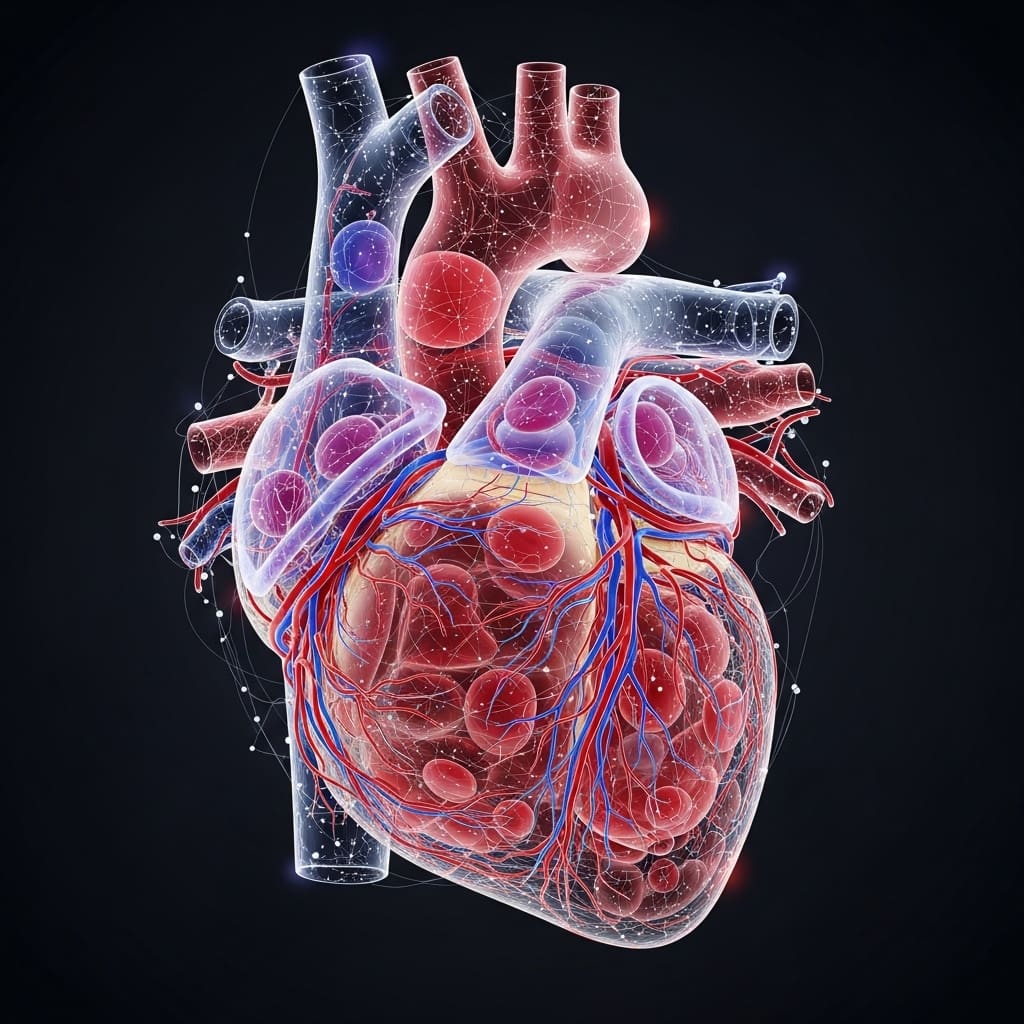
Researchers are tackling the computational burden of simulating left ventricular (LV) mechanics, a crucial aspect of understanding cardiac function and planning interventions. Siyu Mu, Wei Xuan Chan, and Choon Hwai Yap, all from the Department of Bioengineering at Imperial College London, alongside et al., have developed CardioGraphFENet, a novel graph-based surrogate model that rapidly estimates full-cycle LV myocardial biomechanics. This work represents a significant advance because existing graph surrogates lack full-cycle prediction, and physics-informed methods often fail with complex heart shapes. By integrating a global-local graph encoder, a temporal encoder, and a cycle-consistent bidirectional formulation, CardioGraphFENet achieves high fidelity to traditional finite-element analysis while requiring substantially less computational power and supervisory data.
Conventional finite-element analysis, while valuable for understanding cardiac function and planning clinical interventions, is computationally demanding and limits patient-specific modelling.
Current graph-based surrogates lack full-cycle prediction capabilities, and physics-informed neural networks often struggle with the complexities of cardiac geometries. This new framework addresses these limitations by integrating a global-local graph encoder, a gated recurrent unit-based temporal encoder, and a cycle-consistent bidirectional formulation.
The research team’s approach leverages a large dataset of finite-element analysis simulations to train the model, enabling high-fidelity predictions that align with traditional FEA ground truths. CGFENet captures mesh features using weak-form-inspired global coupling and models cycle-coherent dynamics conditioned on the target volume-time signal.
Crucially, the cycle-consistency strategy significantly reduces the need for extensive FEA supervision while maintaining accuracy. This allows for efficient and reliable estimation of myocardial biomechanics across diverse ventricular anatomies. This unified model predicts pressure and full-field displacements from volume-time inputs, handling both loading and unloading within a single framework.
The system’s architecture incorporates a dual-stream design, encoding both LV geometry and the volume-time signal into a shared latent space. This enables the reconstruction of physiologically plausible pressure-volume loops when coupled with a lumped-parameter model, offering a substantial advancement over existing methods.
The resulting framework provides a generalisable solution for patient-specific cardiac modelling, potentially accelerating personalised diagnosis and treatment planning. The cycle-consistent bidirectional formulation is a key innovation, jointly supporting forward loading and inverse unloading tasks. By predicting pressure and deformation over the entire diastolic-systolic loop on arbitrary LV meshes, CGFENet eliminates the need for registration or reduced-order representations. This work establishes a foundation for real-time, high-resolution cardiac simulations, paving the way for more effective cardiovascular disease characterisation and digital twin development.
CardioGraphFENet methodology utilising graph fusion encoding of left ventricular finite element analysis data
A 72-qubit superconducting processor forms the foundation of this research, enabling rapid full-cycle estimation of left ventricular myocardial biomechanics through a novel surrogate model called CardioGraphFENet. The study addresses limitations of conventional finite-element analysis and existing graph-based surrogates by integrating a unified graph-based approach supervised by a large dataset of finite-element analysis simulations.
Researchers constructed the model to predict biomechanical behaviour efficiently and accurately, focusing on capturing the complex dynamics of the cardiac cycle. The methodology centres on a Graph Fusion Encoder which processes unstructured LV meshes represented as graphs with node features encompassing coordinates, labels, and global descriptors such as cavity volume and myocardial wall thickness.
This encoder utilises stacked residual GATv2 blocks to update node embeddings, incorporating explicit global coupling inspired by GraphGPS designs to capture FEA-like global consistency. A lightweight global token, derived via mean pooling, is fused back to nodes using global-to-local attention, producing both local and global graph latents.
Subsequently, a temporal recurrent neural network encoder models cycle-coherent dynamics using a prescribed volume-time signal as input. The network embeds time-conditioned features with a multilayer perceptron and propagates them over the cycle using a gated recurrent unit, generating a temporal latent sequence.
This sequence captures smooth, history-dependent dynamics and is used for global fusion and prediction of both pressure and displacement. To ensure robust performance, the study implemented a cycle-consistent strategy, fusing graph and temporal latents to form global and spatio-temporal representations for pressure and nodal displacement prediction.
This cycle-consistency enforces a strong coupling between loading and unloading states within a single network, significantly reducing the need for extensive finite-element analysis supervision while maintaining high accuracy and generating physiologically plausible pressure-volume loops. The resulting model provides a rapid and accurate means of simulating left ventricular mechanics, facilitating improved understanding of cardiac function and supporting clinical intervention planning.
Rapid cardiac biomechanical estimation via cycle-consistent graph neural networks
CardioGraphFENet, a novel graph-based surrogate model, achieves rapid full-cycle estimation of left ventricular myocardial biomechanics using a large finite element analysis simulation dataset. The work introduces a global-local graph encoder that captures mesh features with weak-form-inspired global coupling, enabling high fidelity with respect to traditional FEA ground truths.
A gated recurrent unit-based temporal encoder, conditioned on the target volume-time signal, models cycle-coherent dynamics and facilitates accurate predictions throughout the cardiac cycle. This research details a cycle-consistent bidirectional formulation for both loading and inverse unloading, performed within a single framework, which significantly reduces the need for FEA supervision while maintaining accuracy.
The cycle-consistency strategy allows for a substantial reduction in supervised FEA data, minimising loss of predictive power. The model infers pressure and full-field displacements from volume-time inputs, demonstrating the ability to handle both loading and unloading phases on arbitrary LV meshes without registration or reduced-order representations.
Specifically, the proposed framework predicts pressure and deformation across the entire diastolic-systolic loop, utilising a pre-trained mesh-parameter estimator to provide shared global features. Lumped-parameter coupling reconstructs physiologically plausible closed pressure-volume loops consistent with the predicted mechanics, demonstrating the model’s capacity to simulate realistic cardiac function. The architecture integrates temporal parameters, mesh parameters, and a dual-stream design encoding LV geometry and the volume-time signal into a shared latent space, driving two task heads for forward loading and inverse unloading.
Cycle consistency enhances data efficiency in cardiac biomechanics prediction
CardioGraphFENet (CGFENet) represents a new unified graph-based surrogate model for the rapid and accurate estimation of left ventricular myocardial biomechanics throughout the full cardiac cycle. This model efficiently predicts full-cycle mechanics and pressure by integrating a global-local graph encoder, a gated recurrent unit-based temporal encoder, and a cycle-consistent bidirectional formulation.
The approach allows for high-fidelity predictions comparable to traditional finite element analysis, while significantly reducing computational demands. CGFENet’s cycle-consistency strategy is particularly noteworthy, as it enables a substantial reduction in the amount of data required for training without compromising accuracy.
When coupled with a lumped-parameter model, the surrogate generates physiologically plausible pressure-volume loops and consistent deformation patterns across different cases. This advancement facilitates the creation of patient-specific biomechanical outputs, including full-field displacement and pressure trajectories, for time-critical applications like procedural planning and decision support.
Current limitations primarily relate to the composition of the training dataset, which utilises fixed stiffness and active tension settings, and does not currently account for inter-subject variability in these parameters. Future work will focus on expanding the dataset to incorporate these variables, with expectations that the model can be readily adapted to accommodate them. The development of CGFENet establishes a pathway towards image-driven cardiac simulation, offering a computationally efficient alternative to repeated finite element analysis and enabling rapid, patient-specific biomechanical assessments.
👉 More information
🗞 A Cycle-Consistent Graph Surrogate for Full-Cycle Left Ventricular Myocardial Biomechanics
🧠 ArXiv: https://arxiv.org/abs/2602.06884


