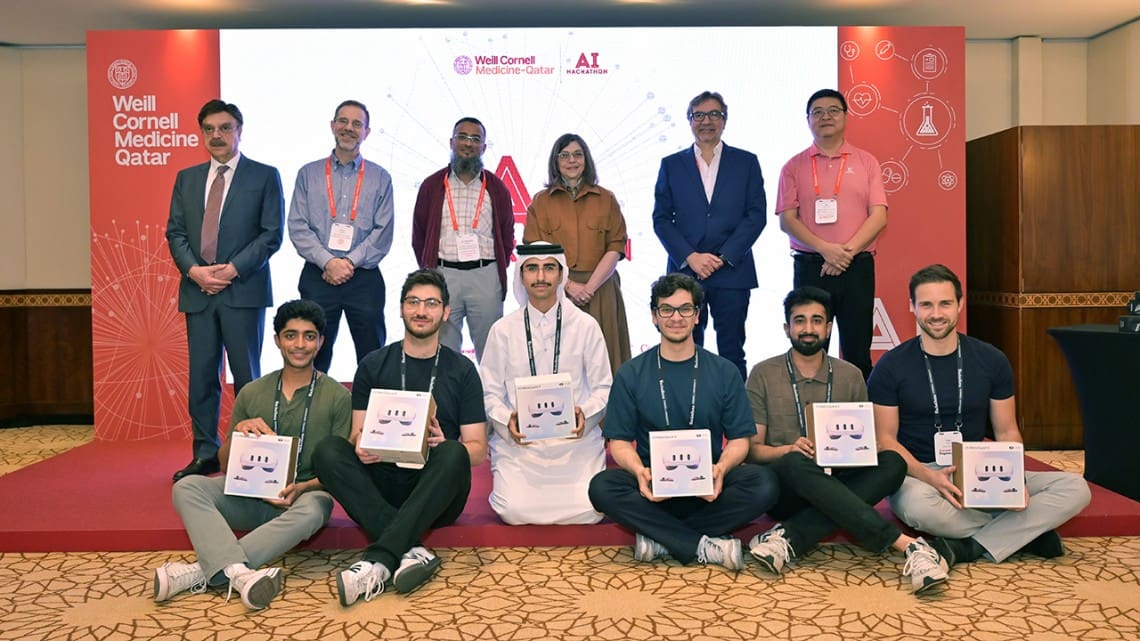
Imagine a future where artificial intelligence helps doctors predict illnesses earlier and personalize treatments more effectively. That vision moved closer to reality at Weill Cornell Medicine-Qatar’s inaugural AI Hackathon, a groundbreaking event uniting future medical and computer science leaders. Over a weekend in October, students from WCM-Q, Cornell University, and Cornell Tech collaborated to tackle critical healthcare challenges – from predicting breast cancer subtypes to identifying early signs of postpartum depression. This innovative “MedAI Hack Collaborative” isn’t just a tech exercise; it represents a vital step towards harnessing the power of AI to revolutionize patient care and improve health outcomes globally.
WCM-Q Hosts First AI Hackathon
Weill Cornell Medicine-Qatar (WCM-Q) recently hosted its inaugural AI Hackathon, a collaborative event designed to spur innovation at the intersection of medicine and technology. Held on October 10-11, “MedAI Hack Collaborative: Unlocking Precision Health with AI,” brought together medical students from WCM-Q with their computer science counterparts from Cornell University and Cornell Tech. The hackathon, co-sponsored by WCM-Q Dean Dr. Javaid Sheikh and Cornell’s Global Chief Information Officer Dr. Curtis Cole, saw six interdisciplinary teams tackle pressing clinical challenges. These ranged from utilizing federated learning for clinical risk prediction and simulating clinical trials with real-world data, to predicting breast cancer tumor subtypes and automating polycystic ovarian morphology classification via medical imaging. Other teams focused on early postpartum depression prediction and leveraging wearable technology for proactive health insights.
Experts in fields like biomedical research, radiology, and data science mentored the students, providing both technical and clinical guidance. Organizers highlighted the value of the event in fostering collaboration between students across continents and disciplines, noting it was a unique learning experience for both the computer science and medical students involved. Ayham Boucher, a key organizer, emphasized that the hackathon demonstrated the “power of interdisciplinary collaboration,” and laid a foundation for a new generation of thinkers equipped to address complex healthcare challenges with innovative solutions.
Collaborative Focus & Key Challenges
Weill Cornell Medicine-Qatar’s inaugural AI Hackathon exemplified a powerful collaborative focus, uniting medical students from Qatar with computer science counterparts from Cornell University and Cornell Tech to tackle pressing clinical challenges. This “MedAI Hack Collaborative: Unlocking Precision Health with AI” event, co-sponsored by leadership from both institutions, deliberately fostered an interdisciplinary environment where clinical knowledge merged with technical expertise. Six teams formed, each addressing a unique issue—from predicting breast cancer subtypes and automating polycystic ovarian morphology classification to early detection of postpartum depression and leveraging wearable data for proactive health insights. A key challenge overcome was bridging the gap between these distinct fields; expert guidance from clinicians, researchers, and faculty—including a dedicated mentorship team—proved crucial in refining solutions. Organizers highlighted the remarkable seamlessness of collaboration across continents, noting the value of students from the U.S. and Qatar learning from each other’s perspectives. Beyond technical innovation, the hackathon aimed to cultivate a new generation of interdisciplinary thinkers, demonstrating the potential of uniting diverse academic disciplines to enhance healthcare outcomes amidst rapid technological disruption.
Impact of Interdisciplinary Partnership
The recent AI Hackathon hosted by Weill Cornell Medicine-Qatar (WCM-Q) powerfully demonstrated the impact of interdisciplinary partnership in driving healthcare innovation. Bringing together medical students from WCM-Q with computer science students from Cornell and Cornell Tech, the event fostered a unique synergy that addressed pressing clinical challenges through AI-driven solutions. Six teams formed, each tackling a distinct problem – from predicting tumor subtypes to early detection of postpartum depression – by merging medical expertise with technical proficiency. This collaborative approach wasn’t merely academic; it represented a proactive response to the rapid technological disruptions impacting healthcare. As Dean Javaid Sheikh noted, uniting diverse disciplines and regions offers the best opportunity to creatively apply new technologies and improve patient outcomes. Beyond the development of potential solutions, the hackathon served as a valuable learning experience for all involved, exposing computer science students to the complexities of medicine and enabling medical students to envision the future of computing in healthcare. Organizers, like Ayham Boucher, highlighted the remarkable collaboration between students in the U.S. and Qatar, laying the foundation for a new generation equipped to tackle complex challenges through interdisciplinary thinking and global partnerships.