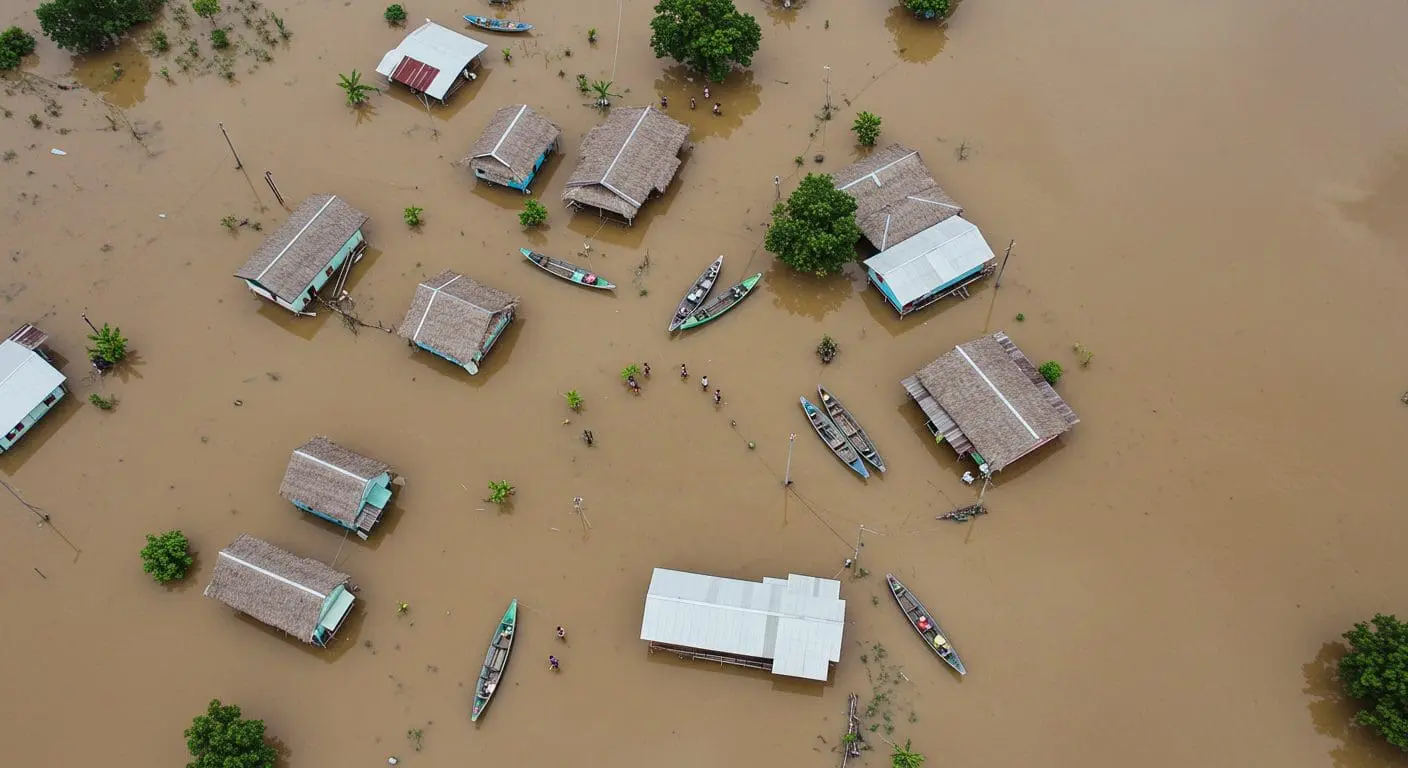
As the world grapples with the escalating impacts of climate change, innovative technologies are being harnessed to bolster community resilience in the face of rising flood risks. Integrating artificial intelligence (AI) and cutting-edge geospatial applications is revolutionizing flood modeling and visualization, enabling more informed decision-making, enhanced public education, and streamlined responder training.
By leveraging machine learning models, high-fidelity visualizations, and advanced hydraulic simulations, experts can now generate highly accurate flood maps, even in challenging conditions such as cloud cover, and create immersive 3D models that facilitate a deeper understanding of flood patterns and extreme weather events. This convergence of AI-powered platforms, satellite data, and high-performance computing is transforming the landscape of disaster management, allowing communities to better prepare for, respond to, and recover from floods, ultimately fostering greater climate resilience.
Introduction to Climate Resilience and AI-Powered Flood Modeling
The increasing frequency and severity of flooding events due to climate change have underscored the need for effective strategies to enhance community resilience. Recent advancements in artificial intelligence (AI) and geospatial technologies have opened up new avenues for improving flood risk management. By leveraging AI-powered flood modeling and 3D visualizations, communities can better prepare for and respond to floods, ultimately reducing the impact of these events on human populations and infrastructure.
Integrating machine learning models with satellite and sensor data has enabled the creation of highly accurate flood maps, even in challenging conditions such as cloud cover. This is exemplified by platforms like FloodSENS, which utilizes U-Net models trained on optical satellite data to deliver high-accuracy flood detection across different biomes. The use of auxiliary datasets, including digital elevation models (DEM) and water flow grids, further enhances the accuracy of these models.
The application of AI-powered flood modeling is not limited to mapping alone; it also extends to simulating fluvial and pluvial flooding. Advanced hydraulic models can integrate land features such as topography, infrastructure, and urban layouts, allowing for ultra-high-resolution simulations at city and regional scales. These simulations are made possible by high-performance computing systems equipped with GPUs like the NVIDIA A100 Tensor Core, which enable rapid processing of complex data sets.
AI-Powered Flood Modeling and 3D Visualization Technologies
The development of next-generation geospatial applications has been pivotal in enhancing disaster resilience. Tools like NVIDIA Omniverse offer high-end 3D visualizations that help decision-makers better understand flood patterns and visualize the impact of extreme weather events. These immersive models facilitate more effective preparation for disasters by providing dynamic tools for decision-making, public education, and responder training.
The FloodSENS platform is a prime example of how AI-powered platforms can create highly accurate flood maps using satellite and sensor data combined with machine learning models running on NVIDIA GPUs. The model’s ability to integrate auxiliary datasets ensures consistent results even in challenging conditions. Furthermore, the use of high-performance computing systems like MeluXina, equipped with NVIDIA A100 Tensor Core GPUs, enables ultra-high-resolution simulations that can inform flood risk management strategies.
The benefits of 3D visualization tools extend beyond decision support; they also play a critical role in risk communication and public education. By providing an immersive and interactive experience, these tools can help communities understand the risks associated with flooding and take proactive measures to mitigate them. Additionally, 3D visualizations can be used in responder training, enabling emergency responders to better prepare for and respond to flood events.
Applications of AI-Powered Flood Modeling in Disaster Management
The role of AI in disaster management is multifaceted, ranging from improving flood prediction and risk assessment to enhancing real-time response strategies. Machine learning models can analyze large datasets to identify patterns and predict flood events with greater accuracy. This information can be used to inform evacuation plans, deploy resources effectively, and minimize the impact of flooding on communities.
Real-world implementations of AI-powered flood modeling have demonstrated its potential in improving disaster resilience. Collaborations between organizations like RSS-Hydro, Microsoft Azure, UN WFP, and the ESA HeManEO program have led to successful deployments of this technology. These partnerships highlight the importance of interdisciplinary approaches in addressing complex challenges like climate change.
The use of high-performance computing systems and AI-powered platforms has also enabled the development of data-driven flood assessment tools. These tools can create detailed flood maps using satellite and sensor data, improving situational awareness during disasters. By leveraging these technologies, communities can develop more effective strategies for mitigating the impacts of flooding and enhancing their resilience to climate-related hazards.
Enhancing Climate Risk Resilience through AI-Powered Technologies
The integration of AI-powered flood modeling and 3D visualization tools has the potential to transform how communities prepare for and respond to climate risks. By providing dynamic tools for decision-making, public education, and responder training, these technologies can enhance disaster resilience and reduce the impact of flooding on human populations and infrastructure.
The benefits of these technologies are not limited to flood risk management alone; they also extend to other areas of climate risk resilience. For instance, AI-powered platforms can be used to simulate and predict other extreme weather events like hurricanes and wildfires, enabling communities to develop more effective strategies for mitigating their impacts.
Furthermore, the use of high-performance computing systems and machine learning models can facilitate the analysis of large datasets related to climate change. This information can be used to inform policy decisions, develop more effective adaptation strategies, and enhance community resilience to climate-related hazards. By leveraging these technologies, communities can take proactive measures to mitigate the impacts of climate change and create a more sustainable future.
Future Directions in AI-Powered Flood Modeling and Climate Risk Resilience
The future of AI-powered flood modeling and climate risk resilience is promising, with ongoing research and development focused on enhancing the accuracy and effectiveness of these technologies. The integration of new data sources, such as satellite imagery and sensor data from Internet of Things (IoT) devices, is expected to further improve the accuracy of flood maps and predictions.
Additionally, the use of emerging technologies like generative AI and large language models (LLMs) is likely to play a significant role in enhancing climate risk resilience. These technologies can facilitate the analysis of complex datasets, identify patterns, and predict extreme weather events with greater accuracy.
The development of more sophisticated 3D visualization tools is also expected to enhance community engagement and education on climate risk resilience. By providing immersive and interactive experiences, these tools can help communities understand the risks associated with climate change and take proactive measures to mitigate them.
Ultimately, the effective integration of AI-powered flood modeling and 3D visualization technologies will require a multidisciplinary approach, involving collaboration between researchers, policymakers, and community leaders. By working together, we can develop more effective strategies for enhancing climate risk resilience and creating a more sustainable future for all.
External Link: Click Here For More