

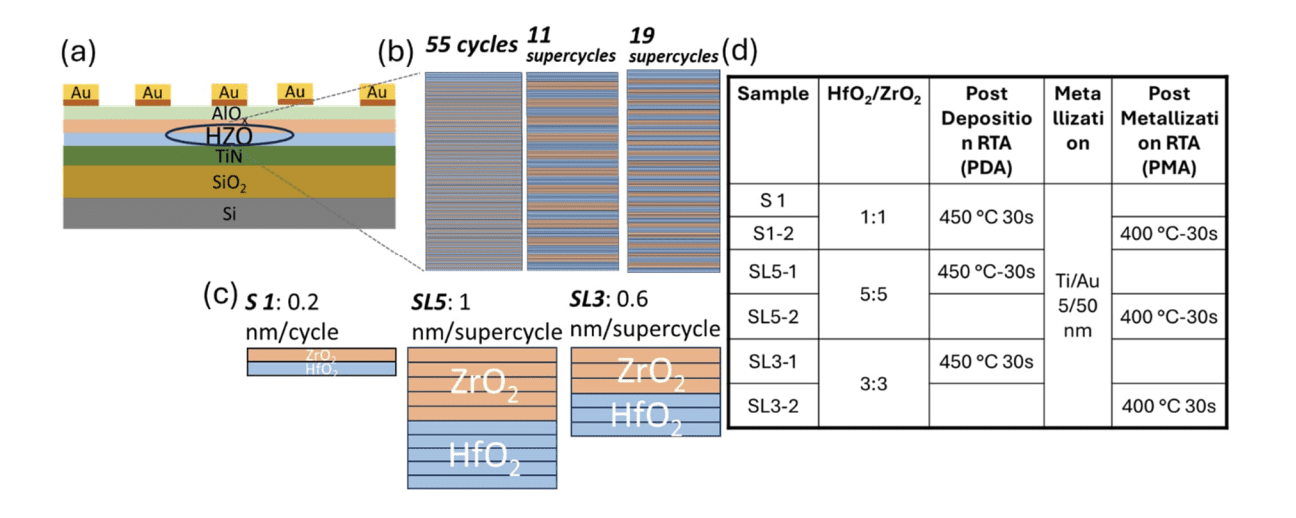
The quest for energy-efficient artificial intelligence inspires researchers to explore materials that mimic the brain’s ability to both store and process information, and ferroelectric materials are emerging as key candidates for building artificial synapses. Xinye Li and Sayani Majumdar, from Tampere University, and colleagues demonstrate a significant advance in this field by creating a superlattice capacitor from Hafnium Oxide and Zirconium Oxide that achieves record-high polarization at just two volts, while also eliminating a common problem known as ‘imprint’. This breakthrough enables stable, reliable switching with a substantial polarization of 76 microcoulombs per square centimetre, and importantly, the devices exhibit robust endurance, surviving up to a billion cycles of operation, paving the way for more sustainable and powerful AI hardware. By identifying the factors that contribute to device fatigue, the team also provides strategies for optimising these materials to meet the demanding requirements of machine learning applications.
FeRAM Superlattices Address Endurance and Imprint
Neuromorphic computing, inspired by biological intelligence, offers a pathway to revolutionise artificial intelligence hardware. Conventional computer architectures face limitations in energy efficiency and parallel processing, motivating exploration of novel memory technologies. Ferroelectric Random Access Memory (FeRAM), utilising the spontaneous polarisation of ferroelectric materials, presents a promising solution for low-power, high-speed, non-volatile memory applications. Precise compositional tuning allows manipulation of the relative stability of ferroelectric and antiferroelectric phases, influencing the polarisation characteristics and switching behaviour of the material. This research investigates the relationship between superlattice composition, structural properties, and ferroelectric/antiferroelectric phase transitions, demonstrating record-high polarisation at low voltages and imprint-free operation through precise control of the balance between phases. The team achieves this by systematically varying layer thicknesses and compositions, correlating these parameters with observed electrical characteristics, representing a significant advancement towards realising high-performance, reliable, and energy-efficient non-volatile memory devices.
Artificial intelligence increasingly demands energy-efficient and sustainable frameworks for data-intensive tasks, and this research explores the unification of memory and processing to meet these needs. Careful tuning of ferroelectric and antiferroelectric phases within hafnium oxide-zirconium oxide (HZO) superlattice-based capacitors can lead to imprint-free switching, achieving a record switchable polarisation of 76 μC/cm2 under an applied electric field of only 2 MV/cm. The sizable remanent polarisation exhibited by the superlattice HZO further enables linear strengthening and weakening of signals, crucial characteristics for synaptic behaviour.
Ferroelectric Hafnia Properties and Device Applications
This collection of references details research related to ferroelectric Hafnia (HfO2) and Zirconia (ZrO2) thin films, with a strong focus on improving their properties for non-volatile memory and neuromorphic computing applications. A significant trend is the use of superlattices, alternating layers of different materials, to enhance polarisation, stability, and control the ferroelectric phase. Understanding and controlling defects within the materials is crucial, as these influence polarisation, conductivity, and reliability. Improving the number of write/erase cycles a device can withstand without failure is a major challenge, with issues such as initial activation and degradation over time needing to be addressed. Many researchers are exploring the use of these materials to create devices that mimic the behaviour of synapses and neurons, enabling energy-efficient artificial intelligence. Supporting information, including data showing crystalline phases, endurance testing, and hysteresis loops, confirms the achievement of record-high polarisation, elimination of imprint, and improved reliability of the superlattice HfO2-ZrO2 devices.
Robust Ferroelectric Synapses for AI Hardware
This work demonstrates significant advances in ferroelectric materials for next-generation artificial intelligence hardware. Researchers successfully engineered superlattice HfO2-ZrO2 capacitors that exhibit record-high switchable polarisation with remarkably low voltage requirements, addressing a key challenge in the field. The devices achieve imprint-free switching and demonstrate both linear strengthening and weakening of signals, crucial for mimicking synaptic behaviour in the brain. The team further characterised the long-term reliability of these devices, identifying and explaining two distinct mechanisms contributing to fatigue during repeated operation. Importantly, the capacitors maintain performance through up to 10^8 cycles, and in some cases, exceed 10^9 cycles with recoverable degradation, indicating potential for robust, energy-efficient computing. The performance of these superlattice structures surpasses existing ferroelectric capacitors in terms of power consumption, polarisation, symmetry, and endurance.
👉 More information
🗞 Record High Polarization at 2V and Imprint-free operation in Superlattice HfO2-ZrO2 by Proper Tuning of Ferro and Antiferroelectricity
🧠 ArXiv: https://arxiv.org/abs/2509.07045


