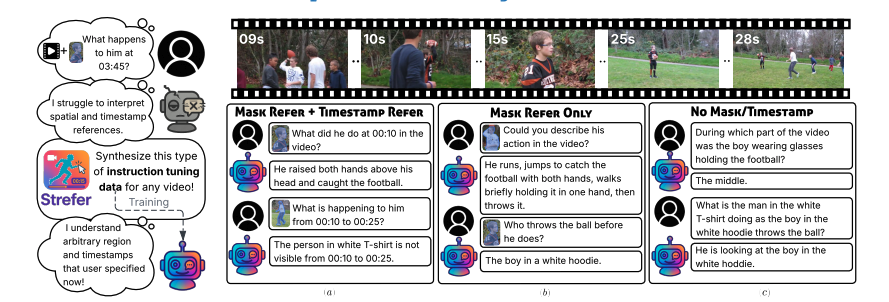
The ability to understand and respond to specific references within a video, relating to both where and when events occur, represents a crucial next step for artificial intelligence. Honglu Zhou, Xiangyu Peng, Shrikant Kendre, and colleagues at Salesforce AI Research address this challenge with Strefer, a novel framework that empowers Video LLMs with advanced spatiotemporal reasoning capabilities. Strefer generates synthetic instruction data, effectively teaching these models to interpret fine-grained spatial and temporal references within dynamic video footage, without relying on expensive or time-consuming human annotation. This approach significantly improves a Video LLM’s ability to understand complex instructions involving specific objects, locations, and moments in time, paving the way for more versatile and perceptually grounded AI companions capable of interacting with the real world. The results demonstrate that models trained with Strefer-generated data outperform existing methods on tasks requiring precise spatial and temporal understanding, establishing a new benchmark for instruction-tuned video analysis.
Data Synthesis and VLM Evaluation Strategies
This research details a project focused on building more robust and accurate Video Language Models (VLMs) to improve their ability to understand and reason about video content, particularly in complex scenarios involving temporal reasoning, object localization, and nuanced descriptions. The core goal is to address limitations of existing VLMs, which often struggle with tasks requiring precise temporal understanding or grounding in specific video segments. The project relies heavily on generating synthetic data to target the weaknesses of existing VLMs, challenging the model in areas where it struggles. This is achieved through a process called Strefer, and the data covers a wide range of tasks categorized as open-ended question answering, multiple-choice question answering, temporal reasoning, object localization, and reasoning about actions and behaviors.
The data format varies, specifying how much of the video is used as input, and whether frames are extracted from a segment or the full video. Many tasks have mask-refer versions, where the question focuses on a specific region of interest in the video, forcing the model to ground its answers in the visual content. To improve the model’s ability to understand time, the research uses a technique that discretizes continuous time into segments, representing each segment with a temporal token added to the language model’s vocabulary. This allows it to process time-related information more effectively. Existing models struggle with understanding complex video content when queries rely on precise spatial locations or specific moments in time. Strefer addresses this limitation by systematically creating detailed, object-centric metadata from videos, including the location of subjects and objects as tracked over time, and their associated actions. This innovative approach leverages a modular system of pre-trained models, including Large Language Models and multimodal vision foundation models, to pseudo-annotate videos with temporally dense information.
By building upon this structured metadata, Strefer guides language models in generating high-quality instruction data specifically designed to train Video LLMs in understanding and responding to complex spatiotemporal references. Unlike existing datasets, Strefer automatically produces instruction-response pairs at scale, grounded in the dynamic, object-centric structures within videos. Current models struggle with detailed spatial and temporal reasoning, particularly when interpreting gestures or time-based cues in user queries. Strefer addresses this limitation by automatically generating synthetic training data that includes rich, detailed information about objects, their locations, and actions occurring at specific moments in time. By using a combination of existing AI models to annotate videos with this detailed metadata, Strefer creates a large dataset without the need for costly human annotation.
Experiments demonstrate that video models trained with this synthetically generated data outperform existing models on tasks requiring spatial and temporal disambiguation, showing enhanced reasoning abilities. The authors acknowledge that the framework relies on the accuracy of the underlying AI models used for annotation. Future work may focus on refining the annotation process and exploring the application of Strefer to more complex real-world scenarios.
🗞 Strefer: Empowering Video LLMs with Space-Time Referring and Reasoning via Synthetic Instruction Data
🧠 ArXiv: https://arxiv.org/abs/2509.03501