

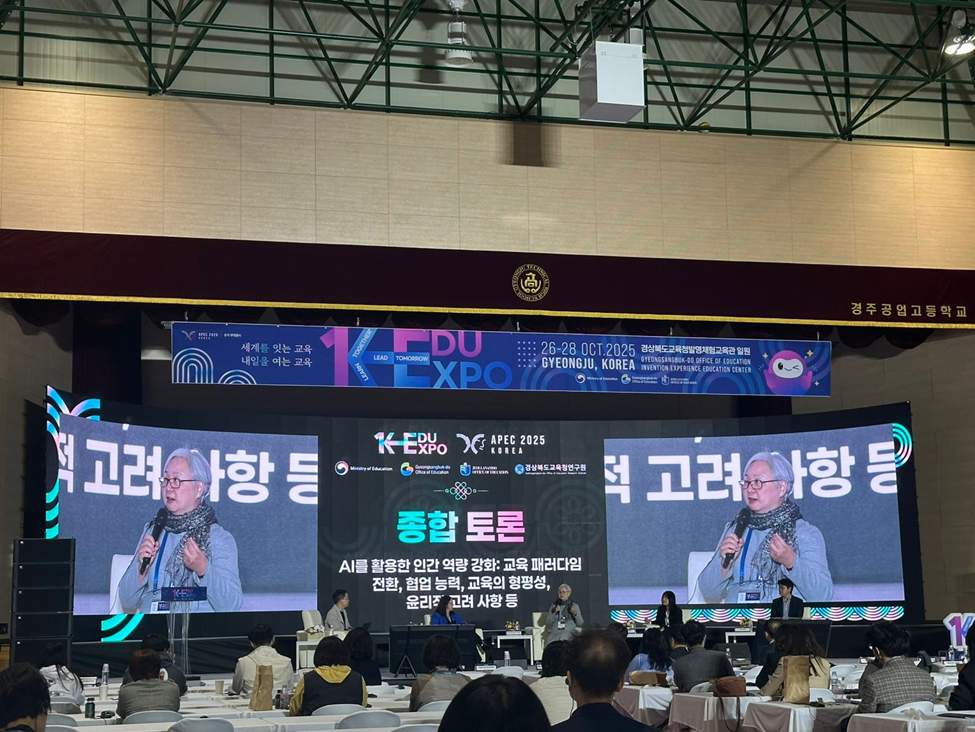
As artificial intelligence rapidly transforms education, a leading Philippine expert is urging a crucial shift in focus—beyond simply using AI, to ensuring it understands the students it serves. At the recent K-EDU EXPO in South Korea, Dr. Maria Mercedes T. Rodrigo, head of the Ateneo Laboratory for the Learning Sciences, delivered a compelling keynote advocating for culturally-responsive AI in education, arguing that successful implementation hinges on tools that acknowledge students’ unique backgrounds and national contexts. Dr. Rodrigo’s presentation, alongside global leaders in the field, highlighted the urgent need to move beyond a one-size-fits-all approach, particularly for empowering under-resourced communities and fostering equitable learning across the Asia-Pacific region.
Rodrigo Advocates Culturally-Responsive AI
At the recent K-EDU EXPO in Gyeongju, Republic of Korea, Ateneo de Manila University’s Dr. Maria Mercedes T. Rodrigo delivered a compelling keynote address advocating for culturally-responsive artificial intelligence in education. Speaking at the international forum, Dr. Rodrigo, head of the Ateneo Laboratory for the Learning Sciences (ALLS), emphasized that AI tools must be grounded in students’ cultural backgrounds, lived experiences, and national contexts to be truly effective. Her presentation, titled “Promoting Educational Equity through Culturally-Responsive AI,” illustrated, through both global and Philippine examples, how cultural factors significantly influence the success of AI-based learning and how thoughtful design can empower under-resourced communities. Dr. Rodrigo’s participation at the APEC 2025-affiliated event underscores the Philippines’ growing role in championing ethical, inclusive, and context-aware AI applications aimed at achieving educational equity throughout the Asia-Pacific region.
K-EDU EXPO Highlights Global EdTech Leaders
The recent K-EDU EXPO in Gyeongju, Republic of Korea, served as a platform for global education and technology leaders to discuss the evolving role of artificial intelligence in learning, with a strong emphasis on equitable and culturally-responsive implementation. During the International Education Forum, Dr. Maria Mercedes T. Rodrigo, Head of the Ateneo Laboratory for the Learning Sciences, delivered a keynote address advocating for AI systems grounded in students’ cultural contexts and lived experiences. The event also featured insights from industry figures like Isabelle Howe, CEO of the Stanford Learning Accelerator, and Choi Yu-jin, CEO and Co-founder of Classum, who explored AI’s capabilities in education, alongside presentations from Professor Kim Joo-ho of KAIST. A panel discussion, chaired by Professor Chan Lee of Seoul National University, further investigated how educators can leverage AI to foster collaboration, equity, and ethical responsibility, solidifying the K-EDU EXPO’s position as a key event for shaping the future of educational technology.
Recent Ateneo News & Announcements
Recent weeks have seen a surge of activity and recognition for Ateneo de Manila University faculty and initiatives. Notably, Dr. Maria Mercedes T. Rodrigo, head of the Ateneo Laboratory for the Learning Sciences (ALLS), delivered a keynote address at the K-EDU EXPO in South Korea, advocating for culturally-responsive AI in education and positioning the Philippines as a leader in ethical AI implementation within the Asia-Pacific region. Beyond this international platform, Ateneo has also focused on internal development, forging a partnership with Unilab to cultivate future nursing leaders and hosting an intellectual property awareness session led by the Ateneo Intellectual Property Office for students in a Technopreneurship class. Additionally, the university community celebrated the success of 7th grader Zia Uy at a national piano competition, while the Bernas Institute launched a new forum series and the Exit Left Collective debuted its inaugural theatrical production, demonstrating a vibrant commitment to arts and culture alongside academic and technological advancement.


