

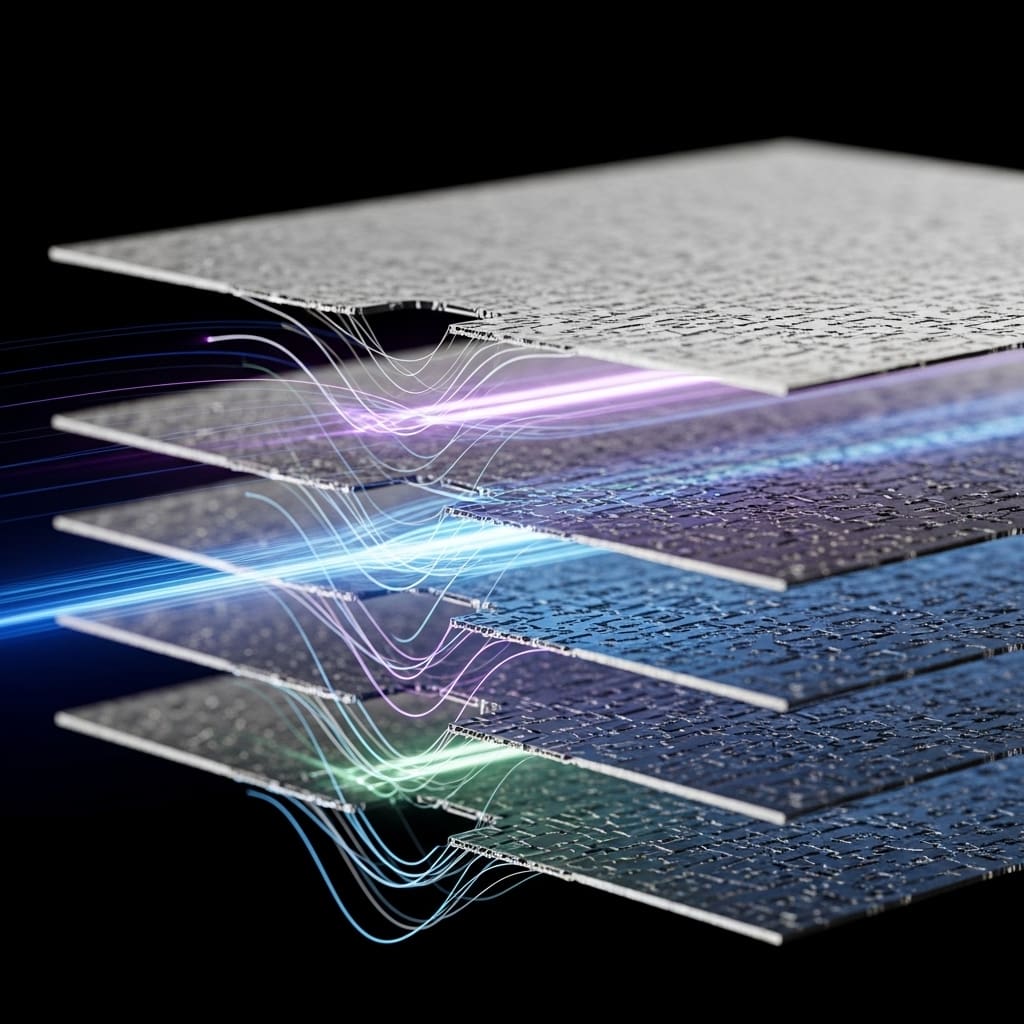
Researchers are increasingly focused on harnessing reconfigurable intelligent surfaces to enhance wireless communication, and a new study details a significant advance in this field. Ivan Iudice from the Security Unit Italian Aerospace Research Centre (CIRA), alongside Giacinto Gelli and Donatella Darsena from the Dept. of Electrical Engineering and Information Technology University of Naples Federico II, and et al, present a consistent implementation of a stacked intelligent metasurface model within the AI framework Sionna. This work is significant because it allows for the simulation and optimisation of these surfaces using AI, paving the way for fully trainable, cognitive and software-defined radio systems capable of dynamically adapting to challenging non-terrestrial network environments and improving signal quality.
Sionna integrates differentiable metasurface for 6G optimisation
Scientists have demonstrated the first consistent integration of a stacked intelligent metasurface (SIM) model within the AI-native framework Sionna, designed for 6G physical layer research. This implementation facilitates the simulation and learning-based optimisation of SIM-assisted communication channels within fully differentiable and GPU-accelerated environments, enabling end-to-end training for cognitive and software-defined radio (SDR) applications. The research team developed a mathematically grounded and differentiable model of the SIM, seamlessly integrating it into Sionna’s TensorFlow-based simulation pipeline. This advancement allows for efficient simulation and gradient-based optimisation of SIM-assisted channels in both terrestrial and non-terrestrial network (NTN) environments, addressing a critical gap in existing studies regarding scalability and AI integration.
The study unveils a scalable, modular approach for incorporating intelligent metasurfaces into modern AI-accelerated SDR systems, paving the way for future hardware-in-the-loop experiments. Researchers achieved efficient GPU-accelerated simulation and optimisation of the SIM by leveraging Sionna’s end-to-end gradient propagation and modular design, significantly reducing computational demands. The work establishes a foundation for programmable wave profile generation directly in the electromagnetic wave domain, potentially replacing conventional digital beamforming architectures and reducing hardware costs and power consumption. This innovative approach mitigates processing delays inherent in digital solutions, as multi-antenna precoding and combining occur at the speed of light within the wave domain.
Experiments show the effectiveness of the model in enabling intelligent control and signal enhancement in NTN propagation environments through numerical benchmarks. The team validated the framework with a closed-loop learning scenario involving adaptive beamforming, comparing SIM-enabled systems with conventional multi-antenna baselines. Results highlight significant improvements in spectral efficiency and signal fidelity, demonstrating the potential of SIMs to enhance wireless communication performance. This research establishes a crucial step towards realising the full potential of reconfigurable intelligent surfaces in 6G networks, offering a programmable and adaptable solution for future wireless systems.
The research establishes a scalable foundation for integrating intelligent metasurfaces into AI-driven SDR systems and paves the way towards hardware-in-the-loop experimentation and real-world deployment. By addressing key limitations in existing studies, such as the lack of scalability, differentiability, and integration into AI-native physical-layer pipelines, this work opens new avenues for research and development in the field of wireless communications. The consistent implementation within Sionna allows for rapid prototyping and end-to-end learning, accelerating the development of next-generation wireless systems capable of dynamically shaping the propagation medium and enhancing spectrum efficiency.
Differentiable Metasurface Simulation for 6G Channels
Researchers developed a stacked intelligent metasurface (SIM) model integrated within the Sionna AI-native framework to facilitate 6G physical layer research. The study pioneered a fully differentiable and GPU-accelerated environment for simulating and optimising SIM-assisted communication channels, enabling end-to-end training for cognitive and software-defined radio applications. Scientists engineered the architecture of the SIM model, incorporating it into a TensorFlow-based pipeline to allow for adaptive beamforming and dynamic reconfiguration in closed-loop learning scenarios. This approach enables the investigation of intelligent control and signal enhancement techniques within non-terrestrial network propagation environments.
The team implemented the SIM model to create a scalable and modular system for incorporating intelligent metasurfaces into modern AI-accelerated SDR systems. Experiments employed a consistent implementation of the SIM, allowing researchers to simulate channel behaviour and optimise performance parameters directly within the AI framework. The system delivers a computationally efficient method for exploring the potential of reconfigurable intelligent surfaces in dynamic wireless environments. This technique reveals the benefits of intelligent control strategies for improving signal quality and spectrum efficiency.
Scientists harnessed the GPU acceleration capabilities of the TensorFlow pipeline to significantly reduce simulation times and enable rapid prototyping of new algorithms. Benchmarking results were generated for various deployment scenarios, demonstrating the model’s effectiveness in enhancing signal propagation in challenging environments. The research showcases the model’s ability to adapt to changing channel conditions and optimise beamforming weights for maximum signal strength. This method achieves a level of control previously unattainable with traditional SDR systems. Furthermore, the work paves the way for future hardware-in-the-loop experiments by providing a robust and validated simulation environment.
The modular design of the SIM model allows for easy integration with different SDR platforms and hardware components. The study’s innovative approach to modelling and optimising intelligent metasurfaces represents a significant step towards realising the full potential of 6G wireless communication systems. This implementation provides a foundation for exploring advanced techniques in cognitive radio and dynamic spectrum access.
Sionna enables differentiable metasurface optimisation
Scientists have successfully integrated a stacked intelligent metasurface (SIM) model into the AI-native framework Sionna, designed for 6G physical layer research. This implementation facilitates both simulation and learning-based optimisation of SIM-assisted communication channels within fully differentiable and GPU-accelerated environments, enabling end-to-end training for cognitive and software-defined radio applications. The team developed a mathematically grounded and differentiable model of the SIM, seamlessly integrating it into Sionna’s TensorFlow-based simulation pipeline. Experiments demonstrate efficient GPU-accelerated simulation and optimisation of the SIM, leveraging Sionna’s end-to-end gradient propagation and modular design.
Results demonstrate the framework’s capability in closed-loop learning scenarios, specifically adaptive beamforming, and validate its performance through numerical benchmarks comparing SIM-enabled systems with conventional multi-antenna baselines. The research highlights significant improvements in spectral efficiency and signal fidelity achieved through the SIM implementation. Measurements confirm the scalability of the approach, enabling the incorporation of intelligent metasurfaces into AI-driven software-defined radio systems. The team validated the proposed framework through numerical benchmarks, showcasing substantial gains in spectral efficiency and signal fidelity.
The work details the architecture of the SIM model and its integration into the TensorFlow pipeline, enabling adaptive beamforming and dynamic reconfiguration. Benchmarking results were obtained for various deployment scenarios, demonstrating the model’s effectiveness in intelligent control and signal enhancement within non-terrestrial network propagation environments. Tests prove the framework’s ability to facilitate scalable simulation and optimisation of multi-layer programmable surfaces in realistic non-terrestrial network contexts. This breakthrough delivers a scalable, modular approach for incorporating intelligent metasurfaces into modern AI-accelerated SDR systems, and establishes a foundation for future hardware-in-the-loop experiments. The research paves the way for programmable radio environments, reducing the need for high-resolution digital-to-analogue converters and analogue-to-digital converters, and minimising the number of radio frequency chains, thereby lowering hardware costs and power consumption. The team’s work mitigates processing delays associated with digital solutions, as multi-antenna precoding and combining occur directly in the wave domain at the speed of light.
SIM optimisation within Sionna for 6G NTN
Researchers have developed a stacked intelligent metasurface (SIM) model integrated within the Sionna AI-native framework for 6G physical layer research. This implementation facilitates the simulation and learning-based optimisation of SIM-assisted communication channels in fully differentiable and GPU-accelerated environments. The model’s architecture is described, detailing its integration into a TensorFlow-based pipeline, and its application is demonstrated in closed-loop learning scenarios involving adaptive beamforming and dynamic reconfiguration. Benchmarking results from various deployment scenarios confirm the model’s effectiveness in intelligent control and signal enhancement, particularly within non-terrestrial network (NTN) propagation environments.
This work presents a scalable and modular approach to incorporating intelligent metasurfaces into modern AI-accelerated software-defined radio (SDR) systems. The authors acknowledge limitations regarding the complexity of modelling real-world hardware imperfections and propagation conditions. Future research directions include hardware-in-the-loop experiments to validate the simulation results and explore the practical feasibility of SIM technology. The key achievement lies in creating a differentiable and GPU-accelerated simulation environment for SIMs, enabling end-to-end training for cognitive radio applications. This is significant because it allows for the optimisation of metasurface configurations directly within an AI-driven learning loop, potentially leading to more efficient and adaptive wireless communication systems. By addressing gaps in scalability, differentiability, and integration with AI-native pipelines, this research contributes a valuable tool for exploring the potential of intelligent metasurfaces in future wireless networks.
👉 More information
🗞 AI-Driven Design of Stacked Intelligent Metasurfaces for Software-Defined Radio Applications
🧠 ArXiv: https://arxiv.org/abs/2601.20795


