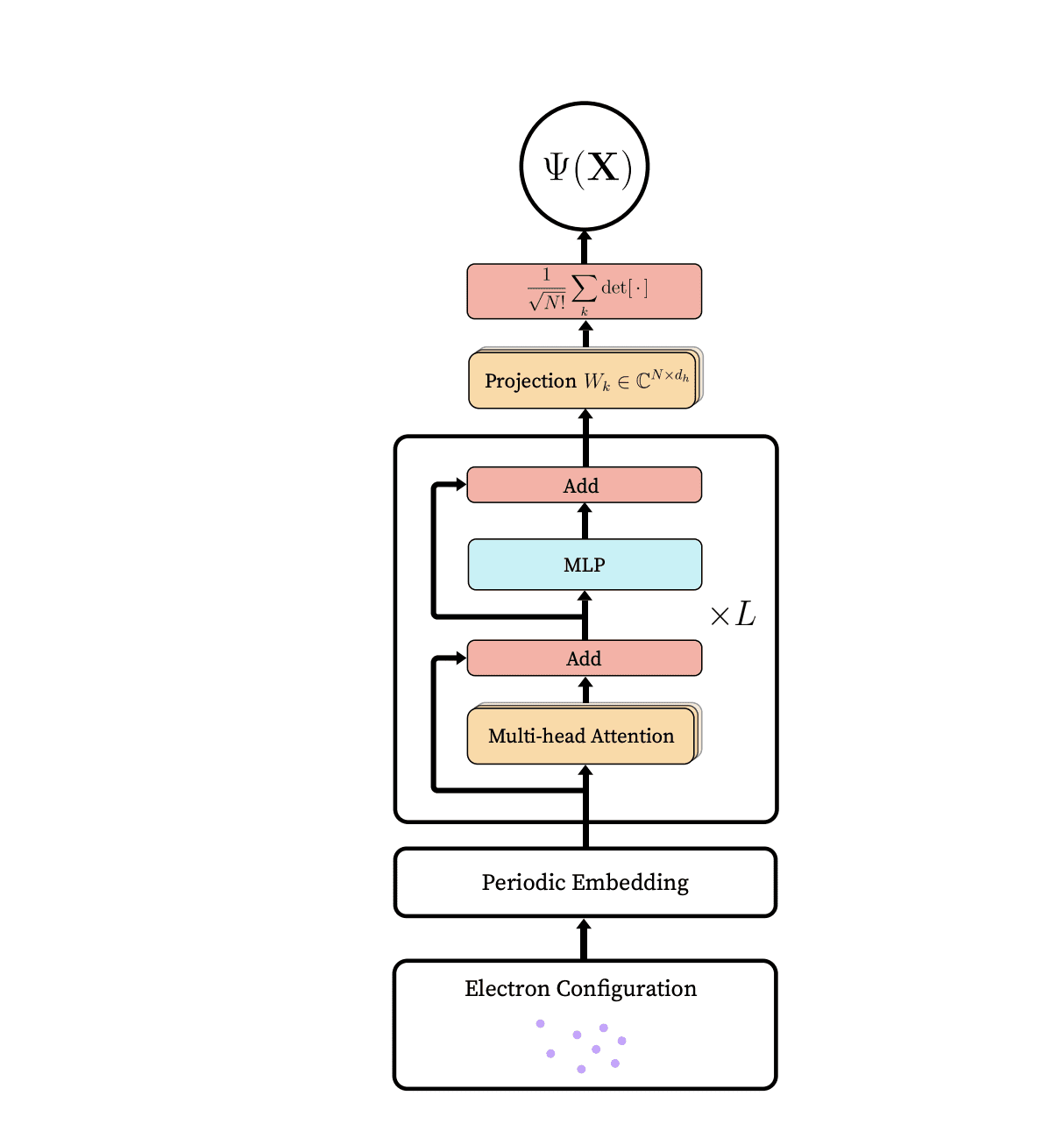
The search for novel superconducting materials receives a boost from an unexpected source: artificial intelligence. Chun-Tse Li, Tzen Ong from the Institute of Physics, Academia Sinica, Max Geier from the Massachusetts Institute of Technology, Hsin Lin from the Institute of Physics, Academia Sinica, and Liang Fu demonstrate that a sophisticated neural network, inspired by the ‘attention’ mechanisms used in modern AI, can independently discover chiral superconductivity within a complex system of interacting particles. The team’s approach bypasses the need for pre-defined assumptions about how materials pair up to achieve superconductivity, instead allowing the network to learn the optimal arrangement through energy minimization. This breakthrough establishes a powerful new method for AI-driven materials discovery, potentially accelerating the search for unconventional and topological superconductors with applications in advanced technologies.
Researchers investigate whether these mechanisms can efficiently capture the complex correlations between quantum particles, addressing a long-standing challenge in materials science. Recent advances in neural quantum states demonstrate the power of attention in learning relationships between objects, inspiring this work and potentially leading to advancements in both materials science and quantum technologies.
Self-attention Fermi neural networks successfully identify chiral superconductivity in an attractive Fermi gas by minimizing energy, operating without prior knowledge of pairing mechanisms. The superconducting state is confirmed by analyzing the optimized wavefunction and measuring key physical properties, including the strength of particle binding, the total angular momentum of the system, and the long-range order within the two-body reduced density matrix. This establishes a pathway for artificial intelligence to discover unconventional pairing symmetries and complex quantum phases of matter, potentially accelerating materials discovery and deepening our fundamental understanding of quantum systems.
Attractive Fermi Gas Exhibits Superfluidity
This research details a sophisticated computational study of an attractive Fermi gas, a model system used to understand superconductivity. The team employed Variational Monte Carlo (VMC) to simulate the behaviour of interacting particles and determine whether the system exhibits superconducting properties. VMC involves making an educated guess about the system’s quantum state, then refining that guess using random sampling and minimizing the system’s energy.
The core of VMC lies in the trial wavefunction, which represents the initial guess about the system’s quantum state. This wavefunction contains adjustable parameters that are optimized during the calculation. Monte Carlo integration, a powerful computational technique, is then used to evaluate integrals that are difficult to solve analytically. By minimizing the energy expectation value with respect to these parameters, the researchers obtain an approximation of the true ground state energy and properties of the system.
Key to diagnosing superconductivity is the two-body reduced density matrix, which provides information about how particles pair up. By analyzing the eigenvalues of this matrix, researchers can identify the presence of off-diagonal long-range order, a defining characteristic of a superconducting state. The team also calculated the momentum-space occupation number, which describes the distribution of particles in different momentum states.
The accuracy of these calculations relies on careful implementation of the VMC method and the use of techniques to improve efficiency and reduce noise. This includes exploiting symmetries within the system and applying post-processing techniques to refine the data. The level of detail in this study reflects the importance of precision and reproducibility in condensed matter physics.
This research demonstrates the power of computational methods in exploring complex quantum systems. By combining sophisticated algorithms with careful analysis, researchers can gain valuable insights into the behaviour of materials and potentially discover new superconducting phases.
AI Identifies Chiral Superconductivity via Energy Minimization
This research demonstrates that a neural network, specifically a self-attention Fermi network, can successfully identify chiral superconductivity within an attractive Fermi gas by minimizing energy, without requiring any pre-defined knowledge of pairing mechanisms. The team achieved this by optimizing a wavefunction and then analyzing physical observables, including pair binding energy, total angular momentum, and long-range order within the two-body reduced density matrix, to confirm the superconducting state. This establishes a pathway for artificial intelligence to discover unconventional and topological superconductivity in complex materials, potentially accelerating materials discovery through artificial intelligence.
The study details the Monte Carlo methods used to evaluate key physical quantities, such as the momentum-space occupation number and the two-body reduced density matrix, within the computationally demanding framework of many-body quantum systems. The authors acknowledge the presence of statistical noise in these calculations and implemented symmetrization and thresholding techniques to improve the accuracy and reliability of the results. Further refinement of the Monte Carlo sampling and analysis may be necessary to reduce noise and improve the precision of calculated observables. Future work could explore the application of this AI-driven approach to more complex systems and materials, potentially uncovering novel superconducting phases and properties.
👉 More information
🗞 Attention is all you need to solve chiral superconductivity
🧠 ArXiv: https://arxiv.org/abs/2509.03683