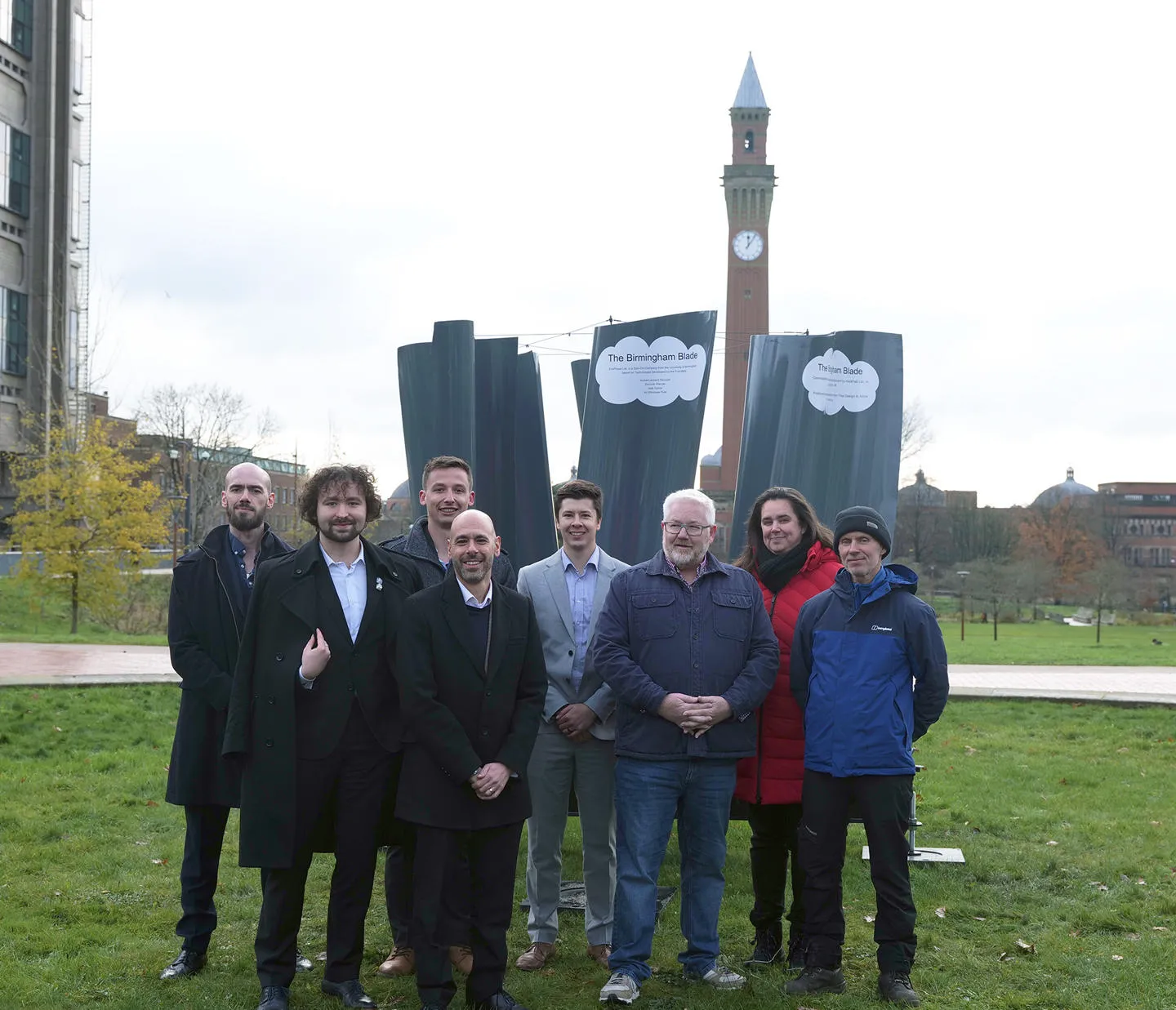
In a breakthrough for urban wind energy, researchers have unveiled the Birmingham Blade, the world’s first geographically tailored urban wind turbine designed by artificial intelligence (AI). This innovative design is up to seven times more efficient than existing turbines in Birmingham’s unique wind conditions and urban environment.
The collaboration between AI design specialists EvoPhase and precision metal fabricators KwikFab has produced a solution for small-scale, affordable clean energy generation. Led by Dr. Kit Windows-Yule from the University of Birmingham, EvoPhase used its AI-driven design process to generate and test over 2,000 wind turbine designs in just a few weeks, significantly accelerating development.
The final design is ready for real-world use, with an aluminium prototype set to be tested on a rooftop in Birmingham. Key individuals involved include Leonard Nicusan, Chief Technology Officer of EvoPhase, and Paul Jarvis from KwikFab. This pioneering work has far-reaching implications for harnessing wind power globally.
Revolutionizing Urban Wind Turbines with AI-Driven Design
The Birmingham Blade, a novel urban wind turbine designed by AI, has been unveiled as a solution to the pressing issue of producing small-scale, affordable generators of clean wind energy. This innovative design is tailored to the unique wind conditions of a specific geographic area, in this case, Birmingham.
The collaboration between EvoPhase and KwikFab has led to the development of a turbine that can capture Birmingham’s relatively low wind speeds while managing turbulence caused by surrounding buildings. The design also had to be compact and lightweight to suit rooftop installations. According to Leonard Nicusan, Chief Technology Officer of EvoPhase, “We needed a turbine that could capture Birmingham’s relatively low wind speeds while managing turbulence caused by surrounding buildings.”
The use of AI was essential in breaking free from the long-standing biases that have influenced turbine designs for the past century. By generating, testing, and refining over 2,000 wind turbine designs in just a few weeks, EvoPhase significantly accelerated their development process, achieving what would have taken years and millions of pounds through conventional methods.
The Science Behind the Birmingham Blade
EvoPhase’s AI-led evolutionary design process mimics natural selection, allowing for simultaneous optimization of many different parameters. This approach avoids traditional trade-offs between performance factors, resulting in a predictive solution that is ready for real-world use. The final design is not just a prototype but has been confirmed to be up to seven times more efficient than existing designs in Birmingham’s wind speeds and urban environment through evolutionary simulations.
The research group led by Dr. Kit Windows-Yule at the University of Birmingham developed EvoPhase’s AI-led evolutionary design process, which has been applied beyond wind energy to industries such as food, pharmaceutical, and chemical manufacturing sectors.
From Design to Prototyping: A Rapid Collaboration
KwikFab produced the first iteration of the Birmingham Blade to demonstrate the feasibility of manufacturing the design. An aluminum version will be sited on a roof space in Birmingham for evaluation and testing, with the final product expected to be available by late 2025. The EvoPhase-KwikFab collaboration provides a rapid design and prototyping service, allowing for quick turnaround from design to prototyping.
Paul Jarvis from KwikFab is confident that Birmingham has sufficient talent and space to deliver this service for wind turbines tailored to specific local conditions around the world. “We can take a complex design, manufacture and ship a prototype for testing within weeks,” he said.
Expanding the Reach of AI-Driven Design
EvoPhase’s collaboration with KwikFab demonstrates the broad applicability of their predictive designs. Since its launch in 2023, EvoPhase has expanded its AI-powered evolutionary design approach to various industries. The team is now working on another design for the very different conditions in Edinburgh.
The Manchester Prize, which named the team as a finalist in May 2024, has also contributed to the development of this innovative technology. This multi-million-pound challenge prize from the UK’s Department for Science, Innovation and Technology rewards UK-led breakthroughs in artificial intelligence for public good.
External Link: Click Here For More