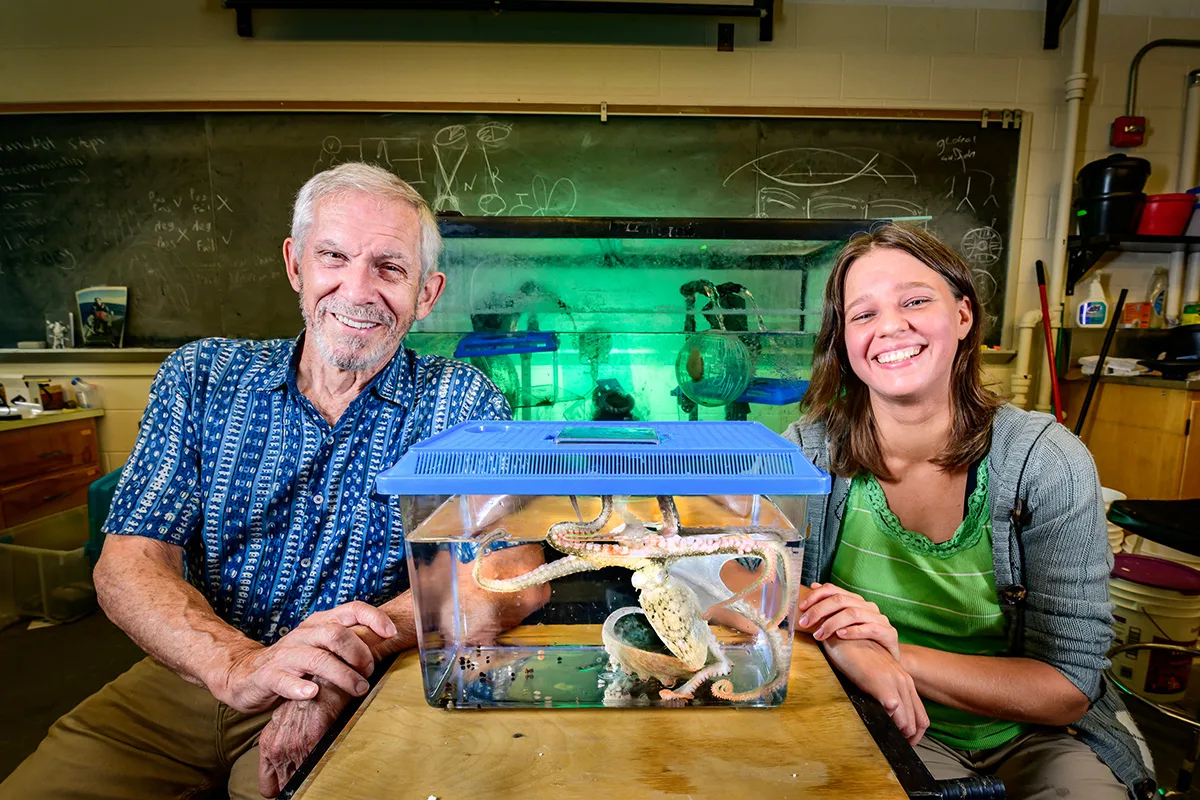
Researchers Ekaterina Gribkova and Rhanor Gillette from the University of Illinois Urbana-Champaign have developed an artificial intelligence (AI) system, named “CyberOctopus”, that can navigate new environments, seek rewards, and learn in real time. The AI was designed based on the neural pathways of sea slugs and octopuses, and is capable of expanding its spatial and temporal awareness. The system is more efficient than traditional AI, as it can perform basic functions without extensive pre-training. The researchers believe this approach could be used to create more advanced AI systems capable of tasks beyond spatial navigation.
From Simple to Complex: The Evolution of AI Learning
Artificial Intelligence (AI) has been given a significant upgrade, with researchers at the University of Illinois Urbana-Champaign developing an AI that can navigate new environments, seek rewards, map landmarks, and overcome obstacles. This new approach, reported in the journal Neurocomputing, allows the AI to explore and gather information, expanding its spatial and temporal awareness and learning on the job. The research was led by postdoctoral researcher Ekaterina Gribkova and molecular and integrative physiology professor emeritus Rhanor Gillette, with support from agricultural and biological engineering professor Girish Chowdhary.
The researchers have drawn inspiration from the neural pathways that drive behavior in sea slugs and octopuses. By giving the AI simple associative learning rules based on these brain circuits, and augmenting it with better episodic memory, the AI has become more efficient and animal-like. This approach is a departure from the standard method of pretraining AI with vast amounts of data before it performs basic functions.
The Power of Memory in AI Learning
A key component of this new approach is the addition of a memory module that allows the AI to retain information about past events. This enables very simple spatial learning to be expanded to much more complex learning. According to Gribkova, this can be applied to learning sequences of motor behaviors, mapping social networks, or even linguistic problem-solving.
The memory module, called the Feature Association Matrix, is modeled on the architecture and functions of the hippocampus, a brain region essential to learning and memory. This work was also informed by studies of the brain networks that drive behavior in an octopus. The researchers have named the AI agent with this memory module a “CyberOctopus.”
The ASIMOV Project: A Step Towards Animal-like AI
The team built on their previous work simulating the decision-making neural circuits of a sea slug, a project known as “Cyberslug.” They named their simulated creature ASIMOV, after Isaac Asimov, a science fiction writer who explored the safety concerns and ethics of robotics in human society.
ASIMOV was programmed to monitor its own internal state and seek satiation and reward. It learned through trial and error to select nutritious over noxious food items. However, its memory and ability to integrate information from past experiences were limited. The addition of the Feature Association Matrix significantly enhanced ASIMOV’s capabilities, leading to the creation of the “CyberOctopus.”
The ASIMOV-FAM Agent: Exploring and Learning
In the new study, ASIMOV-FAM explored a simulated environment with various landmarks, some of which had rewards attached to them. The AI agent was programmed to seek out novelty and rewards, and it used cognitive maps formed by the Feature Association Matrix to learn its spatial environment. It was able to generate new paths and shortcuts for traversing the environment more efficiently, for greater rewards. This is effectively spatial reasoning, a fundamental building block of natural intelligence, which most current AI models lack.
Future Applications of the ASIMOV-FAM Agent
The researchers expect to use this new approach to create a more efficient and advanced AI that can perform a variety of tasks beyond spatial navigation. They believe ASIMOV-FAM can be adapted for more abstract, nonspatial applications, such as enhancing large language models like ChatGPT for more efficient computation and problem-solving, with reduced size and training requirements.
The goal is to build an AI that doesn’t require all that much data, that’s more animal-like in its adaptive behavior and creativity, and that is learning more on its own. In essence, the researchers see advanced AI as learning much more like a child would learn. This work was supported by the U.S. Office of Naval Research.
External Link: Click Here For More