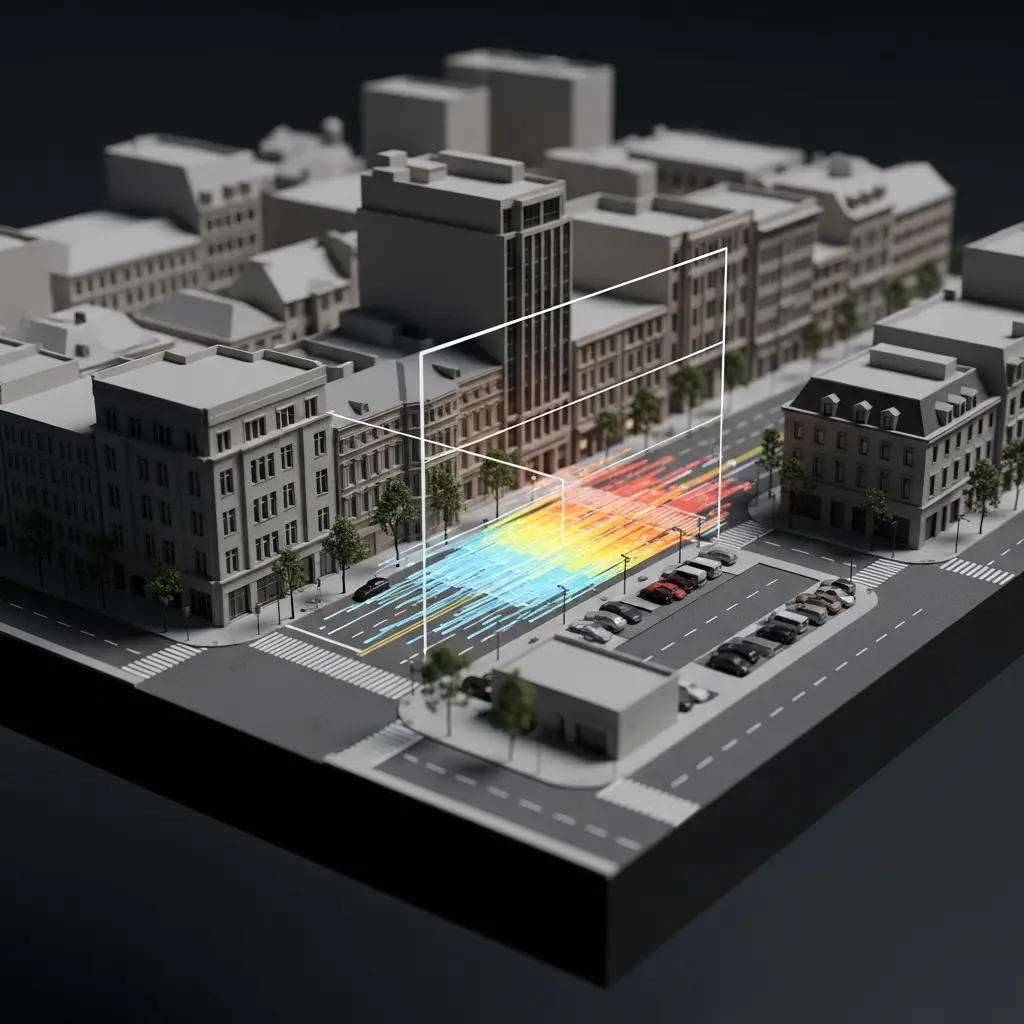
Sidewalk sheds, ubiquitous along New York City’s streets, present a challenge to both pedestrian flow and local business visibility. Junyi Li, Zhaoxi Zhang (University of Florida), and Tamir Mendel (The Academic College of Tel Aviv-Yaffo), with Takahiro Yabe et al., investigate these impacts through a novel approach combining chatbot surveys with human-computer interaction. Their research directly measures how these structures affect pedestrian visibility and route choices, something currently lacking in urban planning practices. By employing a chatbot integrating large language models and image annotation, the team collected data linking shed design, height, spacing, colour, to pedestrian perceptions and behaviours, revealing that scaffolding significantly hinders retail entrance identification and that weather and design influence sidewalk selection. This study not only offers empirical evidence for refining sidewalk shed guidelines, but also demonstrates a pioneering methodology for integrating generative AI into urban research.
Assessing pedestrian impacts from sidewalk sheds using AI-driven interactive surveys offers valuable insights
Developing AI to Measure Pedestrian Flow
Developing AI Chatbots for Urban Assessment
Scientists have developed a novel AI-based chatbot survey to directly measure the impact of sidewalk sheds on pedestrian visibility and movement in New York City. These ubiquitous structures, while essential for safety during construction and maintenance, have raised concerns regarding reduced storefront visibility and altered pedestrian navigation.
The research addresses a critical gap in current planning practices, which lack direct measurement of these effects. This study introduces a new method integrating a large language model, specifically Google’s Gemini-1.5-flash-001 model, with an image-annotation interface. The team achieved this by creating a chatbot that engages pedestrians through interactive dialogue and image-based tasks.
Participants are presented with street images and asked to annotate visual elements, such as storefront entrances, and to indicate their preferred routes. Responses are then linked to specific shed design features, including clearance height, post spacing, and colour, allowing for detailed analysis. This innovative approach combines quantitative data, like entrance recognition rates, with qualitative explanations for route choices gathered through adaptive questioning.
Measuring Significant Loss of Storefront Visibility
Analysis Reveals Significant Loss of Storefront Visibility
The work opens new avenues for e-participatory planning and flexible data collection in urban research. Analysis of a dataset comprising 25 participants reveals that the presence of scaffolding significantly reduces pedestrians’ ability to identify ground-floor retail entrances. Furthermore, the study demonstrates that variations in weather conditions and specific shed design features substantially influence sidewalk selection behaviour.
By employing grid-based analysis of entrance annotations and logistic mixed-effects modelling, researchers established a robust framework for evaluating the impact of these structures. This research provides empirical evidence to support adjustments to sidewalk shed guidelines, aiming to improve the pedestrian experience without compromising safety.
Pioneering AI for Policy and Urban Planning
Pioneering AI for Urban Planning and Policy
This breakthrough reveals a novel application of generative AI in urban research, moving beyond traditional methods of assessing pedestrian behaviour. The study highlights the potential of digital tools to integrate public feedback into policymaking, addressing a long-standing need for data-driven insights into the effects of temporary urban infrastructure. As of 2024, over 8,500 sidewalk sheds cover approximately 330 miles of New York City streets, remaining in place for an average of nearly 500 days, underscoring the importance of understanding and mitigating their impact on the urban environment.
Chatbot survey design and quantitative analysis of pedestrian responses to scaffolding revealed key insights
Implementation Using Large Language Models
Implementing the Large Language Model Interface
Scientists developed a novel chatbot survey integrating a large language model, specifically Google’s Gemini-1.5-flash-001, with an image-annotation interface to assess pedestrian perceptions of sidewalk sheds in New York City. The research team collected data through this chatbot, prompting users to interact with street images, mark visual elements, and provide structured feedback via guided dialogue.
This innovative approach enabled the collection of both quantitative and qualitative data linking pedestrian responses to specific shed design features, including clearance height, post spacing, and colour. To analyse pedestrian behaviour, the study pioneered a grid-based analysis of entrance annotations, precisely mapping where participants identified storefronts obscured by scaffolding.
Researchers then applied logistic mixed-effects modelling to assess sidewalk choice patterns, determining how shed characteristics and weather conditions influenced pedestrian route selection. The dataset comprised responses from n = 25 participants, allowing for statistically robust analysis of the collected data.
Experiments employed real-world images of sidewalk shed conditions, presenting participants with authentic street scenes to elicit realistic responses. The system delivers a dynamic, adaptive questioning process, tailoring follow-up questions based on initial annotations to gain deeper insights into pedestrian reasoning.
Analysis revealed that the presence of scaffolding significantly reduces pedestrians’ ability to identify ground-floor retail entrances, while variations in weather and shed design demonstrably influence sidewalk selection behaviour. This method achieves a novel integration of generative AI into urban research, providing empirical evidence to inform adjustments to shed guidelines and improve the pedestrian experience.
Scaffolding diminishes retail visibility assessed via chatbot and spatial analysis, potentially impacting sales
Scientists have demonstrated that sidewalk sheds, a ubiquitous feature of New York City streets, significantly reduce pedestrian visibility of ground-floor retail entrances. The research team developed a chatbot survey integrating a large language model and image-annotation interface to collect data linking pedestrian perceptions to shed design features.
Analysis of a dataset comprising 25 participants revealed a measurable reduction in the ability to identify entrances when scaffolding is present. Experiments revealed that the presence of scaffolding reduces pedestrians’ ability to identify ground-floor retail entrances, as evidenced by spatial heatmaps and signal-detection sensitivity measures.
Participants demonstrated systematically lower entrance-recognition performance under both current and past shed conditions, with annotations being more diffuse and spatially inconsistent compared to the no-shed baseline. Sensitivity scores (d′), quantifying the ability to differentiate true entrances from non-entrances, were consistently lower when a sidewalk shed was present.
Mixed-effects modeling confirmed a statistically significant decrease in perceptual sensitivity associated with sidewalk-shed exposure (β1 = −0.161, p = 0.021). Furthermore, tests prove that weather conditions substantially influence pedestrian route choices relative to sidewalks with or without sheds.
During normal weather, 81% of participants preferred the unsheltered side, demonstrating a clear avoidance of the shed. However, this preference reversed during heavy rain, with 74.4% of participants choosing the shed side, indicating a strong shift toward seeking shelter. Logistic regression estimates show a significant decrease in the likelihood of selecting the shed side in normal weather (β = , 0.794, p = 0.042) and a substantial increase during heavy rain (β = 1.737, p The study’s model fit, as indicated by a McFadden’s pseudo R2 of 0.614, demonstrates the explanatory power of the discrete-choice model.
These findings provide empirical evidence to support adjustments to shed guidelines, potentially improving the pedestrian experience without compromising safety. The research delivers a novel method for evaluating sidewalk shed designs using generative AI integrated with urban research.
Pedestrian route choices and retail visibility under temporary sidewalk infrastructure are key considerations for urban planning
Scientists have investigated the impact of sidewalk sheds, temporary structures erected during construction and maintenance, on pedestrian behaviour in New York City. The research addresses a gap in urban planning, where the effects of these sheds on visibility and movement are not routinely measured.
Researchers developed an AI-based chatbot survey, integrating a large language model with image annotation, to collect data on pedestrian perceptions and route choices related to shed design features. Analysis of data collected from 25 participants revealed that scaffolding significantly reduces the ability of pedestrians to identify ground-floor retail entrances.
Furthermore, variations in weather and shed design, including post spacing and height, demonstrably influence sidewalk selection. This study introduces a novel method for evaluating sidewalk shed designs, combining AI-driven surveys with image-based interaction to generate quantitative evidence on pedestrian experience.
The findings suggest a trade-off between safety provision and street-level experience, with design choices playing a crucial role in mediating pedestrian comfort and engagement. The authors acknowledge a limitation in data availability, as participants did not consent to public sharing of their data. Future research could explore the application of this methodology to other urban contexts and investigate the long-term impacts of sidewalk sheds on local businesses. Ultimately, this work offers actionable guidance for policymakers and urban designers, suggesting that increasing post spacing and adopting flexible height standards could mitigate negative impacts on storefront visibility while maintaining safety during construction and preserving pedestrian navigation.
🗞 Exploring Sidewalk Sheds in New York City through Chatbot Surveys and Human Computer Interaction
🧠 ArXiv: https://arxiv.org/abs/2601.23095