

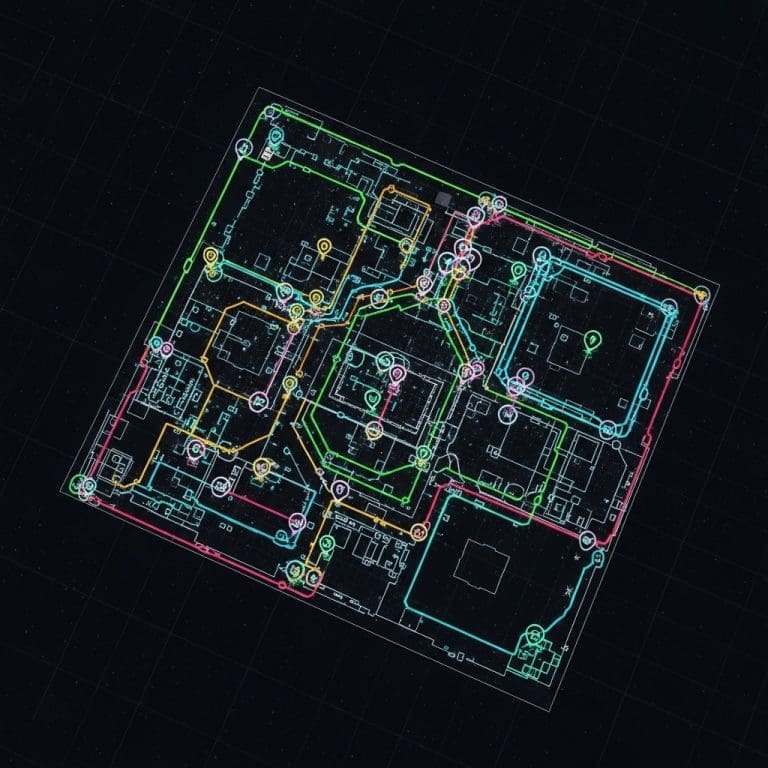
Researchers are tackling the challenge of reliable environmental mapping by multiple robots operating with limited sensing and communication capabilities. Kooktae Lee and Julian Martinez, both from the Department of Mechanical Engineering at the New Mexico Institute of Mining and Technology, detail a novel AI-augmented Density-Driven Optimal Control (D2OC) framework in their recent work. This approach moves beyond traditional methods which struggle with inaccurate initial maps, instead offering an adaptive, self-correcting system that iteratively refines local density estimates. By incorporating a dual multilayer perceptron module, the team’s method demonstrably improves accuracy and scalability, achieving significantly higher-fidelity reconstruction of complex environments compared to existing decentralised techniques, as proven through rigorous theoretical analysis and simulations.
AI-driven decentralised mapping with Optimal transport offers scalable
Scientists have developed an AI-augmented decentralised framework for multi-agent environmental mapping, addressing limitations in scenarios with restricted sensing and communication capabilities. Conventional spatial allocation methods falter when relying on uncertain or biased prior maps, but this new approach introduces an adaptive, self-correcting mechanism within an optimal transport-based framework, guaranteeing both theoretical consistency and scalability. The research team achieved robust and precise alignment with ground-truth density by iteratively refining local density estimates, a significant advancement over existing decentralised methods. A key innovation is the implementation of a dual multilayer perceptron (MLP) module, which infers local mean-variance statistics and dynamically regulates virtual uncertainty in long-unvisited regions, effectively mitigating stagnation around local minima during the mapping process.
This breakthrough reveals a method for reconstructing initially uncertain reference maps through local sensing and limited-range communication, eliminating the need for central coordination. Each agent employs the dual-MLP module to enhance adaptivity, with one network estimating static mean-variance and the other dynamically adjusting virtual uncertainty to prioritise re-exploration of neglected areas. The system operates through three stages: sample selection and optimal control, coverage-tracking weight update, and distributed consensus, supporting a fully decentralised implementation grounded in optimal transport principles.
Theoretical analysis rigorously proves convergence under the Wasserstein metric, demonstrating the framework’s mathematical soundness. Specifically, the study unveils a substantially higher-fidelity reconstruction of spatial distributions, achieving a lower steady-state Wasserstein distance compared to non-AI baselines, even when operating with biased prior information. This work addresses the challenging problem of decentralised map reconstruction under uncertain conditions, a significant departure from previous studies that assumed accurate reference maps.
The research establishes a novel approach to environmental mapping, offering a solution for applications such as environmental monitoring, pollution tracking, precision agriculture, and disaster response where agents operate with limited resources and incomplete information. By integrating artificial intelligence with optimal transport theory, the team has created a system capable of adaptive and self-correcting behaviour, enabling robust and precise mapping even in dynamic and uncertain environments. This AI-augmented framework not only improves the accuracy of spatial reconstruction but also opens new possibilities for autonomous multi-agent systems operating in complex real-world scenarios, paving the way for more efficient and reliable data collection and analysis.
AI-driven optimal transport for decentralised mapping offers scalable
Scientists developed an AI-augmented decentralised framework for multi-agent environmental mapping, addressing limitations in conventional coverage formulations when accurate reference maps are unavailable. The research tackled scenarios with limited sensing and communication, where prior environmental knowledge is often sparse or outdated. This study pioneered a method enabling agents to iteratively refine local density estimates using an optimal transport-based framework, ensuring both theoretical consistency and scalability. Experiments employed a dual multilayer perceptron (MLP) module to enhance adaptivity, inferring local mean-variance statistics and regulating virtual uncertainty in long-unvisited regions to mitigate stagnation around local minima.
The team engineered a three-stage architecture comprising sample selection and optimal control, coverage-tracking weight update, and distributed consensus with range-limited communication. This structure facilitates fully decentralised implementation while upholding theoretical consistency with optimal transport principles. Agents utilise online sensing and limited-range communication to progressively reconstruct the true spatial importance distribution, achieving adaptive coverage. The innovative aspect lies in the integration of an AI module within the sample selection stage. Each agent deploys a dual MLP inference model, with one network estimating static mean-variance and the other dynamically adjusting virtual uncertainty for areas infrequently visited. These learned weights modulate local sampling priorities, promoting re-exploration of neglected areas without centralised coordination. The system delivers analytical preservation of the D2OC structure while improving robustness against sensing noise, sample renewal randomness, and local minima. Theoretical analysis rigorously proves convergence under the Wasserstein metric, validating the method’s efficacy and scalability.
AI agents refine density maps with optimal transport
Scientists have developed an AI-augmented decentralized framework for multi-agent environmental mapping, addressing limitations in scenarios with limited sensing and communication. The research introduces a self-correcting mechanism allowing agents to iteratively refine local density estimates using an optimal transport-based framework, ensuring both theoretical consistency and scalability. Experiments rigorously proved convergence under the Wasserstein metric, demonstrating the framework’s robustness and precision. The team measured alignment with ground-truth density, achieving substantially higher-fidelity reconstruction of complex multi-modal spatial distributions compared to conventional decentralized baselines.
This work details a novel approach to spatial mapping where agents collaboratively build a map despite incomplete or biased prior knowledge. Researchers designed a system where each agent updates local map estimates through online sensing and limited-range communication, progressively reconstructing the true spatial importance distribution. The core of the breakthrough lies in the optimization of a distribution-level objective under the Wasserstein metric, guaranteeing globally consistent convergence towards the accurate density. A key innovation is the incorporation of a dual multilayer perceptron (MLP) module, enhancing adaptivity by inferring local mean-variance statistics and regulating virtual uncertainty in long-unvisited regions. Scientists recorded that these learned uncertainty weights effectively modulate local sampling priorities, encouraging re-exploration of neglected areas without centralized coordination. The team’s simulations showed a significantly lower steady-state Wasserstein distance compared to a non-AI baseline, highlighting the effectiveness of the AI module in mitigating biases and improving map reconstruction. This framework addresses the challenging problem of decentralized map reconstruction under uncertain priors, offering a pathway towards more reliable and efficient autonomous multi-agent systems for applications like environmental monitoring and disaster response.
👉 More information
🗞 AI-Augmented Density-Driven Optimal Control (D2OC) for Decentralized Environmental Mapping
🧠 ArXiv: https://arxiv.org/abs/2601.21126


