

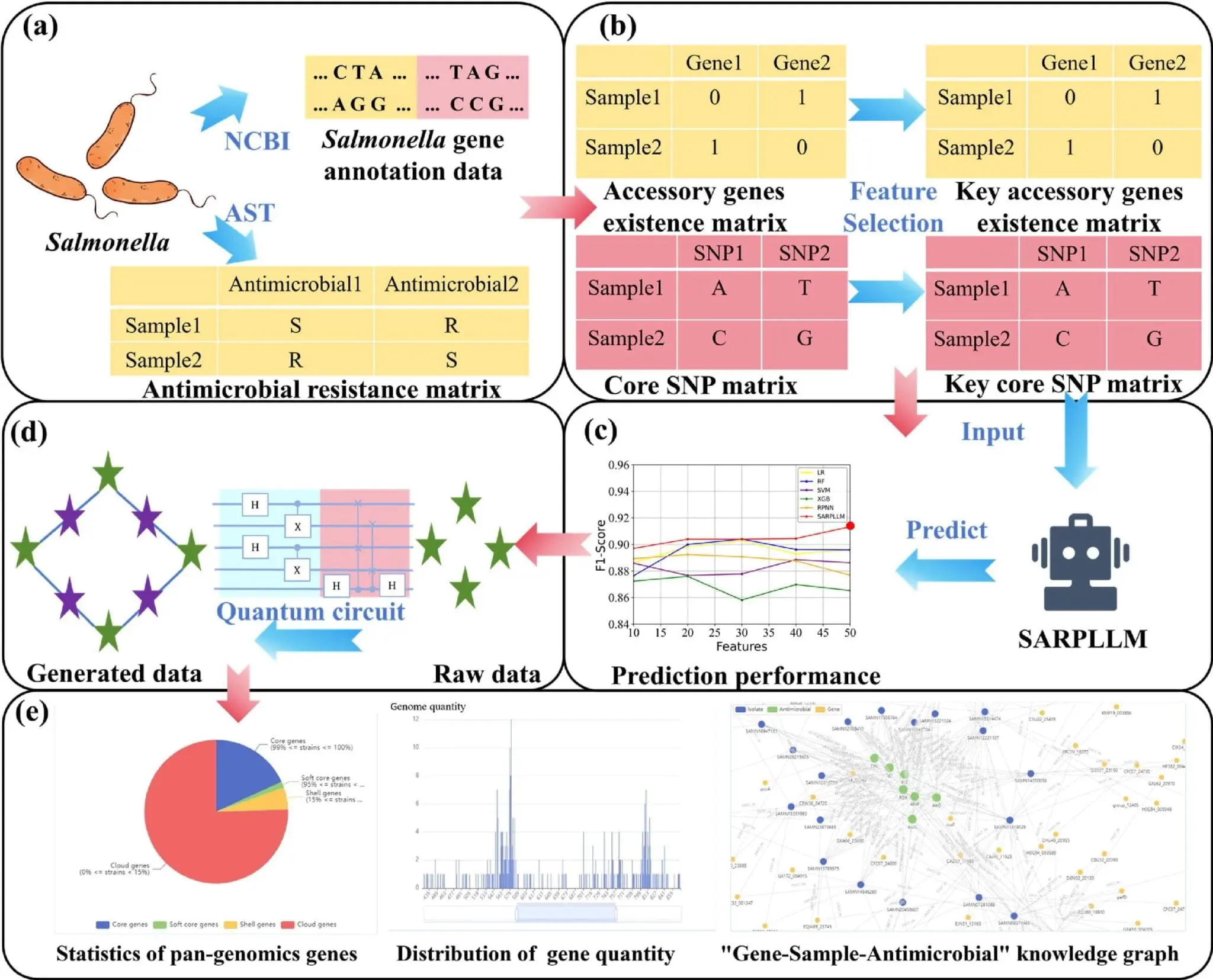
A study published in Engineering introduces a novel predictive platform developed by researchers at Sichuan University led by Le Zhang. The platform leverages artificial intelligence (AI) and quantum computing to address the growing public health concern of Salmonella antimicrobial resistance.
The platform integrates large language models (LLMs), specifically Qwen2 with low-rank adaptation (LoRA), and quantum algorithms like QSMOTEN to predict resistance more accurately and efficiently than traditional methods such as bacterial antimicrobial susceptibility tests (ASTs) or whole-genome sequencing (WGS)-based models, which often suffer from inefficiency and overfitting.
The system employs a two-step feature-selection process for identifying key Salmonella resistance genes and uses quantum computing to enhance data augmentation and reduce computational complexity. The platform also includes a user-friendly online interface with modules for resistance prediction, pan-genomics analysis, knowledge graph visualization, and data management. Experimental results demonstrate high accuracy in predicting antimicrobial resistance across multiple drugs, highlighting the potential of AI and quantum computing in advancing public health solutions.
The rise of Salmonella antimicrobial resistance poses a significant threat to public health, necessitating efficient prediction methods. Current approaches, like bacterial antimicrobial susceptibility tests (ASTs), are inefficient, while whole-genome sequencing (WGS)-based models suffer from overfitting due to their high dimensionality.
To address these challenges, researchers at Sichuan University
To address these challenges, researchers at Sichuan University developed an innovative platform integrating AI and quantum computing for Salmonella Antimicrobial Resistance Prediction. This system leverages large language models (LLMs) and quantum algorithms to enhance prediction accuracy and efficiency.
The platform employs a two-step feature selection process: first, using a chi-square test and conditional mutual information maximization to identify key resistance genes in pan-genomics analysis. This is followed by the SARPLLM algorithm, which converts Salmonella samples into textual representations. By transforming genomic data into sentences, the algorithm enables large language models to process and analyze the information effectively.
The QSMOTEN algorithm addresses sample imbalance in datasets by enhancing the SMOTE technique with quantum computing. It encodes feature data into quantum states, enabling efficient distance calculations between samples and reducing computational complexity from linear to logarithmic. This approach is particularly effective for high-dimensional genomic data, as it generates synthetic samples for the minority class (resistant cases) more effectively than classical methods.
The user-friendly online platform integrates advanced technologies such as AI and quantum computing to provide accurate predictions while maintaining an intuitive interface. It is structured around four key modules: predictive analysis, pan-genomic exploration, knowledge graph visualization, and data download. These tools streamline workflows, allowing users to analyze genomic data, explore resistance patterns, visualize relationships between genes and resistance traits, and easily access comprehensive datasets.
The platform’s backend leverages Django for robust functionality
The platform’s backend leverages Django for robust functionality and Echarts for dynamic visualizations, ensuring efficient data processing and clear communication of results. This combination of technologies not only supports efficient data processing but also facilitates clear communication of results, making it accessible to a wide range of users, from seasoned researchers to those new to genomic analysis.
By focusing on user experience and integrating cutting-edge tools, the platform aims to bridge the gap between technical complexity and practical application, providing a valuable resource in the fight against antimicrobial resistance.
External Link: Click Here For More


