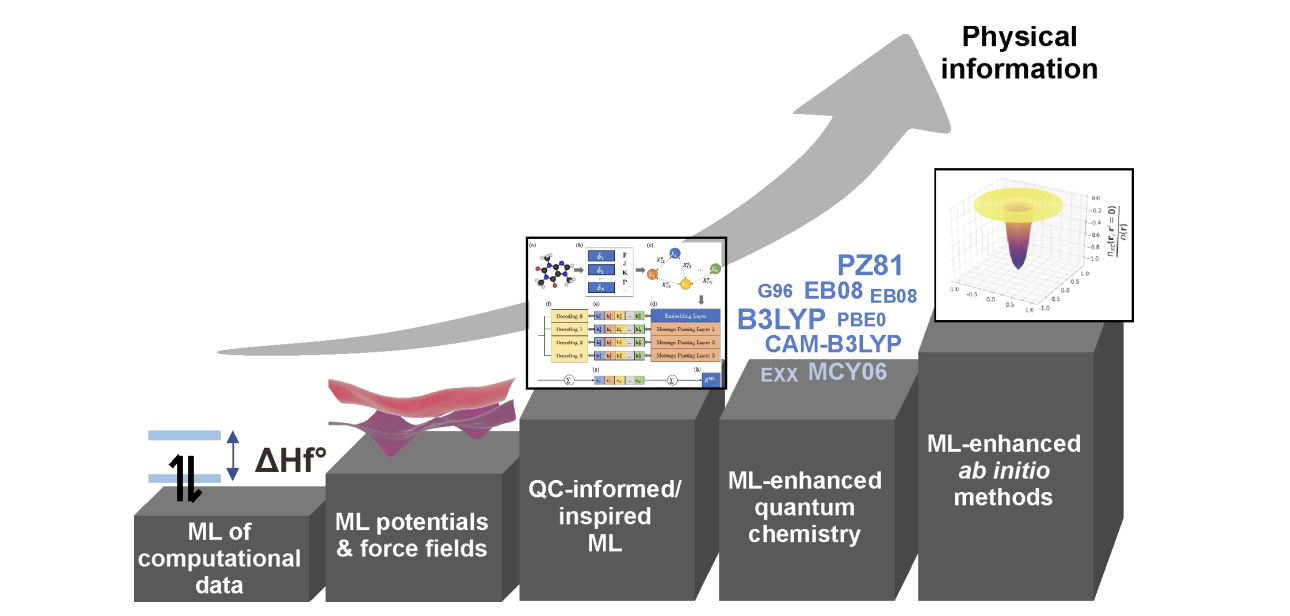
Artificial Intelligence (AI) and Machine Learning (ML) are increasingly being integrated into computational chemistry, offering solutions to scalability and accelerating the exploration of chemical space. However, challenges remain, particularly regarding the reproducibility and transferability of ML models. The goal is to develop AI architectures capable of predicting accurate and transferable solutions to the Schrödinger equation, revolutionizing in silico experiments within chemistry and materials science. Despite the challenges, the potential benefits of AI and ML for computational chemistry are clear, making this an exciting area of research with much potential for future innovation.
What is the Role of AI and Machine Learning in Computational Chemistry?
Computational chemistry is a critical tool for understanding molecules and predicting chemical properties. However, traditional computational methods face significant challenges due to the difficulty of solving the Schrödinger equations and the increasing computational cost with the size of the molecular system. In response, there has been a surge of interest in leveraging artificial intelligence (AI) and machine learning (ML) techniques to in silico experiments.
Integrating AI and ML into computational chemistry offers solutions to scalability and accelerating the exploration of chemical space. However, challenges remain, particularly regarding the reproducibility and transferability of ML models. This review highlights the evolution of ML in learning from complementing or replacing traditional computational chemistry for energy and property predictions.
Starting from models trained entirely on numerical data, a journey set forth toward the ideal model incorporating or learning the physical laws of quantum mechanics. Through a review of existing computational methods, ML models, and their intertwining, this paper also outlines a roadmap for future research, identifying areas for improvement and innovation.
How are In Silico Experiments Revolutionizing Chemical Science?
Silico experiments are nowadays essential in chemical science. Since the dawn of this discipline, theoretical and computational chemistry have sought to reproduce lab experiments or to give additional and unique insights at the atomic, nuclear, and electronic levels. Fields like materials design, drug discovery, catalysis, spectroscopy, or reaction mechanisms have been completely revolutionized by the possibility of running experiments on the computer.
Since the first accurate simulations of gas-phase small molecules, the evolution of the discipline witnessed incredible advancements, marked notably by the award of two Nobel prizes. The first in 1998 to the pioneering work on the development of computational methods, and the second in 2013 for the extensions of computational models to simulate complex biological systems. Nowadays, the widespread usage of computational chemistry in medical and materials science is possible, thanks to advances in methodological developments and computational power.
Silico experiments are based on the laws of quantum mechanics (QM). The revolutionary nature of quantum chemistry (QC) manifests in its ability to find approximate solutions to the Schrödinger equation (SE). This fundamental relation describes quantum mechanical systems such as molecules and materials. One can calculate chemical properties from these solutions, like dissociation energies and reaction rates, or predict experimental spectra and band diagrams.
What are the Limitations of Current Computational Chemistry Methods?
While the approximations developed to solve the SE may be valid for most chemical systems, they fail for the so-called strongly correlated systems, i.e., when the many-body nature of the interacting electrons cannot be simplified. Even in not-so-challenging cases, density functional theory (DFT), known as the workhorse of computational chemistry due to its unbeatable accuracy-cost ratio, can deviate significantly from experiments with errors typically in the range of 3-9 kcal/mol. These discrepancies lead to miscalculation of reaction rates by several orders of magnitude, for example, when using Marcus theory for electron transfer.
Beyond the intrinsic numerical errors of the methods, the second most significant limitation of the applicability of computational chemistry is the computational scaling, as the largest simulations with DFT are far from the size of a single protein. The accuracy and scalability issues worsen when dealing with phenomena requiring more than one single-point calculation. The explosion in the number of nuclear and electronic degrees of freedom adds limitations to the description of the time evolution of molecular systems, like in the dynamics of electronically excited states or in chemical phenomena that happen in long time scales, e.g., light emission in fluorescent materials. In these cases, solving the necessary time-dependent SE requires expensive electronic structure calculations at consecutive geometries.
What is the Future of AI and ML in Computational Chemistry?
The goal is to develop AI architectures capable of predicting accurate and transferable solutions to the Schrödinger equation, thereby revolutionizing in silico experiments within chemistry and materials science. The integration of AI and ML into computational chemistry is not without its challenges, particularly regarding the reproducibility and transferability of ML models. However, the potential benefits, such as improved scalability and accelerated exploration of chemical space, make this an exciting area of research.
The journey towards the ideal model, incorporating or learning the physical laws of quantum mechanics, is ongoing. Existing computational methods and ML models are continually being reviewed and improved upon, with a focus on identifying areas for further innovation. The future of computational chemistry lies in the successful integration of AI and ML, and the development of models that can accurately predict chemical properties and behaviors based on quantum mechanics.
How Can AI and ML Improve the Accuracy and Scalability of Computational Chemistry?
AI and ML have the potential to address some of the key limitations of current computational chemistry methods. For example, they could help to improve the accuracy of predictions by learning from the physical laws of quantum mechanics, rather than relying solely on numerical data. This could lead to more accurate predictions of chemical properties and behaviors, and potentially even the discovery of new chemical phenomena.
In terms of scalability, AI and ML could help to overcome the computational limitations of current methods. By learning from large datasets of chemical information, these models could potentially predict the properties and behaviors of complex molecular systems more efficiently than traditional methods. This could enable the simulation of larger and more complex systems, opening up new possibilities for research in fields such as materials science and drug discovery.
However, it’s important to note that the integration of AI and ML into computational chemistry is still a relatively new field, and there are many challenges to overcome. For example, the reproducibility and transferability of ML models are significant issues that need to be addressed. Despite these challenges, the potential benefits of AI and ML for computational chemistry are clear, and this is an exciting area of research with much potential for future innovation.
Publication Date: 2024-02-16
Authors: Abdulrahman Aldossary, Jorge Campos-González-Angulo, Sergio Pablo‐García, Shi Xuan Leong et al.
Source:
DOI: https://doi.org/10.26434/chemrxiv-2024-1v269