The complex magnetic behaviour of materials often holds the key to new technologies, and recent research focuses on a natural mineral called aegirine, a type of pyroxene. Oleksandr Prokhnenko from Helmholtz-Zentrum Berlin, Stanislav E. Nikitin from PSI, and Koji Kaneko, Chihiro Tabata, and Yusuke Hirose from the Japan Atomic Energy Agency, investigated the spin dynamics within this material using neutron scattering techniques. Their work confirms two distinct magnetic transitions at low temperatures and reveals a surprisingly three-dimensional magnetic interaction, challenging previous assumptions that aegirine’s magnetism was largely one-dimensional. This discovery is significant because it demonstrates the intricate interplay of magnetic forces within the mineral and necessitates a re-evaluation of how such complex materials behave, potentially influencing the design of future magnetic devices.
Magnetization and specific heat measurements, alongside single-crystal neutron diffraction maps, were taken within the temperature range of 2 and 20 K. These investigations aim to characterise the magnetic behaviour of this material and provide insight into its spin dynamics. Understanding these properties is crucial for exploring the fundamental physics of complex magnetic materials and their potential applications.
Spin Dynamics Characterisation of NaFeSi₂O₆
This research presents a comprehensive investigation into the spin dynamics of aegirine. The study focuses on understanding the magnetic excitations, or spin waves, within this material, which is crucial for understanding its combined electric and magnetic properties and potential use in advanced technologies. Detailed characterisation of spin dynamics reveals the nature of magnetic interactions and the role of low-dimensional magnetic behaviour. The material exhibits a complex magnetic structure where magnetic moments do not align in a simple, repeating pattern. Researchers mapped the spin wave spectrum, revealing the energies and momenta of these magnetic excitations using inelastic neutron scattering.
The spectrum demonstrates strong anisotropy and evidence for magnetic interactions that favour alignment along chains within the material. Analysis of the spin wave spectrum allowed the team to estimate the strength of the magnetic exchange interactions, finding both aligning and anti-aligning forces between magnetic moments. High-quality single crystals of NaFeSi₂O₆ were grown to ensure accurate neutron scattering measurements. Inelastic neutron scattering was the primary experimental technique, probing magnetic excitations by measuring the energy and momentum transfer of neutrons scattered by the sample. Sophisticated theoretical models, including linear spin wave theory, were used to analyse the neutron scattering data and extract information about the magnetic structure and exchange interactions.
A multiferroic material exhibits both ferroelectric and magnetic order. An incommensurate magnetic structure is one where magnetic moments do not repeat in a simple, periodic pattern. Spin waves, or magnons, are collective excitations of the magnetic moments in a material. Anisotropy describes the dependence of a material’s properties on the direction of measurement. Exchange interactions are the forces that align or anti-align magnetic moments. Damping is the decay of the amplitude of a wave as it propagates.
In conclusion, this research provides a significant contribution to the understanding of multiferroic materials and their potential applications. The detailed characterisation of the spin dynamics in NaFeSi₂O₆ provides valuable insights into the origin of its multiferroic properties and paves the way for the development of new and improved materials. The open data policy is a particularly commendable aspect of this work.
Aegirine Reveals Complex Magnetic Spin Excitations
Scientists have comprehensively investigated the magnetic properties of aegirine, revealing a surprising complexity in its magnetic behaviour. Through a combination of elastic and inelastic neutron scattering experiments, researchers confirmed two successive magnetic transitions occurring at 8. 8 K and 5. 8 K, and delved into the nature of the resulting spin excitations. These excitations, originating from an incommensurate magnetic order, extend up to energies of approximately 1.
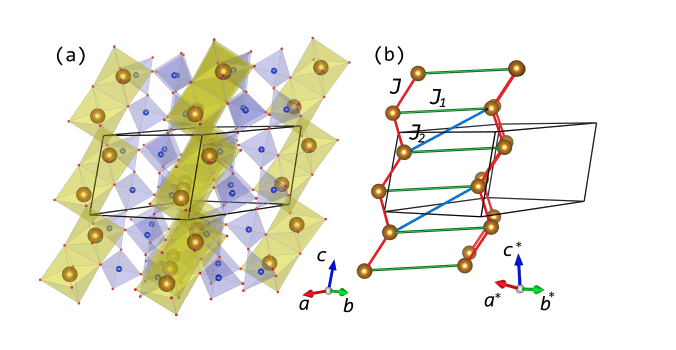
5 meV and are well-described by a linear spin-wave model. The team successfully modeled the observed magnetic behaviour using a spin Hamiltonian incorporating three key exchange interactions: an intrachain coupling of 0. 142 meV, interchain couplings of 0. 083 meV and 0. 186 meV, and an easy-plane anisotropy of 0.
020 meV. Importantly, the results demonstrate that no single interaction dominates the spin dynamics, indicating a complex interplay between these competing forces. Contrary to previous suggestions of quasi-one-dimensional magnetism, the study reveals that the interchain couplings are comparable in strength to the intrachain coupling, establishing a three-dimensional magnetic character for aegirine. This discovery challenges the long-held view of magnetism in this material and highlights the importance of a thorough microscopic analysis.
Helical Magnetism Driven by Interchain Coupling
This study provides a detailed understanding of low-energy magnetic excitations within the helical phase of aegirine. Through neutron scattering experiments and analysis, researchers successfully modeled the observed spectra and determined a consistent set of key exchange interactions that define the material’s magnetic ground state and excitations. The results demonstrate that all identified exchange interactions are antiferromagnetic, contributing to a competition that stabilizes the observed helical magnetic structure. Surprisingly, the strongest magnetic coupling connects spins between chains, while the interaction within the chains is comparatively weaker, revising previous suggestions of a quasi-one-dimensional magnetic structure.
The findings reveal that spin interactions in aegirine are inherently three-dimensional, highlighting the importance of detailed spectroscopic analysis for characterizing complex magnetic systems. Future research will focus on neutron scattering experiments conducted under applied magnetic fields to fully map the magnetic phase diagram and refine the spin Hamiltonian. The data supporting these findings are openly available for further investigation.
👉 More information
🗞 Spin dynamics in natural multiferroic pyroxene NaFeSi O
🧠 ArXiv: https://arxiv.org/abs/2509.05251