

On April 13, 2025, a collaborative research effort published the article Practical Advantage of Classical Communication in Entanglement Detection, demonstrating how one-way classical communication enhances entanglement detection beyond conventional local measurements.
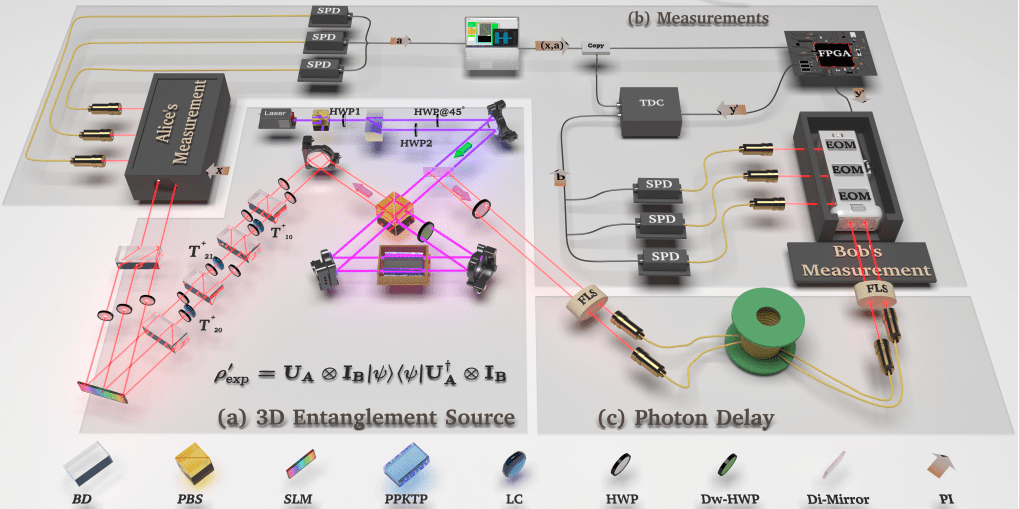
The research introduces a framework showing that one-way local operations and classical communication (1-LOCC) surpass conventional local measurements in detecting high-dimensional entanglement. By formulating entanglement detection as a semidefinite program (SDP), protocols are derived to minimize false negatives at fixed false-positive rates. A machine-learning algorithm efficiently identifies optimal states and measurements, demonstrating 1-LOCC advantages. Experimentally, a three-dimensional photonic entanglement source with fiber delays enables real-time adaptive measurements via FPGA-based sampling. Results validate the predicted 1-LOCC advantage in noisy conditions, reducing trials needed for certification and advancing scalable entanglement detection methods.
Quantum computing has long been recognized as a potential transformative technology, capable of solving complex problems that classical computers cannot. However, realizing this potential has faced significant hurdles, particularly in maintaining the stability and reliability of quantum states. Recent research has introduced an innovative approach that addresses these challenges, marking a notable advancement in the field.
A New Qubit Architecture
At the core of this innovation is a reimagined qubit architecture designed to enhance the precision and longevity of quantum computations. Traditional approaches have been hampered by high error rates due to environmental interference and decoherence. This new method utilizes trapped ions as qubits, capitalizing on their inherent stability to maintain quantum states more effectively.
By implementing advanced error correction protocols, researchers have achieved a significant reduction in computational errors. This breakthrough not only improves the accuracy of quantum operations but also extends the operational lifespan of qubits, paving the way for more reliable and scalable quantum systems.
The implications of this advancement are far-reaching. Industries such as finance, healthcare, and materials science stand to benefit significantly from the enhanced computational power and precision offered by these improved quantum systems. For example, financial institutions could employ this technology for sophisticated risk modeling, while pharmaceutical companies might accelerate drug discovery processes.
Furthermore, the scalability of this new architecture suggests that quantum computing could transition from niche applications to mainstream use in the near future. This shift would democratize access to quantum capabilities, fostering innovation across various sectors and enabling organizations to tackle previously intractable problems with greater efficiency.
While challenges remain, particularly in scaling up these systems and integrating them into existing infrastructure, this advancement represents a crucial step forward. It underscores the relentless progress being made in quantum computing, bringing us closer to realizing its transformative potential. As research continues, the promise of quantum technology grows, offering exciting possibilities for the future of computing and beyond.
👉 More information
🗞 Practical Advantage of Classical Communication in Entanglement Detection
🧠 DOI: https://doi.org/10.48550/arXiv.2504.09791


