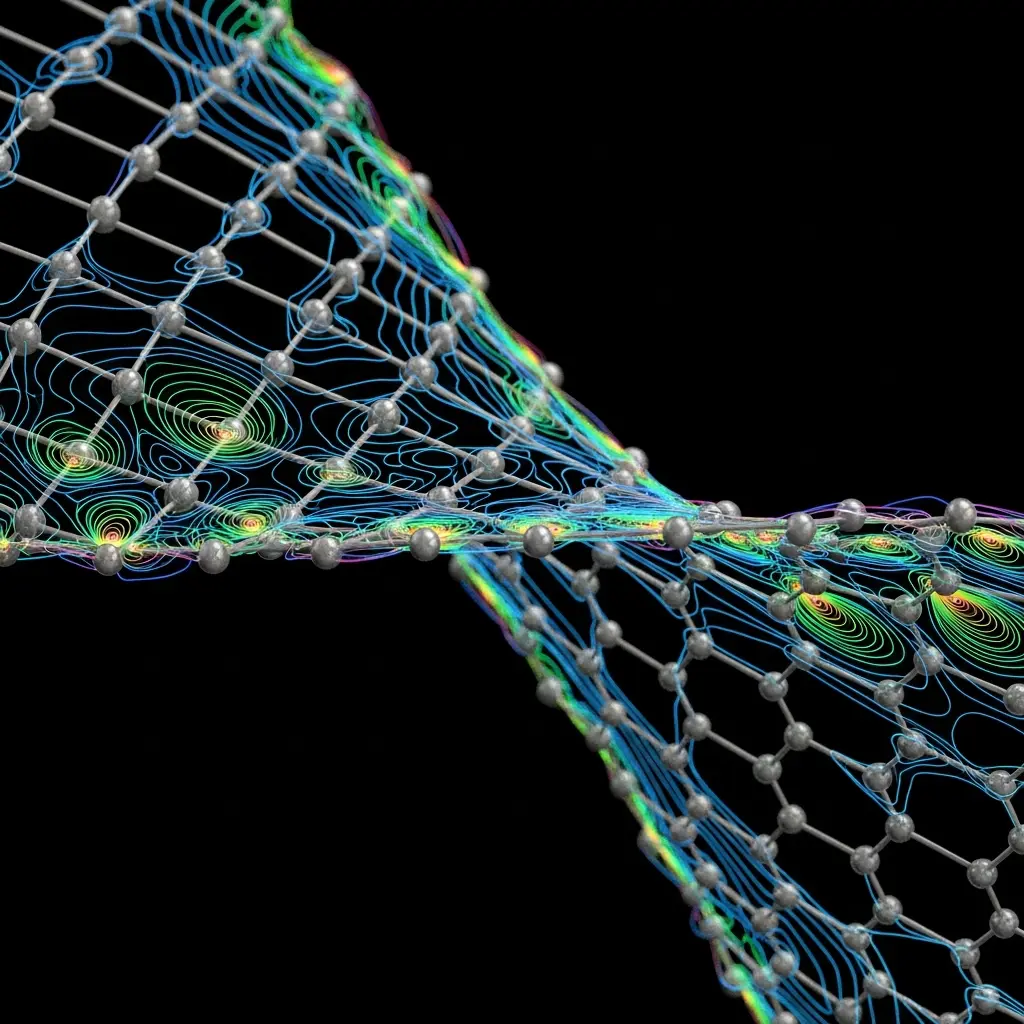
The pursuit of novel superconducting materials receives a significant boost from recent theoretical work exploring the potential of twisted graphene structures, as demonstrated by Kamalesh Bera, Tanay Nag, and Arijit Saha, from the Institute of Physics and BITS Pilani-Hyderabad Campus. Their investigation reveals how chiral topological superconductivity emerges in both twisted bilayer and double bilayer graphene, a phenomenon with potential implications for future quantum technologies. By modelling the behaviour of electrons within these uniquely structured materials, the team identifies specific conditions, relating to chemical potential, superconducting order, and twist angle, that give rise to distinct topological phases. This research not only deepens our understanding of superconductivity in twisted graphene, but also establishes a framework applicable to other multilayer materials, paving the way for the design of tunable and exotic superconducting states.
The study explores how specific arrangements of these graphene layers can give rise to this unusual state of matter, which combines superconductivity with topological properties and a preference for electrons moving in one direction. The team employed a combination of theoretical techniques to understand the interplay between electron interactions, the unique band structure of twisted graphene layers, and the resulting superconducting state. The investigation reveals that chiral edge states, characteristic of topological superconductors, appear at the boundaries of the graphene layers, offering potential for robust quantum information processing.
Twisted bilayer graphene (tBLG) and twisted double bilayer graphene (tDBLG) were investigated using a low-energy continuum model incorporating spin-triplet pairing in each graphene layer. Effective models were constructed for both tBLG and tDBLG with superconductivity, allowing exploration of the emergence of topological superconducting phases. This was achieved by varying the chemical potential, superconducting order parameter, and twist angle, followed by calculation of Chern numbers. Phase diagrams for tBLG and tDBLG, considering different stacking arrangements, reveal distinct topological transitions consistently marked by points where the energy gap closes. Further insight was gained by analysing how Chern numbers change throughout these transitions.
Twisted Graphene Reveals Unexpected Superconductivity
This research establishes a theoretical framework for understanding the emergence of chiral superconductivity in twisted bilayer and double bilayer graphene systems. By constructing a model that incorporates unconventional superconducting pairing, the team investigated the electronic band properties and topological characteristics of these materials. The analysis reveals that these systems can exhibit topological superconducting phases, marked by transitions identified through calculations of Chern numbers and the tracking of gap closings within the moiré Brillouin zone.
Furthermore, the study demonstrates a potential route to realizing effective pairing from conventional superconductivity within the layered graphene structures. By modeling the systems as stacks of graphene sheets with existing superconducting pairing, the researchers suggest that the essential components for this exotic pairing, conventional superconductivity, spin-orbit coupling, and an effective magnetic field, can be inherited and combined. This provides a pathway to engineer tunable topological superconductivity.
👉 More information
🗞 Chiral topological superconductivity in twisted bilayer and double bilayer graphene
🧠 ArXiv: https://arxiv.org/abs/2512.17380