

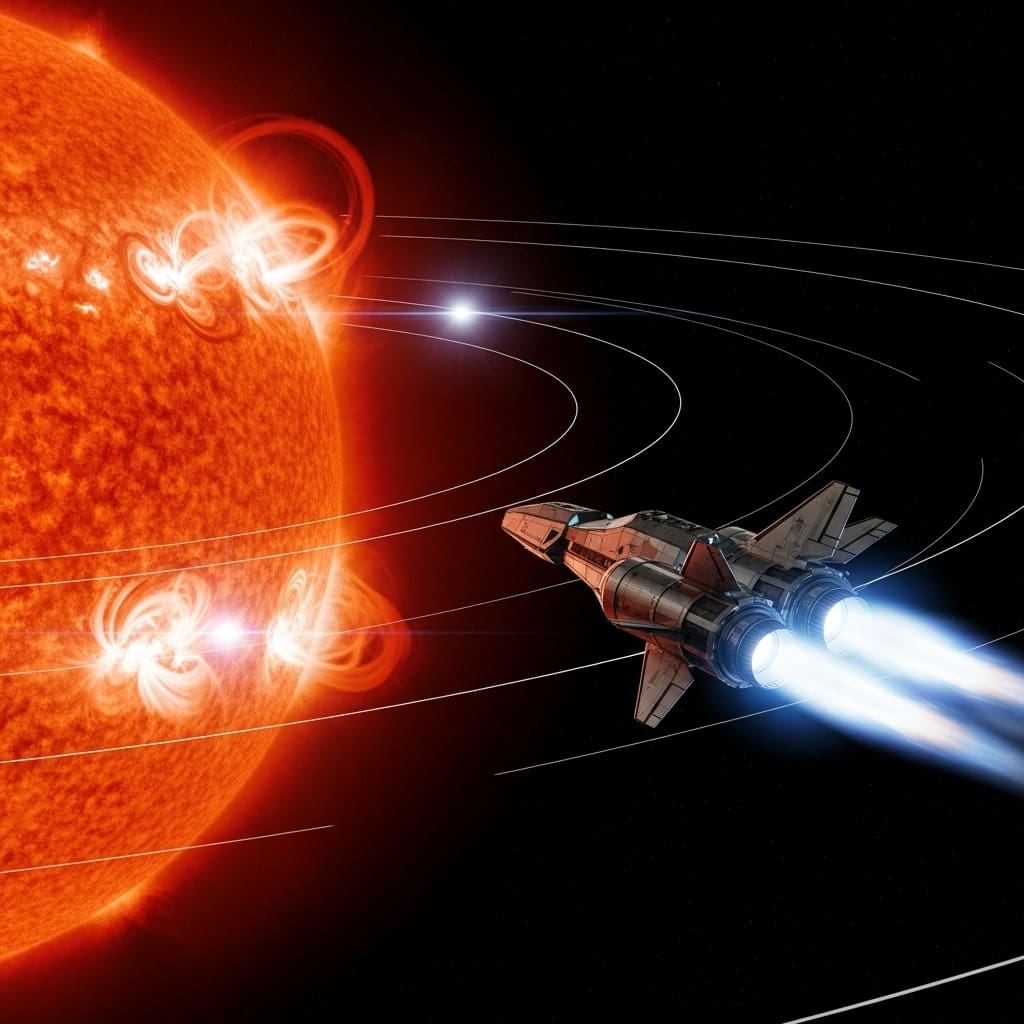
The fleeting visit of interstellar object 3I/ATLAS presents a rare opportunity to study material originating from beyond our Solar System, and researchers are now exploring ambitious methods to intercept it. Adam Hibberd of the Initiative for Interstellar Studies and T. Marshall Eubanks from Space Initiatives Inc, along with colleagues, detail a novel approach utilising the Solar Oberth Manoeuvre (SOM) for a potential mission. Their work diverges from previous studies by investigating an indirect trajectory, exploiting the Oberth Effect to rapidly accelerate a spacecraft towards the receding interstellar object. This research is significant because it demonstrates the feasibility , albeit with considerable challenges , of reaching 3I/ATLAS using currently conceivable technology, identifying 2035 as the most efficient launch window and suggesting a potential intercept within 35 to 50 years. The team’s modelling indicates that a spacecraft leveraging this manoeuvre could achieve the necessary velocity with a combination of solid propellant boosters or a refuelled Starship Block 3, opening a pathway for dedicated interstellar object exploration.
This research is significant because it demonstrates the feasibility, albeit with considerable challenges, of reaching 3I/ATLAS using currently conceivable technology, identifying 2035 as the most efficient launch window and suggesting a potential intercept within 35 to 50 years.
The team’s modelling indicates that a spacecraft leveraging this manoeuvre could achieve the necessary velocity with a combination of solid propellant boosters or a refuelled Starship Block 3, opening a pathway for dedicated interstellar object exploration. Experiments reveal that a launch in 2035 offers the most efficient transfer trajectory, requiring a SOM at 3.2 Solar Radii from the Sun’s centre, with an anticipated intercept time of 35-50 years after launch.
The study establishes that the SOM can effectively accommodate spacecraft with masses up to approximately 500kg, comparable to the New Horizons spacecraft. Calculations show that two or three solid propellant boosters could deliver the necessary delta-V (∆V) for the manoeuvre, while a refuelled Starship Block 3 launched from Low Earth Orbit (LEO) also possesses sufficient performance for the mission. Results confirm that while a SOM is inherently challenging, it presents a viable pathway given the unique orbital characteristics of 3I/ATLAS and the limitations of direct mission profiles. To solve for optimal trajectories, the research team established a system where celestial bodies define a sequence of encounter times that must be optimized to minimize total delta-V. OITS calculates connecting orbits between these bodies using the ‘Universal Variable’ formulation, solving the Lambert Problem for each segment of the trajectory.
A ‘patched conic’ simplification is applied, assuming hyperbolic excess speeds at each encounter, and a Non-Linear Problem Solver is used to refine encounter times and minimize overall delta-V while adhering to constraints. A key innovation within this work was the introduction of the ‘Intermediate Point’ concept, a strategically positioned point with a user-specified Sun-distance, whose heliocentric longitude and latitude are optimized alongside encounter times to further reduce delta-V requirements. Precise calculations of celestial body positions and velocities were achieved using the NASA JPL NAIF SPICE toolkit, downloading relevant kernels to ensure accuracy. The team employed two Non-Linear Programming solvers, NOMAD and MIDACO, to tackle the complex optimization problem.
Experiments focused on an Earth-Jupiter-SOM-3I/ATLAS trajectory (E-J-SOM-3I), strategically incorporating a Jupiter encounter to leverage its gravity and reduce the spacecraft’s tangential velocity. This allowed for a feasible low perihelion burn using chemical propulsion, a critical element for achieving the necessary acceleration. Analysis revealed that a 2035 launch permits the most efficient transfer, requiring a SOM at 3.2 Solar Radii with an intercept occurring 35-50 years later, and capable of leveraging spacecraft masses up to 17754kg. Further analysis indicates that the reference mission profile necessitates a heat shield to protect the spacecraft from intense solar flux during the low perihelion burn.
The work addresses the difficulties posed by 3I/ATLAS’s retrograde orbit and late detection, factors that previously precluded simpler direct mission approaches. Scientists achieved a detailed trajectory analysis, demonstrating how the SOM can overcome these obstacles and potentially enable a flyby mission to the interstellar object. The breakthrough delivers a detailed assessment of the mission parameters, including optimal launch windows between 2031 and 2037, and the specific requirements for propulsion systems. Measurements confirm the feasibility of utilising existing and near-future launch vehicles, such as the Starship Block 3, for such an ambitious undertaking.
This research opens possibilities for future interstellar missions, providing a framework for exploring objects originating from beyond our solar system and furthering our understanding of their composition and origins. The authors acknowledge limitations including the challenges posed by the SOM itself, specifically the need for precise trajectory control and the substantial thermal protection required. Future work could focus on refining trajectory optimisation and assessing the feasibility of in-situ resource utilisation to reduce propellant requirements for such ambitious interstellar missions.
👉 More information
🗞 Catching 3I/ATLAS Using a Solar Oberth
🧠 ArXiv: https://arxiv.org/abs/2601.02533