The challenge of moving atoms with precision underpins advances in quantum technologies, and researchers are continually seeking more efficient and robust methods for coherent atom transport. Sascha H. Hauck from Fraunhofer ITWM and the University of Kaiserslautern-Landau, along with Vladimir M. Stojanovic from the Institut für Angewandte Physik at the Technical University of Darmstadt, now demonstrate a significant step forward in this field. They achieve controlled atom movement within adaptable two-dimensional optical lattices, including structures like square, triangular, and honeycomb arrangements, by employing a technique known as shortcuts to adiabaticity. This approach allows for rapid and reliable atom transport, minimising the impact of experimental imperfections and paving the way for faster and more stable quantum information processing.
Scientists focus on designing pathways that enable rapid and coherent atom movement while maintaining high fidelity and minimising unwanted excitations. The team develops a theoretical framework based on the time-dependent Schrödinger equation and applies it to specifically engineered lattice trajectories, demonstrating that carefully crafted non-adiabatic pathways can significantly reduce transport times. Results show that these pathways achieve speeds several orders of magnitude faster than traditional adiabatic protocols without compromising the coherence of the transported wave packet.
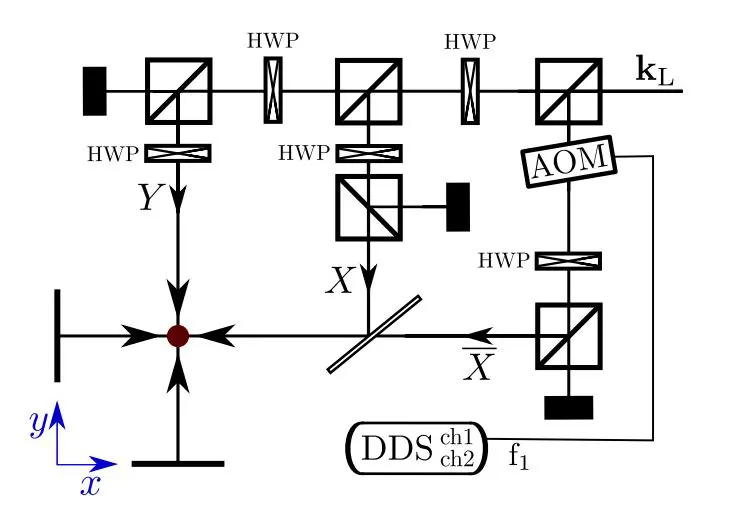
The study further explores the robustness of these accelerated transport methods against imperfections in lattice control and external disturbances, revealing a surprising degree of resilience stemming from the specific design of the lattice trajectories. These findings contribute to the development of advanced quantum technologies, particularly in areas requiring fast and reliable quantum state transfer, such as quantum computation and quantum communication. The research utilises adjustable two-dimensional optical lattices, including square, triangular, honeycomb, dimerized, and checkerboard arrangements. Scientists propose specific arrangements of acousto-optic modulators to induce a frequency imbalance between counterpropagating laser beams, creating the necessary conditions for controlled atomic movement. This frequency imbalance drives the coherent transport of atoms across the lattice structure, allowing for precise manipulation and control of their quantum states, and offering insights into the fundamental physics governing quantum systems.
Adiabaticity, Quantum Control, and Dynamics References
This extensive list of references details a comprehensive study of shortcuts to adiabaticity, quantum control, and related topics in quantum mechanics and physics. The compilation covers theoretical foundations, practical methods, and potential applications across diverse areas of quantum research. Key themes include shortcuts to adiabaticity, quantum control techniques, fundamental principles of quantum mechanics, and applications in quantum information and computation. A significant portion of the bibliography relates to experiments and theoretical work involving cold atoms, Bose-Einstein condensates, and atom chips, alongside numerical methods for solving quantum mechanical problems. Scientists successfully designed specific arrangements of acousto-optic modulators to create a moving lattice effect, enabling controlled atom movement. They then employed shortcuts to adiabaticity, a technique based on designing trajectories using a dynamical invariant, to achieve fast and efficient atom transport. Numerical simulations, using a detailed model of the optical lattice potential, confirmed the effectiveness of this approach, showing high-fidelity atom transport across a range of lattice depths and directions.
The team quantified transport efficiency using atom-transport fidelity, demonstrating that the shortcut to adiabaticity method facilitates rapid movement within the lattices. This work builds upon previous theoretical investigations by addressing the phenomenon with a full, anharmonic optical-lattice potential, increasing the relevance of the results for future experimental validation. Future research directions include experimental implementation of these control schemes and exploration of their application to collisional two-qubit entangling gates for quantum computing. This work provides a foundation for developing more sophisticated control techniques for manipulating neutral atoms in optical lattices, potentially leading to significant advances in quantum information processing.
🗞 Shortcuts to adiabaticity for coherent atom transport in an adjustable family of two-dimensional optical lattices
🧠 ArXiv: https://arxiv.org/abs/2511.10472