
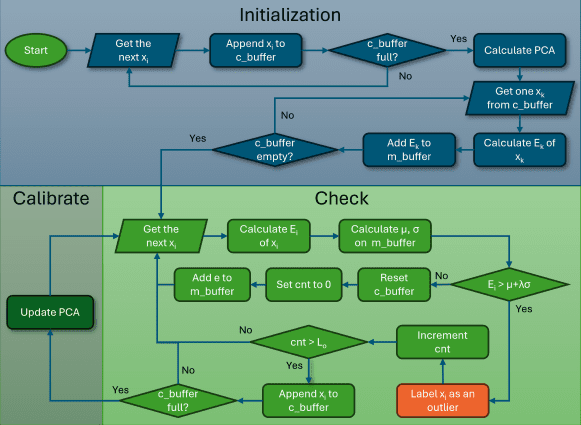
On April 22, 2025, researchers published Adaptive PCA-Based Outlier Detection for Multi-Feature Time Series in Space Missions, detailing an innovative algorithm designed to detect anomalies in space plasma events using real-time data from NASA missions like MMS and THEMIS.
The research introduces an adaptive outlier detection algorithm for real-time analysis of multi-featured time series data in space missions. Using Principal Component Analysis (PCA) with incremental updates, the algorithm dynamically adapts to evolving data distributions without requiring predefined models. A pre-scaling process normalizes feature magnitudes while preserving variance. Demonstrated on MMS mission observations and THEMIS data, the method successfully identifies space plasma events, including distinct environments, dayside/nightside transients, and transition layers, using onboard measurements.
In the realm of space exploration, missions like NASA’s THEMIS and Magnetospheric MultiScale (MMS) generate vast amounts of data daily. This deluge presents a significant challenge: identifying meaningful anomalies amidst the noise. Traditional methods often struggle with high false positive rates or require extensive computational resources. Enter adaptive Principal Component Analysis (PCA)-based outlier detection, an innovative solution designed to sift through complex plasma data efficiently.
At its core, PCA is a statistical technique that reduces data complexity by identifying patterns and structures. The adaptive version enhances this by dynamically adjusting to evolving data streams, making it ideal for real-time analysis in space missions. This method excels in distinguishing true anomalies from noise, significantly reducing false positives while maintaining computational efficiency.
The adaptive PCA method has been successfully applied to THEMIS and MMS data, aiding in the discovery of rare plasma phenomena such as dipolarization fronts and bursty bulk flows. These findings are crucial for understanding Earth’s magnetosphere and its interaction with solar winds. By automating anomaly detection, researchers can focus on interpreting results rather than sifting through raw data.
Looking ahead, this method holds promise beyond current missions. Its adaptability makes it suitable for future space exploration endeavors, where data volume and complexity are expected to grow exponentially. By enhancing our ability to detect and analyze anomalies, adaptive PCA-based detection could lead to new insights into cosmic phenomena, aiding in the development of more robust spacecraft systems.
The introduction of adaptive PCA-based outlier detection marks a significant advancement in space data analysis. It not only streamlines the process but also opens doors to previously overlooked discoveries. As missions grow more ambitious, such innovations will be pivotal in unlocking the mysteries of our universe, ensuring that every byte of data contributes meaningfully to our understanding of space. This method’s success underscores the importance of continuous innovation in data processing techniques, setting a foundation for future explorations and discoveries beyond our current comprehension.
👉 More information
🗞 Adaptive PCA-Based Outlier Detection for Multi-Feature Time Series in Space Missions
🧠 DOI: https://doi.org/10.48550/arXiv.2504.15846