X-ray absorption fine structure, a powerful technique for probing material structure, often presents challenges when interpreting complex experimental data, particularly for systems with inherent defects or surfaces. Philipp Hönicke from Helmholtz-Zentrum Berlin and Physikalisch-Technische Bundesanstalt, alongside Yves Kayser from the Max Planck Institute for Chemical Energy Conversion and Pouya Partovi-Azar from Martin Luther University Halle-Wittenberg, now present a new computational framework that accurately simulates the full X-ray absorption spectrum. Their method combines advanced theoretical approaches to capture both the near-edge and extended features of the spectrum, allowing researchers to disentangle contributions from different atomic environments within a material. By successfully applying this technique to sodium in sodium chloride, the team demonstrates its ability to predict spectra that closely match experimental results, offering a practical route to characterise materials and gain deeper insights into technologically important systems that are difficult to study through experiment alone.
Sodium Electronic Structure for Core Spectroscopy
This research details a comprehensive computational study of sodium’s electronic structure, aiming to provide accurate theoretical predictions for X-ray absorption spectroscopy (XAS) and aid in interpreting experimental data for sodium-containing materials, particularly in the context of battery research. The researchers employed Density Functional Theory (DFT) and Time-Dependent DFT (TDDFT) with a highly optimized computational setup, including specialized pseudopotentials for core-level spectroscopy and advanced exchange-correlation functionals. Large basis sets and efficient computational techniques ensured both accuracy and scalability, while a correction scheme improved the reliability of TDDFT calculations for core electronic states. The study focuses on calculating the core-level XAS spectrum of sodium at the Na K-edge, crucial for understanding the local electronic environment of sodium in various materials. Ultimately, this work provides a reliable theoretical framework for interpreting XAS data from sodium-containing materials used in battery technologies, helping researchers understand structure, bonding, and chemical behavior to improve battery performance.
Simulating XAFS Spectra with Molecular Dynamics
Researchers developed a comprehensive computational framework to accurately reproduce X-ray absorption fine structure (XAFS) through chemical simulations, addressing limitations in existing data for materials characterization. This method combines time-dependent density-functional perturbation theory with ab initio molecular dynamics to capture both the near-edge region and extended features of XAFS spectra, providing a detailed understanding of material properties at the atomic level. This approach enables precise sampling of core-excitation energies and interatomic distance distributions, crucial for interpreting the complex signals observed in extended X-ray absorption fine structure (EXAFS) analysis. The team engineered a system capable of decomposing total spectra into contributions from distinct environments, bulk, defective, and surface, commonly found within experimental materials, enhancing the accuracy of analysis.
By employing ab initio molecular dynamics, scientists accurately model the dynamic behavior of atoms and their influence on XAFS signals, overcoming challenges associated with static approximations. This computational strategy offers a practical route to generating chemically specific XAFS cross-section data for elements and species difficult to characterize experimentally, particularly relevant for advancing energy storage technologies. To demonstrate the methodology, researchers focused on sodium at the Na K-edge within NaCl, predicting spectra that show strong agreement with experimental measurements obtained from thin film samples. The approach achieves high fidelity by simulating core-level excitations and electronic transitions with atomistic accuracy, allowing for the disentanglement of overlapping spectral features and reliable assignment of specific local environments. This combined theoretical and computational strategy bridges the gap between raw experimental data and underlying microscopic processes, enabling a more robust understanding of structure-property relationships in materials science.
Simulating XAFS Spectra for Material Structure Analysis
Researchers have developed a comprehensive computational framework that accurately simulates X-ray absorption fine structure (XAFS), a technique used to probe the atomic structure of materials. This method combines time-dependent density-functional theory with ab initio molecular dynamics to model core excitations and interpret extended X-ray absorption fine structure (EXAFS) features, providing detailed insights into both the bulk and surface environments of materials. The approach successfully decomposes complex spectra into contributions from perfect crystals, defective regions, and surfaces, mirroring the conditions found in real-world experiments. The team demonstrated the framework using sodium chloride (NaCl), predicting spectra that closely match experimental measurements taken from thin film samples.
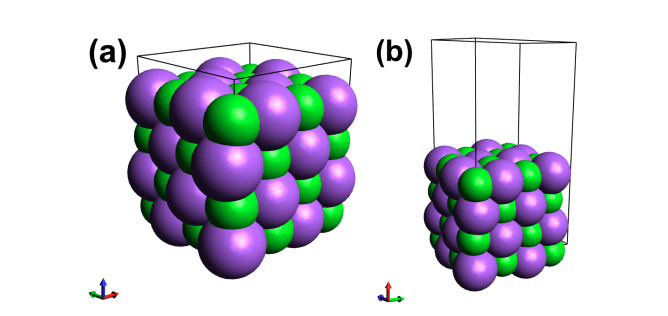
Calculations reveal how temperature affects the XAFS signal; increasing the temperature from 300K to 400K broadens the spectral peaks and reduces distinct features. Importantly, the simulations highlight significant differences between the bulk material and the NaCl (100) surface, with the surface exhibiting substantially altered resonance patterns and a stronger peak at approximately 1087 eV. To replicate the complexity of a real thin film, researchers combined the computed spectra from perfect crystals, defects, and surfaces, achieving remarkable agreement with experimental data. A linear combination, 63% perfect crystal, 26% defective crystal, and 11% surface, closely reproduces the experimental XAFS signal up to 1090 eV. Discrepancies at higher energies suggest the surface contribution may be even more significant than initially estimated. Further analysis of radial distribution functions confirms these structural differences, showing altered nearest-neighbor distances on the surface compared to the bulk material.
👉 More information
🗞 Theoretical calculation of finite-temperature X-ray absorption fine structure: application to sodium K-edge in NaCl
🧠 ArXiv: https://arxiv.org/abs/2509.02206