Understanding the behaviour of quantum systems presents a significant challenge in modern physics, and researchers continually seek more accurate computational methods to model these complex interactions. Samuel Aychet-Claisse, Denis Lacroix, Vittorio Somà, and Jing Zhang, all from institutions within Université Paris-Saclay, now present a novel strategy for simulating Green’s functions, which describe the motion of particles in these systems. Their work focuses on small superfluid systems, and importantly, demonstrates a hybrid computational approach combining classical and quantum techniques to achieve accurate results, even across the transition from normal to superfluid behaviour. This new method offers a promising pathway towards understanding the fundamental properties of these materials and could unlock further advances in areas such as condensed matter physics and materials science.
Quantum Computing, Chemistry, and Nuclear Structure
This compilation details a substantial body of research spanning quantum computing, quantum chemistry, and nuclear physics, focusing on applying quantum computational methods to solve complex problems. Key themes include finding ground states, calculating excited states, and modeling the dynamics of particles within complex structures. Researchers are actively refining the Variational Quantum Eigensolver (VQE) through adaptive methods, dynamically adjusting quantum circuits to improve performance and accuracy, and incorporating symmetries to reduce computational demands and enhance precision. The research is organized around several key areas, including quantum computing algorithms and frameworks like Qiskit, quantum chemistry applying VQE to molecular simulations, and nuclear physics exploring atomic nuclei.
Specific algorithms, such as TETRIS-ADAPT-VQE and Overlap-ADAPT-VQE, are investigated for their potential to improve simulations. The convergence of these fields is evident in the shared mathematical framework used to describe quantum systems, with VQE serving as a versatile tool applicable to both molecular systems and nuclei. Understanding many-body correlations, where particles interact, is crucial in both quantum chemistry and nuclear physics, and exploiting symmetry simplifies calculations in both fields. Quantum computers offer the potential to solve problems intractable for classical computers, demonstrating an active and evolving research area where adaptive algorithms are crucial for efficiency and symmetry exploitation reduces computational cost.
Hybrid Quantum-Classical Calculation of Many-Body Systems
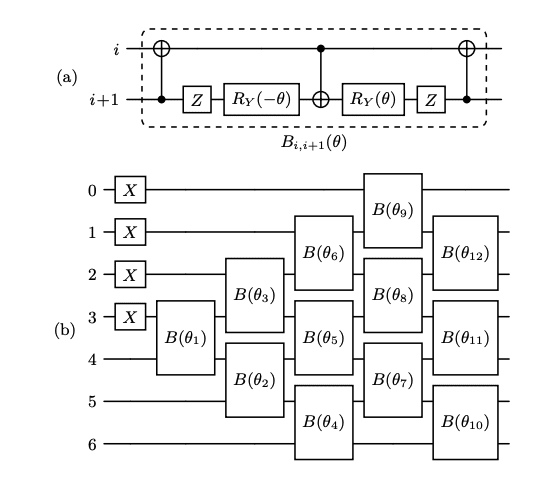
Researchers have developed a new computational strategy combining the strengths of quantum and classical computers to calculate Green’s functions, essential for understanding many-body systems. This hybrid approach assigns computationally demanding tasks to the quantum processor while leveraging classical computation for other aspects, focusing on accurately representing ground and excited states using subspace expansion. The team constructs an approximate ground state using variational techniques, then builds excited states by applying operators that change the number of particles. These states are used to solve a generalized eigenvalue problem, distributing the computational load between quantum and classical processors.
Specifically, the quantum processor calculates expectation values, while the classical processor solves the eigenvalue problem and optimizes the initial trial wave function. This division of labor allows for efficient calculation of eigenstates and their energies for systems with varying numbers of particles, providing approximations resembling techniques used in nuclear physics but adapted for the quantum computing era. This adaptation, termed Quantum Subspace Expansion, aims to mitigate the effects of noise in quantum computers, constructing an approximate Green’s function using these calculated eigenstates to study complex systems with improved accuracy. Applying this strategy to the pairing model, a simplified system used to study superfluidity, the team demonstrated its effectiveness, accurately approximating the system’s behavior across the transition from a normal state to a superfluid state.
Spectral Functions via Classical-Quantum Hybrid Methods
This work presents a new strategy for calculating Green’s functions in many-body systems, combining classical and quantum computational techniques. Researchers successfully demonstrate a method that explicitly uses the spectral representation of the Green’s function, requiring the calculation of both ground and excited states of neighboring systems. By employing variational techniques for the ground state and a subspace expansion method for excited states, they achieve accurate approximations of the one-body Green’s function across a range of parameters, including the transition between normal and superfluid phases. The resulting approach not only accurately describes the Green’s function but also provides a good description of odd-particle systems when the even-particle ground state is well-reproduced. This hybrid strategy offers a viable path toward implementing these calculations on current quantum devices, circumventing the need for extensive improvements in quantum hardware. Further refinement of variational trial wave functions could improve results, and future work may focus on optimizing these methods and exploring the application of this hybrid approach to more complex systems.
👉 More information
🗞 Quantum simulations of Green’s functions for small superfluid systems
🧠 ArXiv: https://arxiv.org/abs/2509.02272