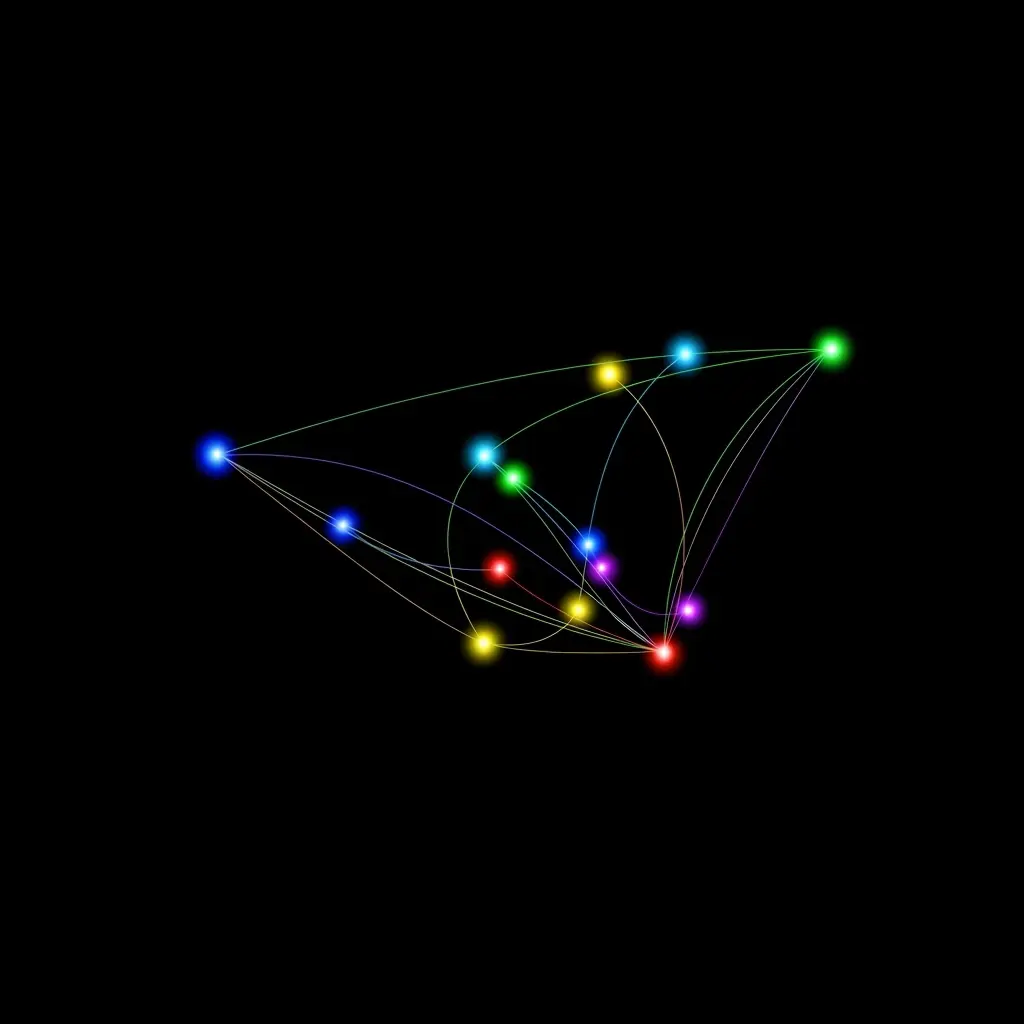
Scientists are continually refining our understanding of confinement in Yang-Mills theory, a fundamental problem in particle physics. Xavier Crean from Swansea University, Jeffrey Giansiracusa from Durham University, and Biagio Lucini from Queen Mary University of London, et al., present a new observable, termed the ‘simplicity’, that characterises the topology of Abelian monopole currents within the Maximal Abelian Projection of SU(3) Yang-Mills theory. Their numerical study, utilising Lattice Gauge Theories, demonstrates that this simplicity observable allows for a more precise determination of the deconfinement temperature than conventional methods with comparable computational effort. These findings suggest a strong link between Abelian current loops and the underlying degrees of freedom responsible for confinement, potentially paving the way for a novel order parameter to explore the complex phase structure of Chromodynamics.
Topological complexity of magnetic monopoles reveals quark-gluon plasma transition
A Novel Observable for Quark Deconfinement
Scientists have developed a new method for pinpointing the precise temperature at which quarks and gluons transition from being confined within particles to existing as a plasma. This breakthrough centres on a novel observable, termed the ‘simplicity’, which quantifies the topological complexity of magnetic monopole currents within the framework of SU Yang-Mills theory.
The simplicity is mathematically defined as the ratio between the zeroth and first Betti numbers of the current graph, effectively capturing the loop structure of these currents. The work leverages Topological Data Analysis, a robust methodology for characterising the shape of discrete data, to expose the topological features of monopole excitations more clearly than prior approaches.
By applying this technique, researchers have overcome challenges associated with lattice discretisation, which often obscures the underlying topological properties. The study’s findings open avenues for defining a new order parameter for deconfinement in Quantum Chromodynamics, potentially revealing a richer phase structure than currently understood.
This new order parameter, derived from magnetic monopole currents, remains consistent even when incorporating dynamical fermions, enhancing its applicability to more complex QCD calculations. Numerical simulations confirm that the simplicity observable accurately determines both the critical coupling value and the order of the phase transition in the pure gauge system, providing compelling evidence for the relevance of Abelian monopoles in the deconfinement process. Calculating these Betti numbers involves analysing the connectivity of the current graph, effectively mapping the topological features of the monopole currents.
Achieving Precise Critical Temperature Calculations
To determine the deconfinement temperature, simulations were performed on lattices with varying sizes and coupling constants. The expectation value of the simplicity was then computed for each configuration, allowing for a precise determination of the critical temperature with improved accuracy compared to conventional methods at a comparable computational effort. This simplicity is defined as the ratio of the zeroth to the first Betti number of the current graph for a given field configuration, providing a quantitative measure of topological characteristics.
A numerical study utilising Lattice Gauge Theories demonstrates the ability to determine the deconfinement temperature with increased accuracy compared to conventional methods, achieved with comparable computational effort. This work proposes a novel order parameter for deconfinement in Quantum Chromodynamics, potentially exposing a richer phase structure than previously understood.
Technical Basis: Lattice Gauge Theory Formalism
The study employed the SU lattice gauge theory described by the Wilson action, with the action defined as β multiplied by the sum over all plaquettes of one minus the real part of the trace of the plaquette variable. Calculations were performed on a four-dimensional Euclidean lattice of dimension Nt × Ns³, utilising periodic boundary conditions in all directions.
The temperature of the system is determined by the inverse of the lattice spacing multiplied by Nt, with the lattice spacing decreasing as the coupling β increases. This observable is defined as the ratio between the zeroth and first Betti numbers of the current graph for a given field configuration, providing a novel method for analysing the behaviour of these currents.
Numerical investigations using Lattice Gauge Theory demonstrate that the expectation value of the simplicity allows for a more precise determination of the deconfinement temperature compared to conventional techniques, achieving this with comparable computational effort. These findings suggest a strong correlation between Abelian current loops and the degrees of freedom governing confinement within the theory.
The simplicity observable offers a potential order parameter for deconfinement in Chromodynamics, potentially revealing a richer phase structure than previously understood. The authors acknowledge limitations in extrapolating results to the thermodynamic limit, a standard challenge in Lattice Gauge Theory, and note the computational expense involved in achieving high accuracy. Future research could explore the behaviour of the simplicity in the presence of dynamical fermions and investigate potential non-monotonic structures in its susceptibility, which may indicate novel intermediate-temperature behaviour in Quantum Chromodynamics.
🗞 Simplicity of confinement in SU(3) Yang-Mills theory
🧠 ArXiv: https://arxiv.org/abs/2602.10088