Estimating motion between image frames, a fundamental problem in computer vision, receives fresh attention from Haytham Ziani of Al Akhawayn University, and colleagues. This research thoroughly investigates both local and global methods for calculating optical flow, the pattern of apparent motion of objects in a visual scene, with a particular focus on refining the established Horn-Schunck algorithm. The team implements a novel multiresolution approach, incorporating bilinear interpolation techniques, to significantly enhance the accuracy and speed of motion estimation, even in challenging image conditions. This work represents a substantial advance in the field, promising improvements in applications ranging from robotics and autonomous navigation to video analysis and surveillance systems.
The core argument is that combining local and global methods is crucial for robust and accurate optical flow estimation. Local methods, like Lucas-Kanade, efficiently estimate motion in textured regions but struggle with large displacements and textureless areas. Global methods, such as Horn-Schunck, address these limitations by enforcing spatial coherence, though they can be limited by motion boundaries and large displacements.
A multiresolution framework, incorporating bilinear interpolation, significantly improves Horn-Schunck’s performance, especially when handling complex motion and ensuring smooth transitions across scales. Optical flow represents the apparent motion of image objects between consecutive frames, effectively mapping the velocity field of moving objects. The multiresolution framework refines flow estimates at multiple scales using image pyramids, improving robustness and accuracy by avoiding local minima and handling large displacements effectively. Bilinear interpolation upsamples flow vectors and warps images between pyramid levels, ensuring smoothness and subpixel accuracy.
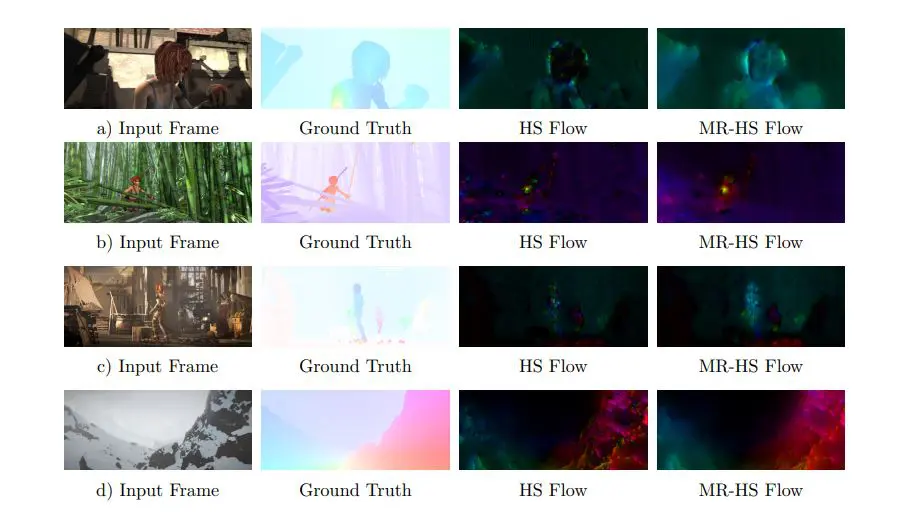
Performance is evaluated using Average Angular Error (AAE), which measures the angular difference between estimated and ground truth flow, and End-Point Error (EPE), which quantifies the Euclidean distance between estimated and ground truth flow vectors, using the Sintel dataset as a benchmark. Results demonstrate that the multiresolution Horn-Schunck (MR-HS) method consistently outperforms the original Horn-Schunck (HS) algorithm on the Sintel dataset. MR-HS achieves lower AAE and EPE values, indicating more accurate motion estimation. Combining local and global methods is essential for robust and accurate optical flow estimation. This work demonstrates that a well-designed multiresolution framework, leveraging the strengths of both local and global methods and incorporating techniques like bilinear interpolation, is a powerful approach for achieving robust and accurate optical flow estimation in challenging scenarios.
Multiresolution Optical Flow with Least Squares Estimation
Scientists conducted a comprehensive analysis of optical flow computation, investigating both local and global methods to estimate motion between image frames. The widely used Lucas-Kanade algorithm, a local technique, was rigorously examined by applying the optical flow constraint equation over small image neighborhoods. Researchers formulated an overdetermined system of equations, where image gradients define a matrix and temporal gradients represent a vector, allowing flow vector estimation using a least-squares solution. This approach ensures stability when local image patches exhibit sufficient intensity variation and strong structure.
To address limitations of sparse methods, the team engineered a multiresolution Horn-Schunck implementation, a dense method that incorporates a regularization term to improve accuracy and handle large displacements. This approach utilizes a pyramidal framework, processing images at multiple scales to refine motion estimates. Scientists employed bilinear interpolation and prolongation techniques between pyramid levels, enhancing both accuracy and computational efficiency. The method iteratively refines the flow field, minimizing an energy function that balances data fidelity, ensuring consistency with image brightness, and smoothness, promoting realistic motion.
Researchers meticulously tested the combined strategies under varying image conditions, demonstrating the effectiveness of the multiresolution Horn-Schunck framework in estimating dense motion fields. The study highlights the benefits of combining local and global approaches, leveraging the speed of sparse methods with the accuracy and robustness of dense techniques. This innovative methodology provides a robust solution for applications requiring precise motion estimation, such as object tracking, video compression, and autonomous navigation.
Multiresolution Horn-Schunck Improves Optical Flow Accuracy
This work presents a detailed analysis of optical flow estimation, focusing on the Horn-Schunck algorithm and a multiresolution extension designed to improve its accuracy. Researchers explored both local methods, such as Lucas-Kanade, and global techniques like Horn-Schunck, demonstrating how combining these approaches enhances motion estimation. The team implemented a multiresolution Horn-Schunck method, utilizing bilinear interpolation and pyramid levels to refine accuracy and convergence, particularly in challenging image conditions. Experiments were conducted using the MPI Sintel dataset, a benchmark for optical flow evaluation featuring complex scenes with large displacements, occlusions, and varying illumination.
The team rigorously tested both the standard Horn-Schunck and the multiresolution version across several Sintel scenes, measuring performance using the Average Angular Error (AAE) and the End-Point Error (EPE). Results demonstrate a clear improvement with the multiresolution approach, consistently reducing both AAE and EPE across all tested scenes. Specifically, on the ‘Alley 1’ scene, the multiresolution Horn-Schunck achieved an AAE of 6. 61 degrees and an EPE of 1. 81 pixels, compared to 12.
46 degrees and 2. 62 pixels for the standard Horn-Schunck. Similar improvements were observed in other scenes, including ‘Bamboo 2’ (8. 81 degrees/1. 17 pixels versus 10.
83 degrees/1. 68 pixels), ‘Market 2’ (15. 31 degrees/0. 41 pixels versus 19. 08 degrees/0.
47 pixels), and ‘Mountain 1’ (15. 28 degrees/2. 78 pixels versus 17. 13 degrees/3. 90 pixels).
Averaging across all scenes, the multiresolution method achieved an AAE of 11. 50 degrees and an EPE of 1. 54 pixels, significantly lower than the 14. 88 degrees and 2. 17 pixels achieved by the standard Horn-Schunck algorithm. These measurements confirm that the multiresolution approach, with its coarse-to-fine strategy and pyramid-based initialization, effectively avoids local minima and enhances convergence stability, delivering more accurate motion estimation, particularly in scenes with complex textures or large displacements. This work establishes the importance of combining local and global methods, and utilizing multiresolution frameworks to address diverse motion patterns in dynamic environments.
Multiresolution Optical Flow Estimation Improves Accuracy
This research presents a detailed analysis of techniques for estimating optical flow, the pattern of apparent motion in visual scenes. The team investigated both local methods, such as the Lucas-Kanade technique, and global approaches like the Horn-Schunck algorithm, revealing the strengths and limitations of each. While local methods excel at efficiently estimating motion in textured areas, they struggle with large displacements and lack detail in uniform regions. The Horn-Schunck algorithm, which enforces spatial coherence, addresses these issues but can be challenged by motion boundaries and large displacements.
🗞 Investigating Optical Flow Computation: From Local Methods to a Multiresolution Horn-Schunck Implementation with Bilinear Interpolation
🧠 ArXiv: https://arxiv.org/abs/2511.16535