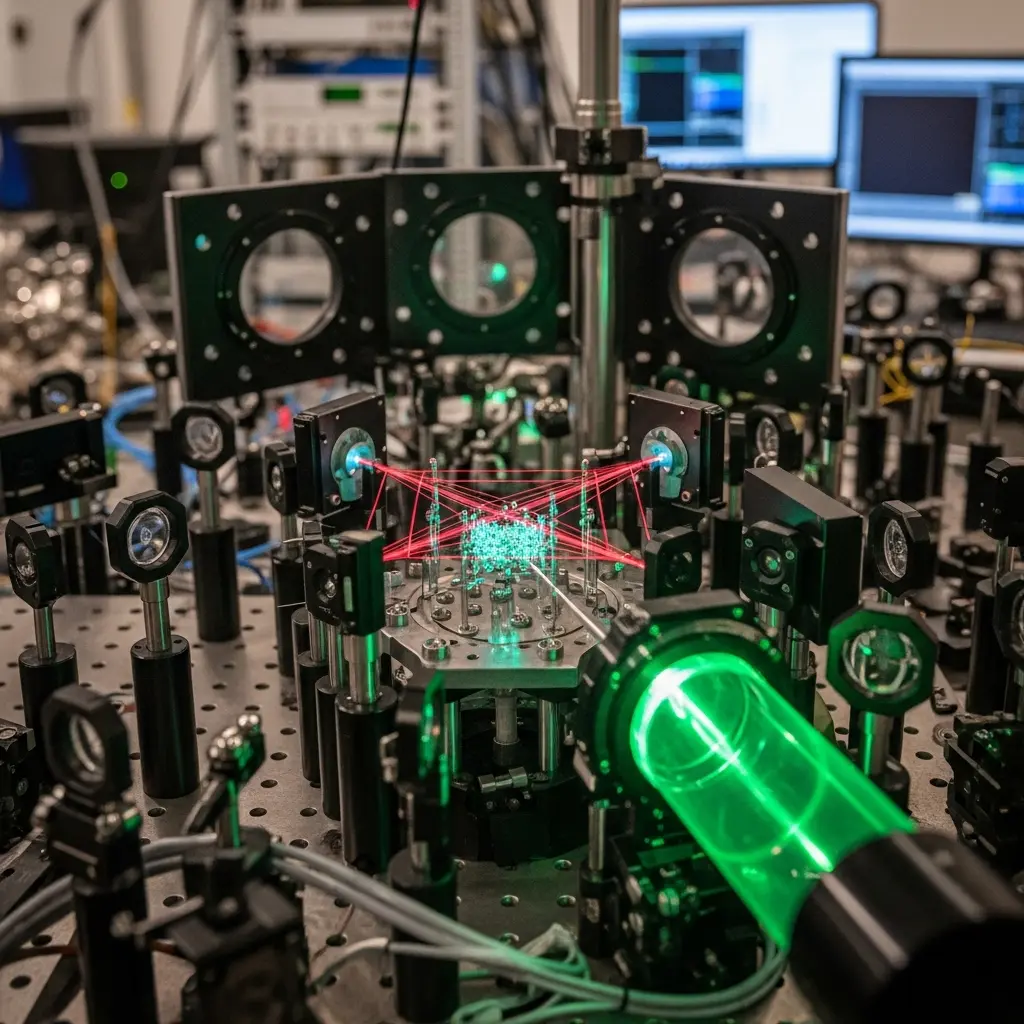
The pursuit of increasingly precise atomic clocks drives advances in fundamental physics and underpins technologies like GPS, and recent research focuses on refining our understanding of strontium’s potential in these devices. Palki Gakkhar from the Indian Institute of Technology, along with colleagues D Angom and B K Mani, performs highly accurate calculations on strontium isotopes to predict key properties for clock development. Their work employs a sophisticated theoretical approach, incorporating relativistic and quantum electrodynamical effects, to determine excitation energies, transition probabilities, and isotope shifts with unprecedented precision. These calculations not only agree well with existing experimental data but also refine previous theoretical predictions, offering crucial insights for optimising strontium-based atomic clocks and pushing the boundaries of timekeeping accuracy.
Scientists have computed the excitation energies for several low-lying states of strontium, alongside the amplitudes for electric dipole and magnetic dipole transitions, hyperfine structure details, and isotope shifts, using a highly accurate theoretical method called Fully Relativistic Second-order Coupled-Cluster theory. These calculations, which incorporate relativistic and quantum electrodynamical effects, and perturbative triples, provide a comprehensive understanding of strontium’s atomic structure and are essential for developing next-generation optical atomic clocks. The team also employed perturbed relativistic coupled-cluster theory to compute the ground state electric dipole polarizability of strontium, achieving results consistent with experimental measurements.
Strontium Isotope Shifts and Atomic Structure
A comprehensive body of research focuses on strontium, investigating its atomic properties, spectroscopy, and theoretical calculations. Core areas of research include precise measurements and calculations of energy levels, transition frequencies, and isotope shifts in strontium, utilising techniques like laser spectroscopy and resonance ionization spectroscopy. Researchers investigate key properties such as energy levels, transition frequencies, isotope shifts, nuclear charge radii, dipole polarizabilities, and van der Waals coefficients, incorporating relativistic corrections, electron correlation effects, and quantum electrodynamic effects.
Strontium Clock Transition Properties Calculated with High Accuracy
Scientists have achieved highly accurate calculations of the clock transition properties of strontium, a leading candidate for next-generation optical atomic clocks. The work employs an all-particle multireference Fock-space relativistic coupled-cluster theory to investigate both fermionic and bosonic isotopes of strontium, focusing on the 5s² ¹S₀, 5s5p ³P₀ clock transition. Calculations encompass excitation energies, electric dipole and magnetic dipole transition amplitudes, hyperfine structure details, and isotope shifts, providing a comprehensive understanding of strontium’s atomic structure. The computed excitation energies align well with existing experimental data for low-lying excited states.
Results for electric dipole, magnetic dipole, and hyperfine structure reduced matrix elements fall within experimental error bars, demonstrating improved accuracy over previous calculations due to a more precise treatment of electron correlations. Crucially, the computed lifetime of the clock state for ⁸⁷Sr matches available experimental results, while the calculated lifetime for ⁸⁸Sr differs significantly from prior calculations, suggesting a need for further experimental validation. These calculations advance the development of strontium-based optical clocks, promising enhanced precision for applications ranging from fundamental physics tests to advanced technologies like geodesy and quantum computing.
Strontium Clock Transition Properties Calculated Accurately
Researchers employed a sophisticated theoretical approach, all-particle multireference Fock-space relativistic coupled-cluster theory, to compute excitation energies, transition amplitudes, hyperfine structures, and isotope shifts for both fermionic and bosonic isotopes of strontium. These calculations incorporated relativistic and electrodynamical effects, alongside perturbative triples, to achieve a high level of accuracy. The computed excitation energies align well with existing experimental data, and the calculated transition matrix elements and lifetimes of the clock states demonstrate consistency with previous theoretical work, while benefiting from a more detailed treatment of electron correlations. Notably, the calculated lifetime for one isotope of strontium differs significantly from previous model potential calculations, suggesting a need for further experimental validation.
The team also calculated isotope shift parameters and the ground state electric dipole polarizability, finding agreement with experimental results and differences from other theoretical approaches, attributable to improved correlation modelling. Researchers acknowledge limitations in the precision of current experimental data, which impacts the ability to fully validate their results. Future work could focus on refining these calculations further and comparing them with more precise experimental measurements, ultimately contributing to the development of even more accurate atomic clocks and a deeper understanding of atomic structure.
🗞 FSRCC two-valence calculations of clock transition properties, dipole polarizability and isotope shifts in Fermionic and Bosonic Sr
🧠 ArXiv: https://arxiv.org/abs/2510.15592