The elusive binding energy of the deuteron, a key component of atomic nuclei, receives fresh scrutiny in new research that harnesses the power of quantum computing. Sreelekshmi Pillai, S. Ramanan, V. Balakrishnan, and S. Lakshmibala, from the Indian Institute of Technology Madras, demonstrate a method for estimating this fundamental property using quantum algorithms and realistic nuclear interactions. Their approach employs a quantum simulator to calculate the binding energy, and importantly, reveals that the computational demands of the calculation decrease as the complexity of the nuclear interaction is reduced, paving the way for more efficient quantum simulations of increasingly complex nuclei. This work represents a significant step towards understanding nuclear forces and validating quantum computing techniques for tackling problems in nuclear physics, potentially unlocking new insights into the building blocks of matter.
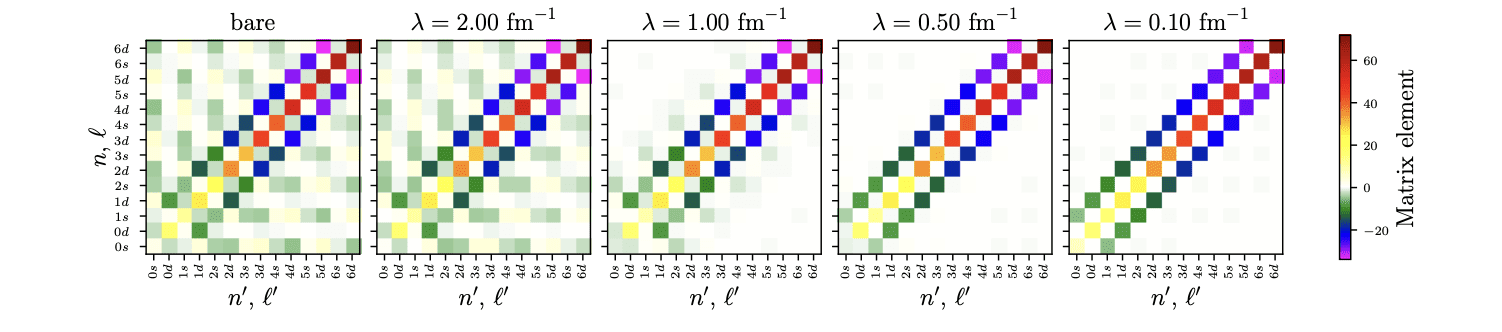
The research investigates the application of the variational quantum eigensolver (VQE) to renormalization group (RG)-based low-momentum effective interactions. Binding energy calculations are performed within a truncated harmonic oscillator (HO) basis, utilising the Qiskit-Aer simulator under both noise-free and noisy conditions, with noise models derived from actual IBM quantum hardware, and the resulting data are extrapolated to the zero noise limit. The findings demonstrate that the number of HO basis states required to achieve a binding energy within 1 percent of the experimental value decreases as the RG parameter λ diminishes, and the study examines the relationship between entanglement between oscillator modes and the value of λ.
Ab Initio Calculations of Nuclear Properties
This research focuses on solving the complex many-body problem of describing the nucleus, aiming to predict its properties directly from the fundamental interactions between protons and neutrons. Scientists employ ab initio methods, performing calculations from first principles without relying on approximations or empirical data, utilising techniques like chiral effective field theory and sophisticated many-body methods such as coupled cluster and no-core shell model theories. Researchers also utilise the in-medium similarity renormalization group to simplify calculations by reducing the complexity of the nuclear system. The primary goals are to accurately predict nuclear properties such as energy levels and radii, gain insights into the arrangement of nucleons within the nucleus, and model nuclear reactions and the behaviour of neutron matter.
However, classical computers struggle with these calculations for even moderately sized nuclei, motivating the exploration of quantum computing as a potential solution, with quantum algorithms like the variational quantum eigensolver and quantum phase estimation offering promising avenues for tackling these computationally intensive problems. Researchers are developing hybrid quantum-classical approaches, combining the strengths of both types of computers, often using the quantum computer to perform demanding calculations while the classical computer handles the remaining tasks. Crucially, the team is also investigating quantum error mitigation techniques to reduce the impact of noise and errors inherent in quantum computers, employing techniques like Trotterization and Hamiltonian simulation, building on classical methods like density matrix renormalization group and configuration interaction theory. Significant challenges remain, including scaling up quantum computers to handle realistic nuclear physics problems, overcoming the effects of noise, and developing efficient quantum algorithms. The research team calculated this energy within a truncated harmonic oscillator (HO) basis, employing both noise-free and noisy simulations using the Qiskit-Aer simulator, with noise models derived from actual IBM quantum hardware. Results demonstrate that the number of HO basis states required to achieve a binding energy within 1 percent of the experimental value decreases as the renormalization group (RG) parameter λ is reduced. Experiments revealed a clear connection between the RG parameter and the computational resources needed; lower values of λ correlate with a reduced requirement for basis states.
The team investigated the extent of entanglement between oscillator modes as a function of λ, providing insights into the relationship between RG evolution and qubit requirements on the quantum computing platform. Measurements confirm that the binding energy was calculated with high precision, aligning with the experimentally determined value of -2. 225 MeV. This work explores how the numerical advantages gained through RG-based interactions on classical machines translate to the quantum realm. Investigations into mode entanglement provide crucial links between single-particle states, efficient qubit mappings, and optimized resource allocation for complex nuclear simulations, demonstrating the potential of quantum computing to address computationally intensive problems in nuclear structure calculations, potentially outperforming classical approaches even with current, near-term quantum devices.
Deuteron Binding Energy via Quantum Simulation
This research demonstrates the feasibility of simulating the binding energy of the deuteron, a nucleus consisting of one proton and one neutron, using quantum computation techniques. Calculations were performed using a variational eigensolver and low-momentum interactions to simplify the computational challenge. The results indicate that the number of computational resources needed to achieve accurate results decreases as the strength of the nuclear interaction is reduced, suggesting a pathway towards more efficient simulations. Furthermore, the study analysed entanglement between oscillator modes within the deuteron, revealing that as the interaction strength decreases, entanglement becomes concentrated in the lowest energy modes, providing insight into the internal structure of the deuteron and how its properties emerge from the underlying quantum interactions. The team acknowledges that the accuracy of the simulations is dependent on the truncation of the harmonic oscillator basis and the extrapolation to the zero-noise limit, representing inherent limitations in the computational approach. Future work could focus on refining the extrapolation techniques and exploring more sophisticated methods for mitigating the effects of noise in quantum computations, enabling the simulation of larger and more complex nuclei, furthering our understanding of nuclear structure and interactions, and contributing to the growing field of quantum nuclear physics.
👉 More information
🗞 Estimation of deuteron binding energy using Qiskit with renormalization group-based effective interactions
🧠 ArXiv: https://arxiv.org/abs/2509.08948