

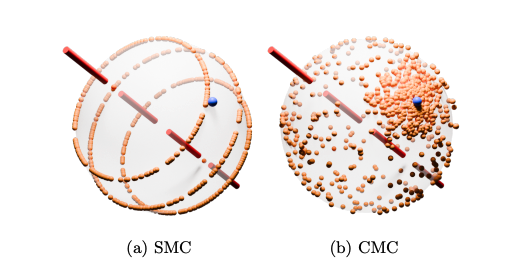
Understanding the electrical resistivity of magnetic materials remains a significant challenge in physics, despite qualitative insights into the role of temperature-induced disorder. Fabian Engelke and Christian Heiliger, from the Institute for Theoretical Physics and Center for Materials Research at Justus Liebig University Giessen, and their colleagues, now present a new approach to accurately model this complex behaviour. Their work combines first-principles transport calculations with detailed atomistic modelling of temperature-dependent spin disorder, crucially incorporating mechanical effects via a local quantization of the Heisenberg model. This refined method, demonstrated using iron, substantially improves the prediction of spin-disorder contributions to electrical resistivity, and importantly, allows researchers to study magnetic behaviour both near and above the Curie temperature, a regime where previous theoretical models have consistently fallen short.
Temperature-induced lattice and spin disorder determines the temperature dependence of resistivity. Prior publications achieve good agreement with experiment using computational methods for non-magnetic materials, where the influence of magnetic disorder is minimal. However, accurately describing magnetic materials remains a challenge, stemming from difficulties in modelling temperature-dependent spin disorder. This work presents a combined approach, integrating calculations of electron transport with atomistic modelling of how magnetic disorder evolves with temperature, offering a new method for understanding and predicting the behaviour of magnetic materials at varying temperatures.
Spin Disorder Resistivity From First Principles
The primary focus of this research is understanding and modelling the electrical resistivity in ferromagnetic materials caused by the random arrangement of atomic magnetic moments, known as spin disorder. This is particularly important at temperatures near and above the Curie temperature, where the material loses its spontaneous magnetization. The research utilizes calculations based on the fundamental laws of quantum mechanics, combined with advanced techniques to predict material properties without relying heavily on empirical data. Accurately modelling spin disorder and its impact on resistivity is computationally demanding, as it requires capturing the complex interplay between electronic structure, magnetic fluctuations, and scattering processes.
The team employs calculations of electronic structure alongside a disordered local moment approach to represent the disordered magnetic moments. An alloy analogy model simplifies the calculations by treating the disordered magnetic moments as a random alloy, and the Kubo-Greenwood formula calculates electrical conductivity from the current-current correlation function. Monte Carlo simulations generate configurations of disordered magnetic moments and average over different configurations, with a rescaled Monte Carlo technique improving simulation efficiency. Non-Equilibrium Green’s Function calculations are used for calculating transport properties.
The authors propose a novel approach combining a semiclassical Heisenberg model, describing the magnetic moments, with local quantization. This aims to provide a more accurate and efficient way to model magnetic fluctuations and their effect on resistivity. The combination of semiclassical and quantum approaches better captures the complex interplay between magnetic order and disorder, and the calculated resistivities are validated against experimental data for iron, nickel, and potentially other materials. The model accurately predicts the temperature dependence of resistivity, including behaviour near the Curie temperature, and explores the use of a quantum heat bath to model thermal fluctuations on the magnetic moments.
This research has potential implications for materials design, aiding in the creation of new materials for spintronic devices, magnetic sensors, and other applications. Understanding the role of spin disorder is crucial for optimizing the performance of spintronic devices, which rely on manipulating electron spin, and can contribute to the development of new magnetic recording materials with improved properties. Ultimately, this work advances our fundamental understanding of the relationship between magnetism, electronic structure, and transport phenomena in materials.
Magnetic Disorder Drives Electrical Resistivity Changes
Researchers have developed a new computational method to accurately model the electrical resistivity of magnetic materials, a longstanding challenge in materials science. Existing theoretical approaches struggle to capture the complex behaviour of these materials, particularly the influence of temperature on their magnetic order and resulting electrical resistance. This new method combines sophisticated calculations of electron transport with detailed modelling of how magnetic disorder develops with increasing temperature, offering a significant improvement over previous simulations. The key breakthrough lies in incorporating the effects of mechanical interactions within the material’s magnetic structure.
By using a semiclassical approach to quantify the magnetic disorder, the researchers were able to accurately simulate the behaviour of iron, a notoriously difficult material to model. This allows for the study of magnetic behaviour both near and above the Curie temperature, something previous methods could not reliably achieve. The simulations demonstrate the importance of considering short-range magnetic order, the local alignment of magnetic moments, which significantly impacts the material’s electrical properties. The team validated their method by comparing simulation results to experimental data for iron, focusing on the Curie temperature and the material’s magnetization, a measure of its magnetic strength.
The simulations, particularly those employing a specific semiclassical approach, closely matched experimental values, demonstrating a substantial improvement in accuracy compared to earlier computational models. Specifically, the new method accurately predicts the temperature-dependent magnetization, a crucial property for understanding a material’s magnetic behaviour. Furthermore, the researchers observed that the simulations capture the evolution of magnetic order within the material. They found that the method accurately depicts the transition from ordered to disordered magnetic states as temperature increases, and reveals how local magnetic fluctuations contribute to the overall electrical resistance. Above the Curie temperature, the simulations show a clear decrease in magnetic short-range order, aligning with experimental observations and confirming the method’s ability to model the material’s behaviour across a wide range of temperatures. This advancement promises to accelerate the design and discovery of new magnetic materials with tailored electrical properties for a variety of technological applications.
Spin Disorder Accurately Models Iron Resistivity
This research presents a new approach to modelling electrical resistivity in magnetic materials, specifically alpha-iron, by combining calculations of electron transport with a detailed atomistic model of temperature-dependent spin disorder. The team demonstrates that incorporating mechanical effects via a semiclassical local quantization of the Heisenberg model significantly improves the accuracy of describing how spin disorder contributes to electrical resistivity, particularly at temperatures around and above the Curie point. This model successfully captures the increasing contribution of spin disorder to resistivity, aligning with experimental observations, and provides a more complete picture of electron transport in magnetic materials than previously possible. The findings show excellent agreement with experimental values for total electrical resistivity when assuming Matthiessen’s rule. Future work could explore reversed Monte Carlo simulations to create more realistic representations of spin disorder, and establish a first-principles framework for determining the spin-quantum number, ultimately refining the accuracy and applicability of this approach to a wider range of magnetic materials.
🗞 Realistic modelling of transport properties at finite tempeature in magnetic materials by local quantization of a Heisenberg model
🧠 ArXiv: https://arxiv.org/abs/2508.11405


