Scientists at Ivan Franko National University, Mykola Samar and Mariia Seniak, have investigated the influence of a minimal length scale, a concept arising from certain quantum gravity theories, on the trajectories of particles in the Kepler problem and the phenomenon of gravitational lensing. Their analysis, grounded in the precession of the Hamilton vector, reveals that this minimal length introduces subtle but potentially measurable corrections to orbital paths and alters the expected bending of light. The findings suggest a pathway towards experimentally verifying predictions of quantum gravity through astrophysical observations, specifically by examining phenomena such as Einstein rings.
Minimal length effects refine Kepler trajectories and gravitational lensing
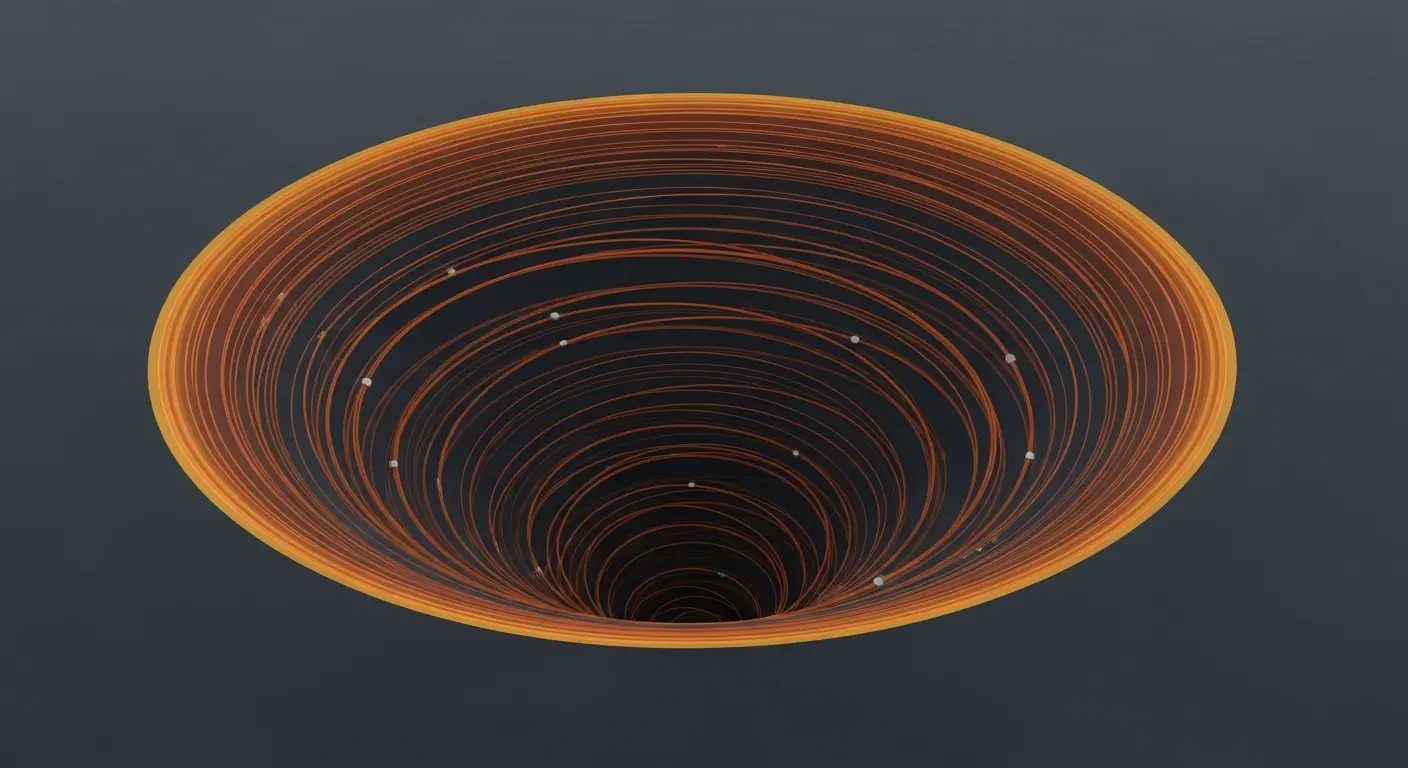
The Kepler problem, a classical model describing the motion of one body orbiting another under the influence of gravity, traditionally assumes continuous trajectories. However, theories incorporating a minimal length, stemming from Generalised Uncertainty Principles (GUP) and various quantum gravity models like string theory and loop quantum gravity, posit that spacetime itself may possess a granular structure at the Planck scale. This granularity implies the existence of a fundamental, irreducible length, preventing measurements of distances smaller than this minimum value. Samar and Seniak’s research demonstrates that accounting for this minimal length, represented mathematically as lmin = ħ p Dβ + β′, significantly alters the predicted scattering angles in Kepler problem trajectories. Their calculations show a reduction in these angles by up to 17%, a level of precision exceeding previous analyses. This reduction arises from a deformation of the Heisenberg algebra, the fundamental mathematical framework governing quantum mechanics, which introduces corrections to the momentum and position operators. The deformed Heisenberg algebra effectively modifies the commutation relation between position and momentum, leading to the minimal length scale and consequently, the altered trajectories.
Crucially, the incorporation of a minimal length also weakens the gravitational lensing effect for massless particles, such as photons. Gravitational lensing occurs when the gravity of a massive object bends the path of light, creating distorted images of background sources. Standard models predict no alteration to this effect beyond what is described by general relativity. However, the researchers found that the minimal length introduces a subtle reduction in the degree of light bending. This is because the minimal length modifies the effective gravitational potential experienced by photons, reducing the curvature of spacetime and thus diminishing the lensing effect. The magnitude of this weakening is directly related to the value of the minimal length scale, providing a potential observational handle for its determination. The significance of this finding lies in offering a novel avenue for probing quantum gravity effects, distinct from traditional approaches focused on high-energy particle collisions.
Precise measurements of orbital precession, particularly for Mercury, provide constraints on the deformation parameter within the deformed Heisenberg algebra. The authors demonstrate that a specific value of this parameter best fits the observed precession of Mercury’s orbit, suggesting a corresponding minimal length scale. Similarly, calculations performed for electrons also yield a small, but non-zero, minimal length. These estimations are heavily reliant on the accuracy of existing observational data, including precise measurements of planetary orbits and the properties of fundamental constants. The researchers highlight that the deformation parameter can be estimated using observations of the Einstein ring, where the distortion of light around a massive object provides a sensitive probe of spacetime curvature. While current calculations offer only indirect evidence for the minimal length, the potential for direct detection hinges on the development of instrumentation capable of resolving scales far beyond current technological limitations, potentially requiring interferometers with kilometre-scale baselines or advanced space-based observatories. Future research will concentrate on refining these estimations, exploring the limitations of this approach in diverse astrophysical scenarios, and investigating the impact of other physical factors on the observed orbital perturbations.
Gravitational lensing as an independent probe of spacetime granularity
The search for a minimal length scale is driven by the ongoing quest to reconcile general relativity with quantum mechanics, a central challenge in modern physics. Quantum gravity theories consistently predict a fundamental limit to the precision with which distances can be measured, implying a granular structure of spacetime at tiny scales. Increasing attention is therefore focused on discerning this granularity through observational evidence. While current measurements of planetary orbit precession, such as those for Mercury, offer the highest level of precision in constraining the minimal length, improving the accuracy of gravitational lensing data could provide complementary and independent constraints. This is particularly important because different observational techniques are susceptible to different systematic errors. A robust confirmation of the minimal length requires consistency across multiple independent measurements.
The analysis conducted by Samar and Seniak, utilising the precession of the Hamilton vector, establishes a rigorous method for quantifying the impact of a minimal length scale on both the trajectories of orbiting bodies and the bending of light. This approach demonstrates that incorporating a minimal length not only reduces scattering angles but also weakens gravitational lensing, offering a novel means of probing quantum gravity effects. Estimating these parameters from observations of Einstein rings provides a direct pathway to test these theoretical predictions against real-world astrophysical phenomena, potentially revealing subtle deviations from the predictions of classical general relativity. The strength of this approach lies in its reliance on well-established physical principles and its potential for independent verification through multiple observational channels. Confirming these effects through diverse methods strengthens our confidence in the underlying theoretical models, mitigating the risk of systematic errors inherent in any single observational technique and paving the way for a deeper understanding of the fundamental nature of spacetime.
The research demonstrated that a minimal length scale, predicted by quantum gravity theories, reduces the scattering angle of particles and weakens gravitational lensing effects. This is significant because it provides a potential observational signature for the granular structure of spacetime at extremely small scales. By analysing data from Einstein rings and the orbit of Mercury, researchers estimated the deformation parameter and corresponding minimal length. The findings highlight how observations in high-energy astrophysics and gravitational optics can be used to test predictions from these quantum gravity models.
👉 More information
🗞 Minimal Length Effects on Keplerian Scattering and Gravitational Lensing
🧠 ArXiv: https://arxiv.org/abs/2604.01177
See today’s quantum computing news on Quantum Zeitgeist for the latest breakthroughs in qubits, hardware, algorithms, and industry deals.