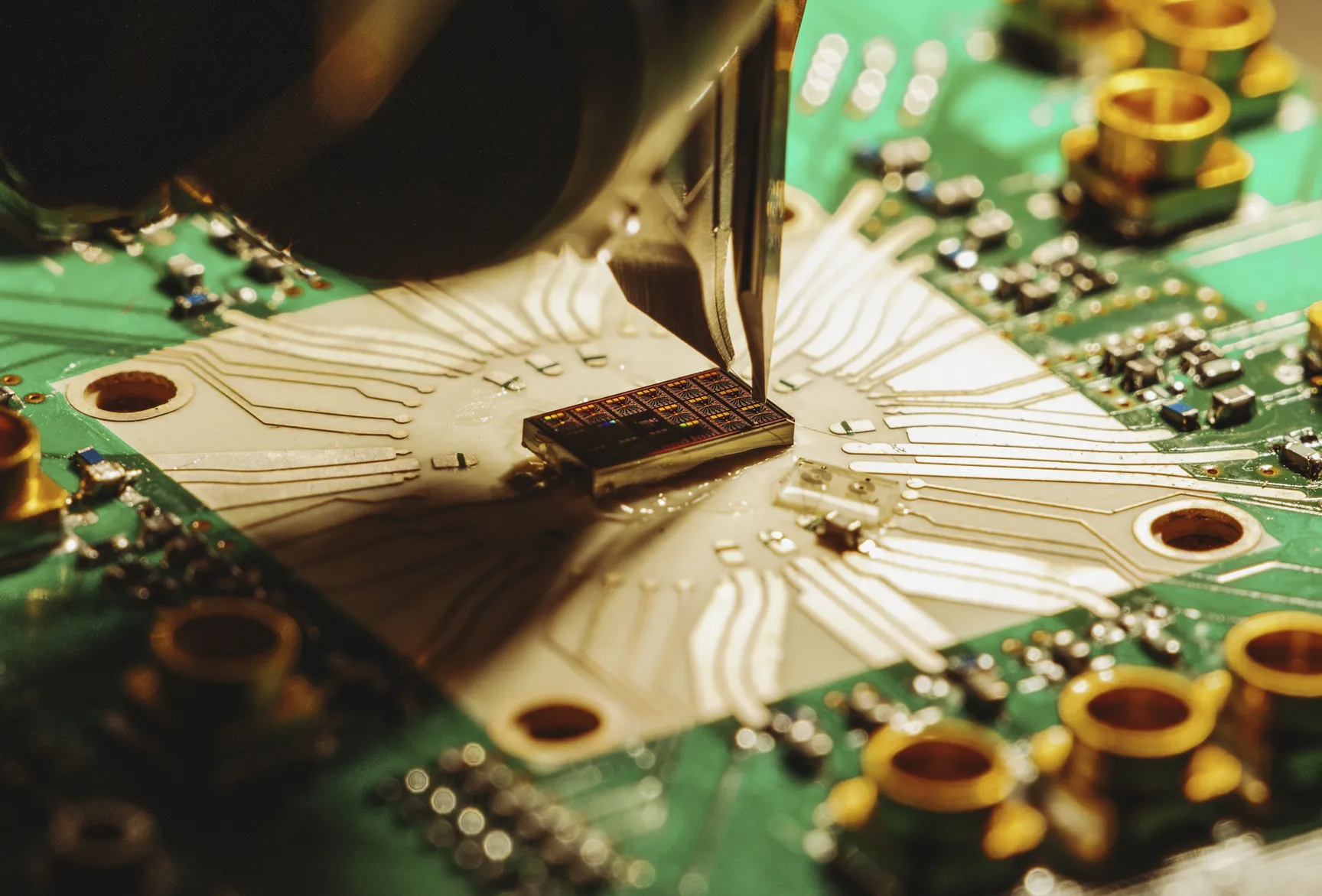
Quantum Motion has achieved the fastest dispersive readout of a silicon spin qubit using a novel technique directly compatible with standard 300mm silicon manufacturing processes. Published in Nature Electronics, the team’s research details a new approach called radiofrequency electron cascade, which amplifies detectable signals and reduces readout time to a minimum integration time of 8 microseconds, an improvement of over two orders of magnitude compared to previous results on the same platform. This advancement addresses a critical bottleneck in scaling up quantum computers by moving away from bulky sensing components and towards compact, fast, and scalable readout solutions. “By applying a radio frequency tone, we found we can repeatedly trigger an electron cascade during dispersive spin qubit readout, effectively giving built-in signal amplification,” says Jacob Chittock-Wood, Quantum Engineer and lead author; the method also demonstrated a two-qubit gate, enabling entangled gate operations essential for utility-scale quantum computation.
Radiofrequency Electron Cascade Enables Fast Spin Qubit Readout
Researchers at Quantum Motion detailed their findings in Nature Electronics, addressing a longstanding limitation in quantum processor development: the speed and efficiency of qubit state detection. Traditional dispersive readout methods, while preserving qubit state, often suffer from weak signal coupling in planar silicon devices, hindering their practicality for large-scale systems. The team’s approach circumvents this issue by amplifying the detectable signal without compromising qubit coherence. The core innovation lies in introducing a third quantum dot coupled to a charge reservoir, effectively creating an amplifier that boosts the signal generated by charge transitions within the qubit, providing more than 35 dB of power amplification compared to standard dispersive readout. This cascaded charge signal allows for substantially faster and more sensitive detection, eliminating the constraints of bulky sensing components like radio-frequency single-electron transistors which limit qubit connectivity.
This compatibility positions the technology for potential mass production and integration with existing semiconductor infrastructure, a critical step toward building utility-scale quantum computers. The team also demonstrated coherent exchange control and dephasing times of up to 500 nanoseconds, with a gate quality factor exceeding 10, further supporting the potential of this technique to support complex quantum operations and maintain qubit stability.
300mm Silicon MOS Process Validates Scalable Quantum Manufacturing
The pursuit of scalable quantum computing has long faced a critical hurdle: translating laboratory demonstrations into devices compatible with existing manufacturing infrastructure. Researchers detailed their findings in Nature Electronics, outlining a new technique called radiofrequency electron cascade that amplifies the signal generated by spin qubits, enabling faster and more reliable measurements. This approach bypasses limitations of previous methods, such as the large footprint of radio-frequency single-electron transistors and the weak coupling in planar MOS devices. The use of a 300mm silicon MOS process, the same used for smartphone chips, demonstrates a pathway to mass production and isn’t merely a performance boost. Advanced semiconductor manufacturing promises to improve yield, uniformity, and the integration of qubits with classical control electronics, addressing a key bottleneck in scaling. The team intends to further refine coherence times and gate fidelities using isotopically enriched silicon, solidifying the potential of spin qubits as a viable route toward building a large-scale, fault-tolerant quantum computer.
By applying a radio ‑ frequency tone, we found we can repeatedly trigger an electron cascade during dispersive spin qubit readout, effectively giving built-in signal amplification. In our planar silicon MOS quantum ‑ dot array, that lets us determine the qubit state in about 8 microseconds, substantially faster than prior in ‑ situ dispersive readout results in the same platform. Because it’s rf ‑ driven, it also points toward reading many qubits in parallel by assigning each one a different frequency.
Jacob Chittock-Wood, Quantum Engineer and lead author