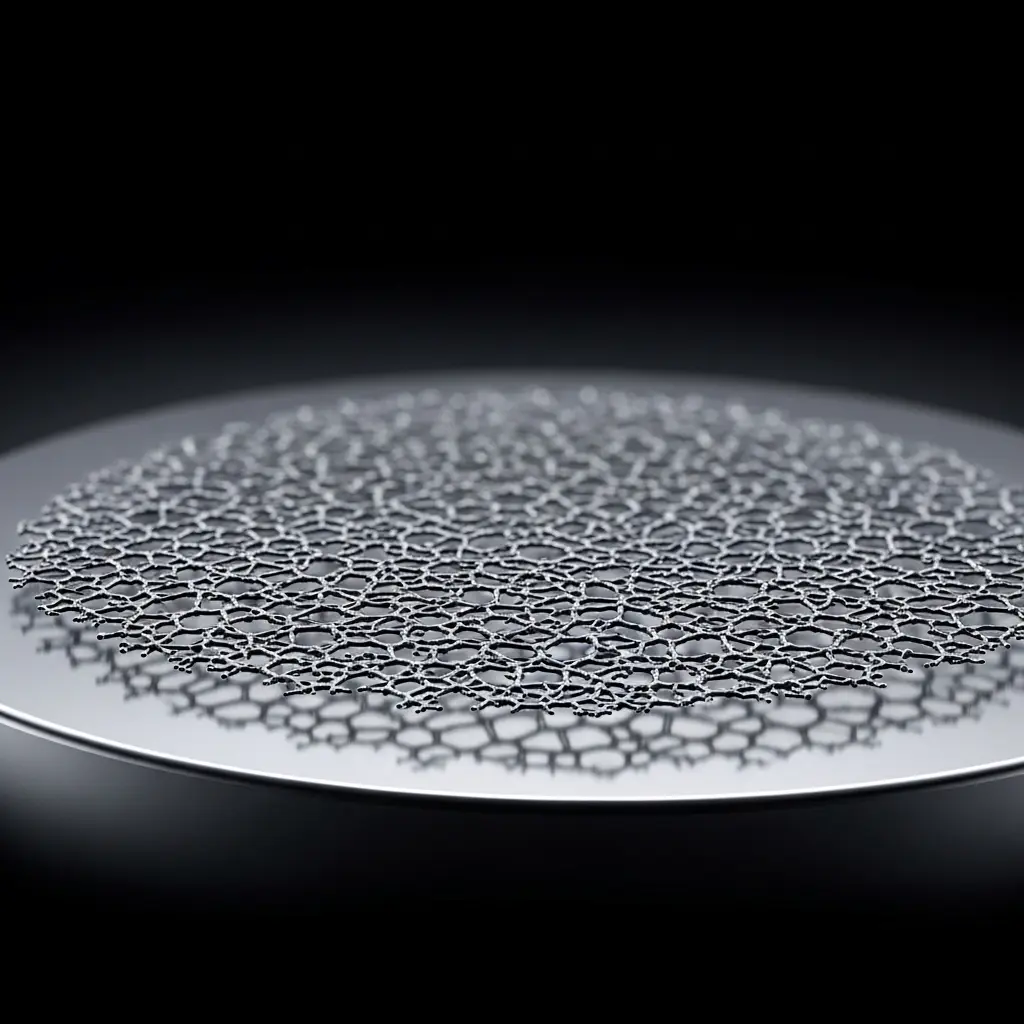
Scientists report a novel method for creating high-quality, large-area graphene using tin, potentially advancing materials science and nanoelectronics. Zamin Mamiyev, Niclas Tilgner, and Narmina O. Balayeva, working at the Institute of Physics, Chemnitz University of Technology and Research Center for Materials, Architectures and Integration of Nanomembranes (MAIN), alongside Dietrich R.T. Zahn, Thomas Seyller, Christoph Tegenkamp and colleagues, demonstrate the successful intercalation of a two-dimensional tin layer beneath graphene grown on silicon carbide. This confinement epitaxy not only stabilises the graphene but also allows for the creation of durable graphene-metal heterostructures with tunable properties. The research distinguishes between different growth mechanisms, identifying diffusion as key to achieving superior crystalline quality, and reveals a dynamic structural coupling between the graphene and tin interface, offering new avenues for strain engineering and the development of next-generation electronic platforms.
Better electronics and sensors could soon benefit from stronger, more reliable materials at the nanoscale. Creating these advanced components requires precise control over how materials assemble, and a new technique allows tin to be neatly layered beneath graphene, promising durable, adaptable structures for future technologies. Scientists are increasingly focused on stabilising and functionalizing two-dimensional (2D) materials with precise atomic control.
Advanced Platforms for Graphene Material Development
Epitaxial graphene (EG) grown on silicon carbide has become a well-established platform for large-scale, uniform, high-quality 2D carbon, providing consistent electronic and structural properties for both fundamental research and device integration. Beyond its role as a 2D conductor, EG serves as a protective layer enabling confinement epitaxy at buried interfaces.
This architecture kinetically hinders three-dimensional clustering, while interface bonding and lattice alignment guide the epitaxial ordering of intercalated metals and semimetals into atomically thin films, structures that are typically unstable on exposed surfaces. This interfacial “capsule” allows for the creation of tailored electronic phases and superstructures across device-scale areas, offering a modular approach to adjust doping, strain, and hybridization without affecting the graphene layer above.
Intercalation breakthrough for large-area graphene sheets
Achieving Large-Area Graphene Via Tin Intercalation
Achieving long-range order at the interface while preserving high-quality graphene remains a considerable hurdle. Researchers have now demonstrated the synthesis of large-area quasi-free-standing monolayer graphene (QFMLG) through the intercalation of a two-dimensional (2D) tin (Sn) layer. The resulting triangular Sn(1×1) interface exhibits a metallic band structure, while the decoupled QFMLG maintains charge neutrality, a finding verified through photoemission spectroscopy.
This work distinguishes between direct intercalation and diffusion-driven expansion, identifying the latter as the key pathway to superior QFMLG crystalline quality. Understanding the precise mechanisms governing this process is vital for controlling the properties of these heterostructures. Temperature-dependent analysis reveals a active structural coupling between the decoupled QFMLG and the Sn interface, opening up new possibilities for strain engineering.
Creating Quantum Materials with Metal Interlayers
Metal intercalation defines next-generation quantum materials
Beyond elucidating the diffusion-driven mechanism, this research establishes metal intercalation as an effective strategy for creating durable graphene-metal heterostructures with tunable properties suitable for next-generation quantum materials platforms. Previous studies have shown that lead intercalation induces strain-mediated superstructures and spin-orbit coupling in graphene.
Engineering diverse quantum states using 2D interfaces
Similarly, tin and silicon form Mott-insulating phases near graphene, while indium creates triangular lattices exhibiting a strong quantum spin Hall insulator state. Two-dimensional gallium interfaces have even demonstrated superconductivity with critical temperatures higher than those of their bulk counterparts, and calcium intercalation can induce superconductivity in graphene bilayers.
In particular, a one-third monolayer coverage of tin forms a Mott insulating state with a correlated gap of approximately 1.2 eV, whereas full monolayer coverage results in a metallic triangular (1×1) lattice with decoupled, charge-neutral QFMLG. Once formed, this decoupled QFMLG, possessing a high electronic density of states, interacts strongly and initiates Kekul e-O type bond density wave formation in the graphene with an energy gap of around 90 meV.
Recent investigations have also revealed that a 2D Sn interfacial layer can behave as an embedded nanoantenna, forming a plasmonic gap mode with an external plasmonic nanoantenna and greatly amplifying photon-graphene coupling. These characteristics make Sn intercalation particularly compelling, both from a fundamental scientific perspective and for potential device applications.
Spot-profile LEED monitors tin intercalation into zero-layer graphene lattices
Zero-layer graphene (ZLG) and monolayer graphene (MLG) were initially grown epitaxially by Si sublimation on 4H-SiC substrates, a process detailed in a prior publication. These samples then underwent transfer to a spot-profile analysis low-energy electron diffraction (SPA-LEED) chamber, a technique employing low-energy electrons to examine surface structures.
Prior to analysis, samples were degassed at 850 K using direct-current heating to ensure homogenous ZLG structures exhibiting a characteristic (6 √ 3 × 6 √ 3)R30° reconstruction, visible in SPA-LEED patterns. A high-resolution SPA-LEED setup, featuring a 200nm transfer width, was employed to monitor and investigate the Sn intercalation process and resulting interface structures.
For Sn intercalation, material was deposited via electron-beam evaporation from a molybdenum crucible, maintaining the sample at room temperature. A potential equivalent to the evaporator’s acceleration voltage was applied to prevent sputtering from ionized Sn. Temperatures were precisely monitored using an infrared pyrometer (Impac IGA) calibrated with an emissivity of 0.92.
Further details regarding the Sn intercalation procedure are available in a related study. Confocal Raman measurements, performed under ambient conditions, utilised a Horiba Xplora Plus system with a DPSS continuous-wave laser source, a 1200mm−1 grating, 3.0mW laser power, and 1.6cm−1 spectral resolution. Temperature-dependent Raman spectroscopy was conducted using a Linkam THMS600 stage under vacuum, allowing for analysis across a range of temperatures.
Following air transport, samples were subjected to photoelectron spectroscopy, both before and after degassing at 870 K. This involved a monochromatized SPECS XR50M Al-Kα X-ray source and a SPECS UVS 300 ultraviolet source providing linear polarized He-I radiation. Photoelectrons were detected using a 2D CCD detector coupled to a SPECS Phoibos 150 hemispherical analyzer, achieving total energy resolutions of 100 meV for XPS and 40 meV for ARPES measurements.
Zero-layer graphene decoupling evidenced by suppressed reconstruction and bell-shaped component emergence
Initial SPA-LEED analysis of pristine zero-layer graphene (ZLG) on 4H-SiC revealed (6 √ 3 × 6 √ 3)R30° reconstruction spots alongside the SiC(1×1) and ZLG(1 × 1) patterns. These reconstruction spots, indicative of moiré periodicity arising from lattice superposition, displayed sharp higher-order reflections confirming long-range order within the ZLG.
Following Sn deposition and annealing at 1075 K, these reconstruction spots were substantially diminished, signifying the decoupling of ZLG and transitioning it into a quasi-free-standing monolayer graphene (QFMLG). The ZLG(1×1) spots transformed into brighter Gr(1 × 1) spots accompanied by an intense isotropic background, termed the bell-shaped component (BSC), a characteristic feature of free-standing graphene.
Its in-phase relationship with the Bragg component suggests a connection to the atomic lattice, potentially stemming from low-energy flexural phonons activated upon decoupling. Quantitative analysis of the (5/13,0) and (6/13,±1) diffraction spots indicated a surface fraction undergoing intercalation. Raman spectroscopy further characterised the structural changes.
The G peak of the graphene exhibited a downshift of 3.2cm⁻¹ after intercalation. This contrasts with the doped behaviour observed in the pristine ZLG, where the valence band maximum was shifted away from the Dirac point due to charge transfer from the SiC substrate. The observed metallic triangular (1×1) lattice formed by Sn exhibited a strong metallic band structure, while the decoupled QFMLG maintained charge neutrality.
Metallic underlayers enable diffusion-driven growth of decoupled graphene films
Once considered a material of pure theoretical interest, graphene’s potential hinges on controlling its properties at the interface with other materials. This latest work bypasses many familiar hurdles by employing an unusual technique, sliding a metallic layer underneath graphene to create a quasi-free-standing film. Rather than battling strong substrate interactions that typically distort graphene’s electronic structure, researchers have demonstrated a pathway to a remarkably clean material.
Beyond simply achieving this separation, the discovery of a diffusion-driven growth process offers a degree of control previously absent in similar attempts. While the reported areas are substantial, scaling up production without introducing defects will be essential for practical applications. Yet, the observed coupling between the graphene and the underlying metal, while seemingly counterintuitive for a ‘decoupled’ system, opens exciting possibilities for strain engineering.
By manipulating the metal layer, it may be possible to finely tune graphene’s electronic properties, creating materials tailored for specific devices. The significance extends beyond graphene itself. For years, the field of two-dimensional materials has struggled with the problem of substrate-induced effects. Unlike many top-down approaches that attempt to correct for these issues after fabrication, this method proactively avoids them.
Instead of seeking ways to ‘undo’ unwanted interactions, this research demonstrates a way to prevent them from forming in the first place. At present, the focus will likely broaden to explore different metal combinations and their impact on graphene’s behaviour. Beyond that, the principles established here could be applied to other two-dimensional materials, offering a general strategy for creating high-quality heterostructures with predictable properties.
🗞 Confinement Epitaxy of Large-Area Two-Dimensional Sn at the Graphene/SiC Interface
🧠 ArXiv: https://arxiv.org/abs/2602.16451
See today’s quantum computing news on Quantum Zeitgeist for the latest breakthroughs in qubits, hardware, algorithms, and industry deals.