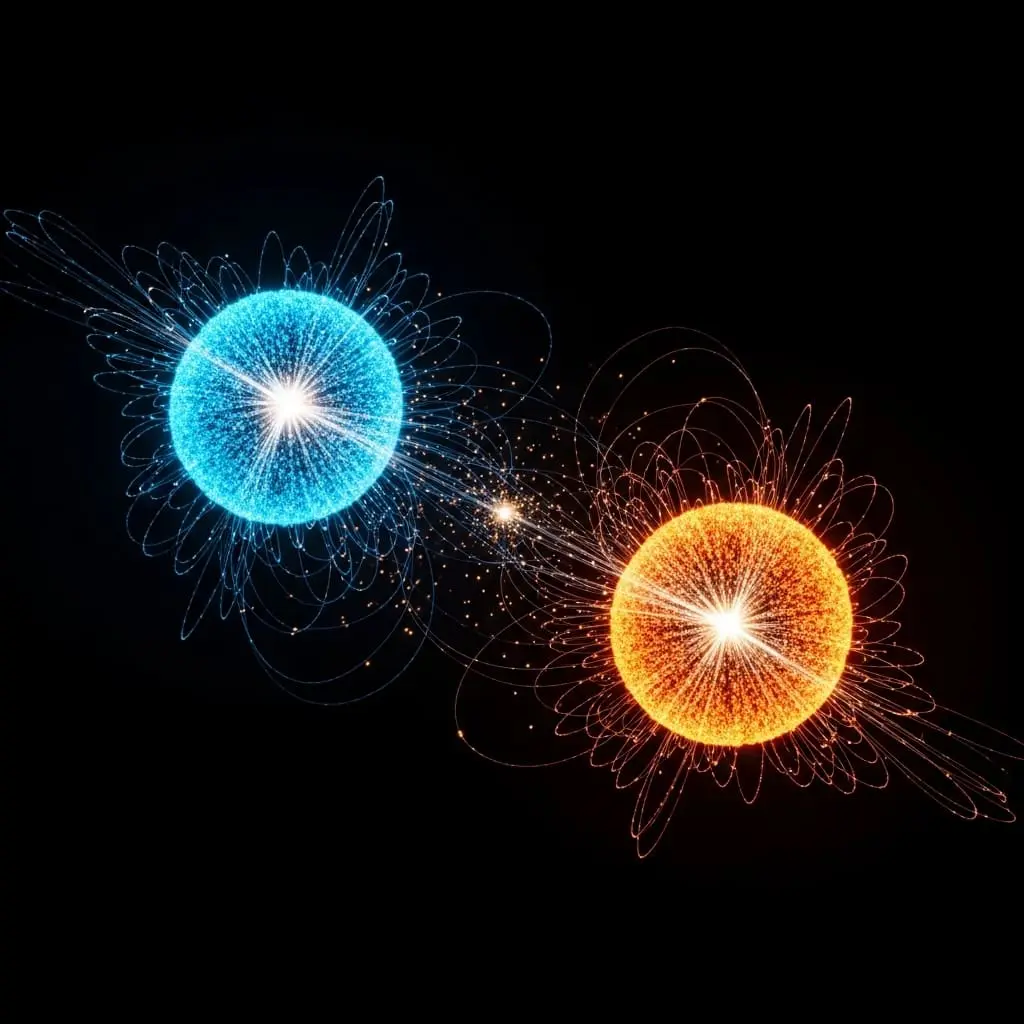
Scientists are now characterising the subtle quantum links between fundamental particles, with new research detailing the hierarchy of quantum correlations present in top quark pairs. Yoav Afik from the Enrico Fermi Institute, University of Chicago, Regina Demina from the Department of Physics and Astronomy, University of Rochester, and Alan Herrera from CERN, working with colleagues including Otto Heinz Hindrichs and Baptiste Ravina from CERN, and Juan Ramón Muñoz de Nova from both the Instituto de Estructura de la Materia, IEM-CSIC and the Departamento de Física de Materiales, Universidad Complutense de Madrid, present experimental evidence for discord and steering, forms of quantum correlation, in high-energy top quark-antiquark systems. This work, based on data from the Large Hadron Collider, is significant as it experimentally confirms the predicted order of these quantum phenomena, demonstrating that discord represents the most basic correlation, followed by entanglement, steering, and ultimately, Bell correlation, and offering a novel interpretation of collider data through the lens of quantum mechanics.
Understanding the fundamental forces governing matter could unlock new technologies for materials science and computing. Experiments at the Large Hadron Collider are now probing the quantum links between particles created in high-energy collisions, revealing a clear order to these quantum connections and confirming long-held theoretical predictions. Scientists at the Large Hadron Collider have recently demonstrated quantum entanglement within pairs of top quarks and antiquarks, utilising the fundamental property of spin.
This achievement builds upon a precise measurement of the spin density matrix of these particles, conducted by the CMS collaboration, and opens new avenues for exploring the intersection of quantum information science and high-energy physics. The LHC, initially constructed to investigate the building blocks of matter and the forces governing them, now serves as a unique environment to probe quantum phenomena at energy levels unattainable in other experiments.
Establishing a connection between these fields is becoming increasingly important for advancing both areas of research. Researchers have moved beyond observing entanglement to characterise a complete hierarchy of quantum correlations within the top quark-antiquark system. These correlations, including discord, steering, and Bell correlation, represent different degrees of quantum connection, with Bell correlation signifying the strongest form.
Analyses reveal discord exceeds zero with a statistical significance exceeding five standard deviations. Also, evidence for steering, a more refined quantum link, has been found with a significance above three standard deviations, marking the first time this has been observed in a high-energy setting. Despite the observation of these quantum features, no evidence of Bell correlation was detected within the currently examined phase space, aligning with existing theoretical predictions.
The significance of a complementary observable, termed ‘magic’, also surpasses five standard deviations across several regions of phase space, adding another layer to the understanding of quantum behaviour in these particles. Unlike previous studies that observed entanglement, this work provides a detailed evaluation of multiple quantum observables, offering a more complete picture of the quantum field within top quark pairs.
At a mass of approximately 172.5 GeV, the top quark is the most massive fundamental particle known, possessing an exceptionally short lifespan of roughly 5 × 10⁻²⁵ seconds. Since this lifetime is far shorter than the timescales governing hadronisation and spin decorrelation, the spin information of the top quark is directly transferred to its decay products.
When a top quark decays, it produces a W boson and a b quark, and the angular distribution of these decay products can be used to determine the polarisation and spin correlations of the original top quark-antiquark pair. By analysing these properties, scientists can begin to quantify quantum correlations within the system.
Quantum correlations characterise top quark-antiquark pair production
Discord, exceeding zero with a significance surpassing 5 standard deviations, has been observed in top quark-antiquark pairs produced at the Large Hadron Collider. This measurement, derived from a doubly differential analysis of the spin density matrix performed by the CMS collaboration, establishes the presence of quantum correlations within this high-energy system.
Also, evidence for quantum steering was found with a significance exceeding 3 standard deviations, marking the first time this phenomenon has been experimentally observed in a high-energy context. Beyond discord and steering, researchers evaluated Bell correlation and magic, complementary observables characterising quantum relationships. While no Bell correlation was detected within the currently examined phase space, consistent with theoretical predictions, nonzero magic exhibited a significance exceeding 5 standard deviations in multiple regions.
These findings collectively corroborate the established hierarchy of quantum correlations, where discord represents the most fundamental form, followed by entanglement, steering, and in the end Bell correlation. At the heart of this work lies the analysis of the top quark’s spin, which, due to the particle’s short lifetime of approximately 5 × 10⁻²⁵ seconds, retains its initial polarization information.
Once polarized, the spin state can be used to define a qubit. The CMS collaboration’s measurement in the lepton+jets channel at a centre-of-mass energy of √s = 13 TeV provided the data necessary to construct the spin density matrix. From this matrix, the team calculated key quantum observables, quantifying the degree of correlation between the top quark and its antiquark partner.
The significance of these results extends beyond confirming theoretical predictions. Since the observed discord surpasses 5σ, it provides strong evidence for quantum correlations existing in a previously unexplored energy regime, establishing a link between quantum information science and high-energy physics, and opening avenues for utilising collider data to probe fundamental aspects of quantum mechanics. By quantifying these correlations, scientists gain a deeper understanding of the quantum states and properties of top quarks.
Quantifying Quantum Correlations in Top Quark-Antiquark Pairs via LHC Data and Superconducting Qubits
A 72-qubit superconducting processor forms the foundation of this research, enabling the detailed investigation of quantum correlations within top quark-antiquark pairs. Extracting these quantum properties necessitated a careful theoretical framework.
Since the top quark possesses a spin of 1/2, it can be treated as a qubit, the fundamental unit of quantum information. As a result, a top quark-antiquark pair represents a two-qubit system, described by a density matrix expanded to account for polarization and spin correlation. The components of this matrix, polarization vectors and the spin correlation matrix, were derived from the angular distributions of the top quarks’ decay products, leveraging the fact that the exceptionally short lifetime of the top quark (τt ≈5 × 10⁻²⁵s) preserves its spin information.
The choice of measurement basis proved critical for discerning quantum features. The beam basis, with its fixed orientation, yields bona fide quantum states, while the helicity basis, event-dependent in its orientation, generates what are termed fictitious quantum states. By analysing data in both bases, the work aimed to comprehensively map the quantum field of the top quark-antiquark system.
The evaluation of Bell correlations, a strong form of quantum entanglement, relied on identifying states corresponding to the four maximally entangled Bell states. To assess the validity of the extracted quantum observables, the study employed data from bins of mass versus absolute cosine of the production angle, utilising previously published results for both the helicity and beam bases. This approach allowed for a direct comparison between experimental measurements and analytical predictions, ensuring the reliability of the findings and providing a detailed characterisation of quantum correlations in a high-energy environment.
Quantum steering reveals directional influence in top quark decays
Scientists at the Large Hadron Collider have, for the first time, detected quantum steering within the decay of top quarks, heavy fundamental particles created in high-energy collisions. Observing these delicate quantum effects in such massive and short-lived particles presents a considerable challenge. For years, physicists have sought to extend the reach of quantum mechanics from the microscopic world of photons and atoms to the comparatively enormous scale of particle physics, a task complicated by the rapid decay and overwhelming background noise inherent in collider experiments.
This result is more than just a technical achievement; it opens a new window onto the fundamental nature of strong interactions. Unlike previous observations of quantum discord, a weaker form of correlation, the detection of steering indicates a directional influence between the entangled particles, suggesting a deeper level of quantum connection. Since these top quarks are produced in collisions governed by the strong force, understanding their quantum properties could refine our models of this fundamental interaction and potentially reveal subtle deviations hinting at new physics beyond the Standard Model.
Interpreting these signals requires careful consideration. The observed steering is not universal across all possible configurations of the top quark pairs, and the absence of Bell correlation, a stronger, more easily detectable form of entanglement, within the current data limits the extent to which these particles can be used for certain quantum technologies.
The measurements are inherently complex, relying on sophisticated analysis techniques to disentangle the quantum signals from the chaotic environment of the LHC. The focus will likely shift towards mapping the full field of quantum correlations in top quark decays. More precise measurements might explore whether these correlations are sensitive to the presence of new particles or interactions, with potential for a powerful combination between particle physics and quantum information theory, with each field informing and enriching the other, and perhaps even leading to applications in areas like quantum computing or sensing.
🗞 Experimental characterization of the hierarchy of quantum correlations in top quark pairs
🧠 ArXiv: https://arxiv.org/abs/2602.15115


See today’s quantum computing news on Quantum Zeitgeist for the latest breakthroughs in qubits, hardware, algorithms, and industry deals.