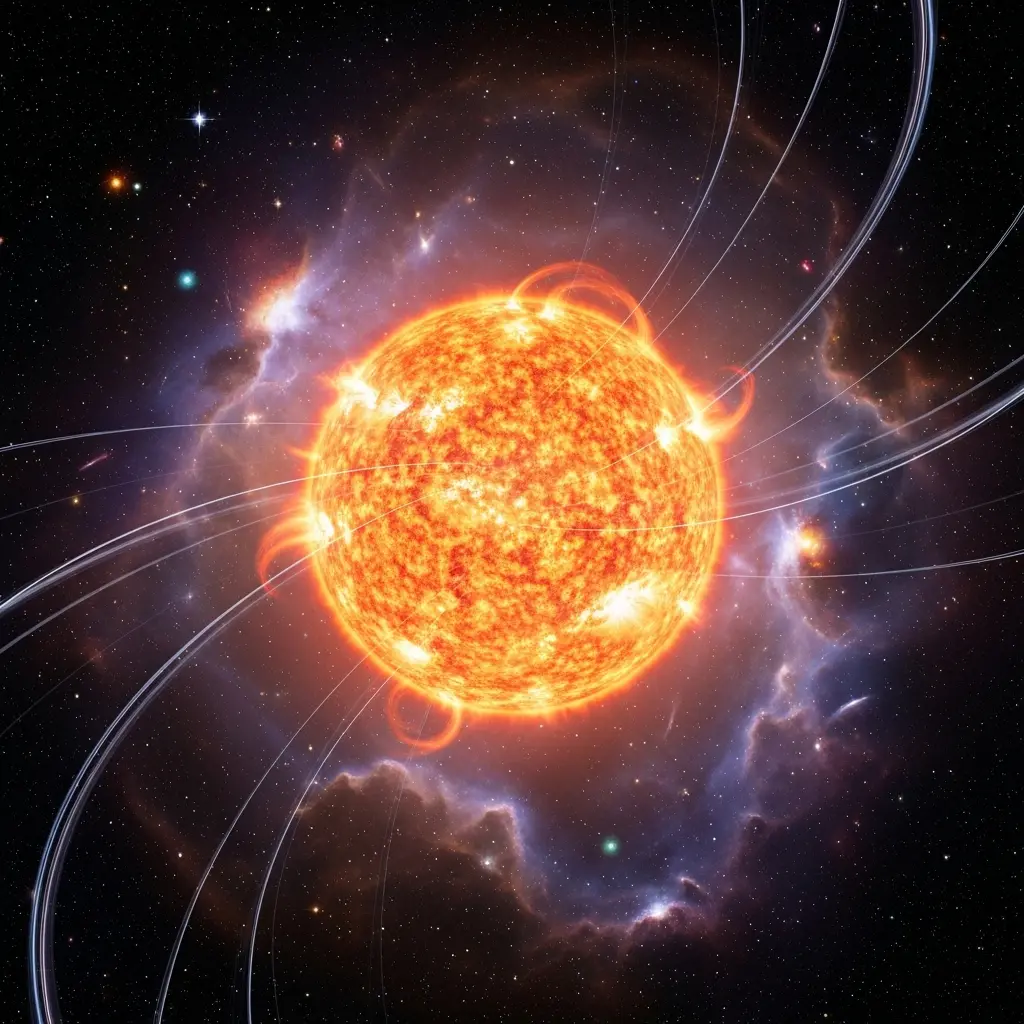
O-type stars shed substantial mass through radiation-driven winds, fundamentally influencing their lifecycle and galactic enrichment. Figueroa-Tapia, Panei, and Curé, working with colleagues from the University of Concepción, the Institute of Astrophysics of Paris, and the University of La Serena, present new self-consistent theoretical descriptions for calculating these crucial mass-loss rates. Their research couples hydrodynamic modelling with detailed line acceleration calculations, utilising the TLUSTY, LOCUS, and HYDWIND codes to derive mass-loss rate distributions across a range of stellar configurations and chemical compositions. This innovative approach demonstrates a systematic reduction in mass-loss rates as more elements are incorporated into the radiative transfer, offering improved accuracy for stellar evolution models and population synthesis, and yielding wind momentum-luminosity relationships consistent with observational data.
Accurate stellar models depend on knowing how much material these stars shed into space, a process now better understood thanks to new theoretical work. These refined calculations will improve our picture of the cosmos and the elements it contains.
Massive stars are key constituents in the evolutionary history of galaxies due to their profound influence on both the dynamical and chemical aspects of the interstellar medium. Their life cycles are characterised by energetic feedback mechanisms, intense radiation, strong stellar winds, and explosive phenomena such as core-collapse supernovae, which contribute to the dispersal of heavy elements and the formation of compact objects.
Despite their rarity compared to lower-mass stars, their cumulative impact extends far beyond mere statistics, shaping star formation and influencing the evolution of their host galaxies. The evolutionary development of very massive stars is predominantly dictated by their ability to lose mass through powerful, radiation-driven winds, propelled by the momentum transfer from photons to atomic ions, most efficiently through metal lines in the ultraviolet portion of the stellar spectrum.
As a result, the resultant mass-loss rates not only substantially alter the surface chemical composition and observable wind parameters but also determine the evolutionary path, influencing whether the star will in the end collapse into a neutron star or form a black hole. These processes are also instrumental in driving galactic chemical enrichment and regulating feedback cycles, which influence subsequent generations of star formation.
Stellar Mass-Loss Rates Dictate Stellar Fate
Importance of Accurate Stellar Mass-Loss Modeling
Accurate predictions of wind strengths and mass-loss rates are important for stellar evolutionary models, population synthesis efforts, supernova rate estimates, and understanding the propagation of energetic feedback at galactic scales. Theoretical modelling of line-driven stellar winds faces persistent challenges, as traditional prescriptions often depend heavily on empirical calibrations or assume oversimplified stellar atmospheres, potentially missing subtleties of non-local thermodynamic equilibrium (NLTE) effects and complex atomic physics.
Sensitivity of Mass Loss to Stellar Flux
A dominant issue is the sensitive dependence of mass-loss rates on the atomic structure and chemical composition of the emergent stellar flux, particularly in the UV, where the bulk of momentum transfer occurs. Models that oversimplify this radiation field can yield mass-loss rates that systematically deviate from values estimated from observations, especially in the ‘weak wind’ regimes of O-type stars.
Challenges of Radiative Transfer in Stellar Winds
Complexities of Wind Dynamics and Chemistry
Recent observations and theoretical work suggest that metallicity, clumping, and the radial temperature profile of the wind play substantial roles in determining both the efficiency and the observable imprint of the wind. Addressing these complexities is important for reconciling theoretical models with observations and enabling the reliable application of wind parameters to stellar populations in diverse environments.
Developing a Self-Consistent Modeling Framework
Now, a new self-consistent approach to modelling these winds offers a pathway to more accurate predictions. By coupling detailed stellar atmosphere calculations with hydrodynamic simulations, researchers have established a framework for deriving mass-loss rate distributions across a range of stellar configurations, revealing a surprising sensitivity to atomic composition and offering a means to refine existing theoretical prescriptions. The results demonstrate a systematic trend in mass-loss rates dependent on the inclusion of elements in the stellar flux, with implications for understanding stellar evolution and galactic feedback.
Ultraviolet flux dilution explains reduced mass loss and strong correlation with theoretical models
Calculations revealed a systematic reduction in mass-loss rates as the number of elements included in the radiation field increased, due to a diminished contribution of the ultraviolet region within the spectral energy distribution. Incorporating additional elements introduces a greater number of spectral lines, effectively diluting the UV flux responsible for driving the stellar wind.
Pearson correlation values exceeded 0.92 for each model grid when fitted against three theoretical prescriptions using a Bayesian approach, indicating strong agreement between the model outputs and established theoretical frameworks. The research also allowed for the estimation of wind momentum-luminosity relationships for each of the three chemical grids, closely aligning with those derived from observational studies of O-type stars, validating the model’s predictive capability.
The study quantified how the inclusion of more elements affects the UV portion of the spectrum, demonstrating a clear link between spectral composition and wind strength. Models incorporating fewer elements exhibited stronger UV emission and, as a result, higher mass-loss rates. Detailed modelling also provided precise values for the line-force parameters, essential components in calculating the acceleration of the stellar wind.
By iteratively coupling these parameters with hydrodynamic simulations, the research achieved self-consistent wind solutions for a broad range of O-type stellar models, offering a refined understanding of the physical processes governing mass loss in massive stars. The systematic trends observed in mass-loss rates provide valuable insights into the sensitivity of stellar winds to changes in chemical composition, and the calculated wind momentum-luminosity relationships are consistent with observational data, strengthening confidence in the model’s accuracy.
NLTE spectral modelling and iterative hydrodynamic wind simulations
Detailed stellar atmosphere models were computed using the TLUSTY code to generate non-local thermodynamic equilibrium (NLTE) spectra, serving as the foundational radiation fields for subsequent calculations and providing a realistic representation of the energy distribution emitted by the O-type stars. The LOCUS code then processed these radiation fields to determine the line-force parameters, quantifying the acceleration exerted on ions within the stellar wind due to absorption and re-emission of photons.
Specifically, LOCUS calculates the force multiplier, a key factor in determining the overall strength of the wind. Then, the derived line-force parameters were iteratively integrated with the HYDWIND code, a hydrodynamic modelling tool designed to simulate the dynamics of stellar winds, until a self-consistent solution was achieved. By coupling TLUSTY, LOCUS, and HYDWIND, the research established a strong framework for calculating mass-loss rates from first principles.
The procedure was systematically applied across a grid encompassing three distinct chemical compositions, allowing for an assessment of how varying the abundance of elements affects the wind properties. Unlike previous studies that often relied on simplified assumptions about the stellar atmosphere, this work prioritised a detailed, self-consistent treatment of radiative transfer, accurately capturing the complex interaction between radiation, atomic physics, and hydrodynamics, leading to more reliable predictions of mass-loss rates. A Bayesian approach was employed to fit three established theoretical prescriptions for mass-loss rates, yielding Pearson correlation values exceeding 0.92 for each of the three chemical grids, demonstrating strong agreement between the model predictions and existing theoretical frameworks.
Refined stellar models resolve decades-old uncertainties in massive star evolution
Scientists have long struggled to accurately model the behaviour of massive stars, and this work represents a step forward in understanding how they shed mass throughout their lives. For decades, predicting stellar mass-loss rates has been hampered by the sheer complexity of the physics involved, requiring detailed calculations of radiative transfer, hydrodynamics, and atomic data.
Previous models often relied on simplifying assumptions, leading to uncertainties in our understanding of stellar evolution and the enrichment of the interstellar medium with heavy elements. Now, a new self-consistent approach, coupling stellar atmosphere models with wind hydrodynamics, offers a more refined picture. Understanding mass loss is vital for interpreting observations of distant galaxies, where the collective light of many stars reveals clues about their age and composition.
Since these massive stars profoundly influence their surroundings, better mass-loss predictions translate directly into more realistic simulations of star formation and galactic evolution. Even this sophisticated modelling relies on approximations of complex physical processes, and while the Bayesian fitting yielded strong correlations, the models remain sensitive to the assumed chemical composition of the stellar atmosphere.
By incorporating more elements into the radiation field, researchers observed a decrease in mass-loss rates, a result attributed to changes in the ultraviolet spectrum. Unlike earlier work, this study provides a framework for systematically exploring the impact of stellar composition on wind properties. Extending this approach to include magnetic fields and rotation, factors known to influence stellar winds, would be a logical progression. The broader effort to build more accurate stellar models will likely benefit from advances in computational power and the development of more detailed atomic databases.
🗞 New self-consistent theoretical descriptions for mass-loss rates of O-type stars
🧠 ArXiv: https://arxiv.org/abs/2602.16526
See today’s quantum computing news on Quantum Zeitgeist for the latest breakthroughs in qubits, hardware, algorithms, and industry deals.