Researchers are developing a novel geometric framework for understanding how measurements affect quantum entanglement in linear cluster states. Sougata Bhattacharyya from the Dept. of Astronomy, Astrophysics and Space Engineering, Indian Institute of Technology, Indore, and Sovik Roy from the Dept. of Mathematics, Techno Main Salt Lake (Engg. Colg.), Techno India Group, detail a phase-sensitive topological classification of single-qubit measurements, achieved through a measurement-surgery correspondence linking local measurements to operations on a linear Hopf chain. This collaborative work establishes that subtle phase factors, arising from lateral measurements, necessitate a ‘framed’ ribbon representation to distinguish between measurement outcomes, something previously unaddressed by standard link models. By encoding these phases as geometric twists, the study reveals a direct connection between measurement-induced entanglement transformations and framed invariants, offering a unified and geometrically intuitive approach to measurement-based quantum computation and potentially advancing the development of more robust quantum technologies.
Understanding how to manipulate quantum information is crucial for building powerful new technologies. This work clarifies the fundamental processes occurring when measuring qubits within a specific quantum state known as a linear cluster state, offering a new way to visualise and predict entanglement transformations. A novel geometric framework has been developed for classifying single-qubit measurements performed on one-dimensional linear cluster states, a crucial step towards more precise control in measurement-based quantum computation.
Linking Measurements to Topological Link Operations
Mapping Measurements to Topological Link Operations
This introduces a method to directly link local measurement choices to topological surgery operations on a specially constructed link model, representing the cluster state as a linear Hopf chain. Within this model, measurements in the computational (Z) basis act as a severance, disconnecting portions of the chain, while end measurements prune boundaries.
Transverse (X) basis measurements remove qubits but splice their neighbours, maintaining connectivity through real-valued correlations. A key finding concerns lateral (Y) basis measurements, which preserve connectivity but introduce complex phase factors not captured by standard link models. To address this, researchers introduced a framed ribbon representation, encoding these phases as geometric twists, specifically, chiral ±90° twists corresponding to phases of ±i.
This framing provides a phase-sensitive and outcome-resolved description of all single-qubit measurements, offering a unified geometric interpretation of measurement-induced entanglement transformations. The resulting framework reveals that quantum phases directly correspond to framed topological invariants, offering a deeper understanding of how entanglement is restructured during computation.
Phase-Sensitive Description of Quantum Entanglement
Phase-Sensitive Description of Quantum Entanglement
While restricted to one-dimensional linear cluster states and single-qubit measurements in the Pauli bases, the implications extend to the broader field of quantum information processing. By establishing a precise operational correspondence between quantum measurements and topological surgery, the study moves beyond algebraic descriptions like the stabilizer formalism and measurement calculus, offering a physical insight into the restructuring of entanglement and the emergence of complex phases, which are inherently geometric phenomena.
The ability to encode quantum phases geometrically as ribbon twists represents a significant advance in visualizing and manipulating quantum information. The work demonstrates that the dynamics of measurements, and the resulting complex phases, can be characterised by the evolution of a quantum state’s intrinsic topological structure. Qualitative analogies between multipartite entanglement and linked structures have been previously explored, but this study establishes a systematic and operational connection.
Leveraging Topology for Quantum Information Processing
Applications for Quantum Algorithms and Information Processing
This phase-sensitive topological classification not only provides a new language for describing nonlocal correlations but also opens avenues for designing more robust and efficient quantum algorithms based on the principles of measurement-based quantum computation. The framework’s ability to capture phase information promises to refine our understanding of entanglement topology and its role in quantum technologies.
Hopf links model cluster state topology and measurement effects
A framed ribbon representation underpins the geometrical classification of single-qubit projective measurements performed on one-dimensional linear cluster states. Initially, linear cluster states are modelled as linear Hopf chains, where each qubit corresponds to a closed loop and CZ interactions between nearest neighbours are represented as Hopf links, a specific type of mathematical link.
This approach allows us to establish a precise measurement-cutting correspondence, linking local measurement choices to topological surgery operations on the associated link model. Bulk-qubit measurements and end-qubit measurements are treated distinctly to reflect their differing effects on the cluster state’s topology. Projective measurements in the computational (Z) basis enact a topological cutting operation, removing the measured qubit and disconnecting the chain into separate segments.
Conversely, transverse (X) basis measurements induce topological splicing, removing the qubit but fusing its neighbours, maintaining connectivity and preserving real-valued correlations. These constructions directly mirror established graph state measurement update rules, providing a visual and geometrical analogue to existing algebraic descriptions.
Crucially, measurements in the lateral (Y) basis introduce a topological ambiguity not captured by unframed link models, generating intrinsically complex phase factors of ±i. To resolve this, a framed ribbon representation, inspired by the mathematical theory of framed knots, encodes quantum correlations through both connectivity and geometric twist.
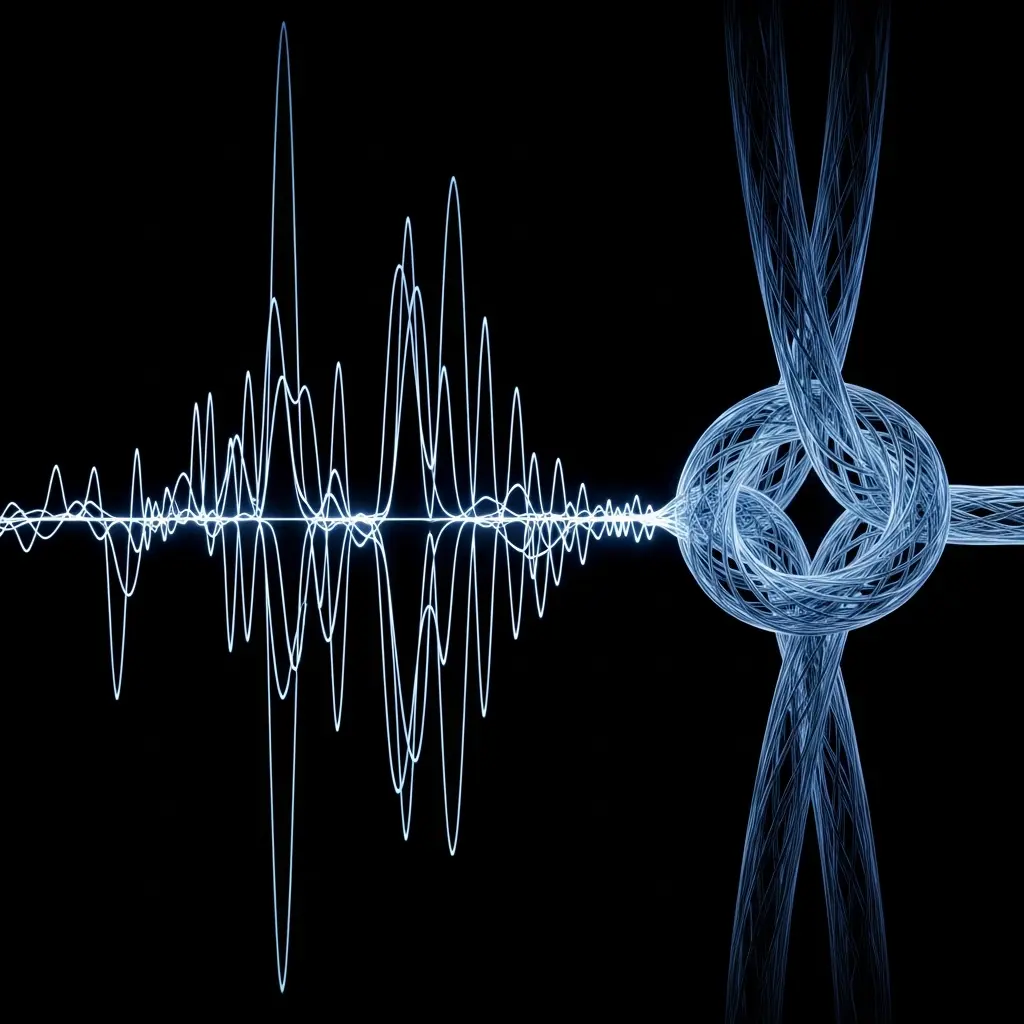
Real-valued correlations are represented by untwisted ribbons, while complex phases are encoded as chiral ±90° twists, a geometric torsion quantifying the ribbon’s deviation from a plane. This phase-sensitive framework provides a complete topological description, linking measurement-induced Pauli frame corrections to geometric features of the ribbon representation.
Chiral twists reveal phase-sensitive topology in qubit measurement
Lateral measurements in the Pauli Y basis generate complex phase factors not captured by standard link models, revealing a subtle distinction from X basis measurements at the level of connectivity alone. These complex phases manifest as chiral twists of ±90◦ when mapping quantum states to geometric ribbon representations, a crucial finding for accurately describing measurement processes on linear cluster states.
This geometric torsion parallels the correspondence between quantum evolution and geometric phases, providing a complete, phase-sensitive topological description of single-qubit projective measurements. The research establishes a direct link between quantum phases and framed invariants, effectively reformulating known measurement update rules with a novel topological structure.
Untwisted or orientation-flipped ribbons correspond to relations within the quantum system, while the observed ±90◦ twists directly encode these complex phases. This framing yields a phase-sensitive and outcome-resolved description of all single-qubit measurements, allowing for precise tracking of measurement-induced Pauli frame corrections and monitoring the flow of quantum information within measurement-based quantum computation.
Measurements in the Z basis act as severance within the associated link model, while boundary pruning occurs for end measurements. Transverse measurements, specifically in the X basis, remove the measured qubit while splicing its neighbours, preserving connectivity through real-valued correlations. The introduction of a framed ribbon representation resolves the ambiguity between X and Y basis measurements, which are otherwise indistinguishable based solely on connectivity.
Quantum measurement visualised using knot theory and braid geometry
Scientists have long sought a more intuitive and geometrically grounded understanding of how quantum information is manipulated during measurement. This work offers a significant step in that direction, demonstrating a powerful correspondence between seemingly abstract quantum operations and the concrete world of knot theory and braid geometry. The ability to visualise single-qubit measurements on cluster states as surgical operations on mathematical links is not merely an aesthetic achievement.
It addresses a fundamental challenge in quantum information processing: bridging the gap between theoretical descriptions and the physical realisation of quantum algorithms. For years, researchers have struggled to reconcile the complex phase factors that emerge during quantum measurements with simple, intuitive models. This new framework, employing a ‘framed ribbon representation’, elegantly encodes these phases as geometric twists, effectively making the invisible visible.
This has implications for designing more robust quantum protocols, particularly in measurement-based quantum computation where precise control over measurement outcomes is paramount. However, the current work is limited to one-dimensional cluster states and single-qubit measurements, a considerable simplification of more complex quantum systems. Extending this geometric approach to higher dimensions and multi-qubit interactions will be crucial.
Moreover, while the framework clarifies the how of measurement-induced transformations, the why, the ultimate physical origin of these phases, remains an open question. Future research might explore connections to topological quantum matter and the exotic properties of anyons, potentially revealing deeper links between quantum information and fundamental physics. The prospect of leveraging knot theory to engineer and control quantum states is now demonstrably more than just a mathematical curiosity.
🗞 Phase sensitive topological classification of single-qubit measurements in linear cluster states
🧠 ArXiv: https://arxiv.org/abs/2602.13990
See today’s quantum computing news on Quantum Zeitgeist for the latest breakthroughs in qubits, hardware, algorithms, and industry deals.