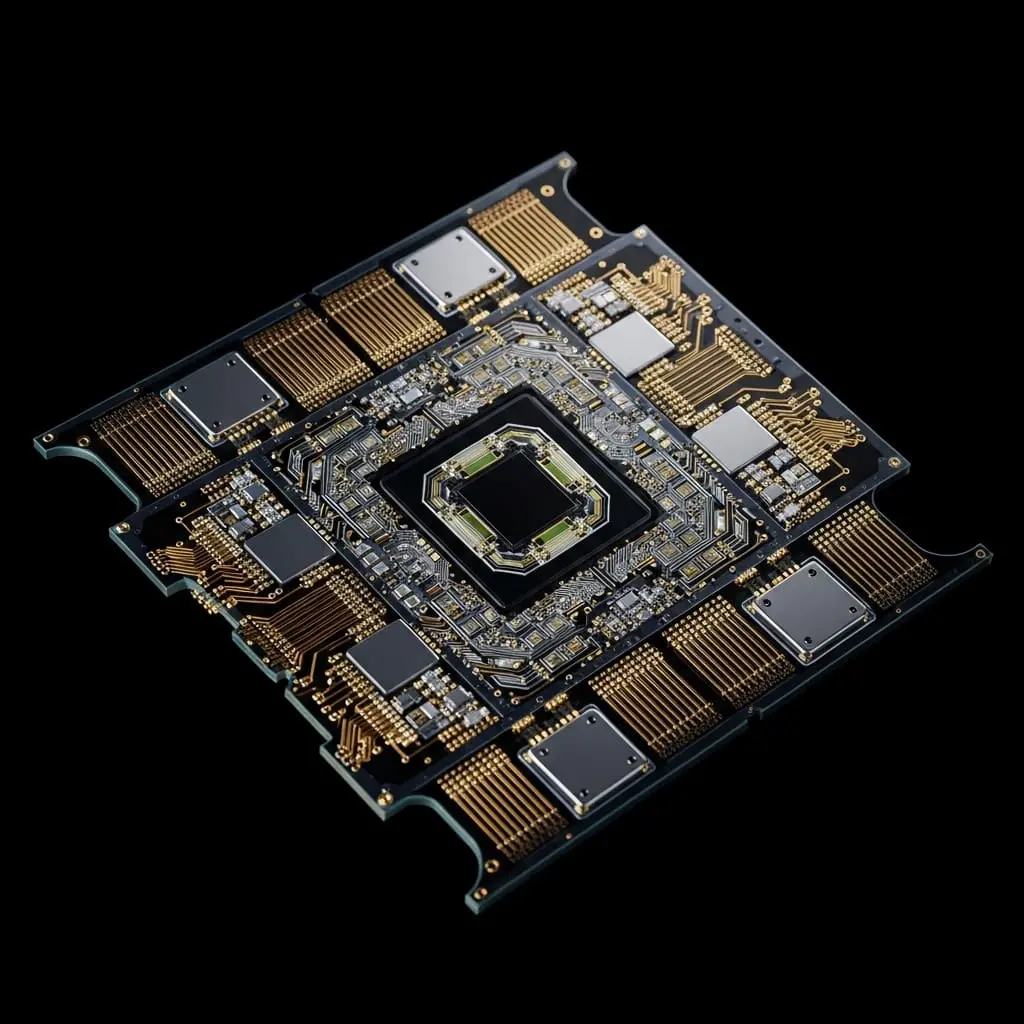
Scientists have demonstrated a novel method for controlling the interaction between qubits using a double superconducting resonator circuit. Hui Wang and Daichi Sugiyama from the Department of Physics, Graduate School of Science, Tokyo University of Science, working with Rui Wang and colleagues at Fujitsu Limited, detail how they experimentally manipulated qubit-qubit coupling by tuning qubit frequencies. Their research reveals that shifting qubit frequencies by less than 50MHz can effectively switch coupling strength from an off state to a strong coupling exceeding 5MHz. This advance is significant because the double-resonator coupler quantum circuit offers simplified fabrication, reduced flux noise, and decreased demand on dilution refrigerator cabling, potentially providing a scalable platform for future quantum processors.
This work demonstrates the ability to dynamically tune the effective coupling strength between qubits, the measure of how strongly they interact, by precisely adjusting their frequencies.
The research establishes a pathway towards more scalable and robust quantum processors by offering a method to switch qubit interactions ‘on’ and ‘off’ with unprecedented control. By shifting qubit frequencies by less than 50MHz, researchers successfully tuned the effective coupling strength from a ‘switched off’ state to a strong coupling regime exceeding 5MHz.
This double-resonator approach offers several advantages over existing qubit coupling technologies. The circuit’s simplified fabrication process reduces the introduction of unwanted flux noises, which can disrupt quantum states. Furthermore, it minimizes the demand on dilution refrigerator cables, a critical limitation in scaling up quantum systems.
Analyzing Qubit Interactions Using Spectroscopy Methods
Measuring Coupling Dynamics Using Spectroscopy Techniques
These improvements position the double-resonator coupler as a promising platform for building larger, more complex superconducting quantum processors. The study meticulously examines the switching-off processes within the circuit, observing variations in qubit-qubit coupling in both the frequency and time domains.
Measurements reveal that manipulating the energy level crossings between qubits and resonators via Z-control signals allows for precise control over the anti-crossing gap, a key indicator of coupling strength, in two-tone spectroscopy. Even with limitations in measurement equipment, such as the absence of a Josephson parameter amplifier and a relatively high base temperature of 25mK, variations in the envelope of vacuum Rabi oscillations were observed.
These oscillations directly reflect changes in the effective qubit-qubit coupling, confirming the dynamic control achieved. The theoretical model underpinning this work details how the effective qubit-qubit coupling is influenced by resonator and qubit frequencies, paving the way for optimised circuit designs.
Dynamic Qubit Coupling Via Precise Frequency Tuning
Dynamic qubit coupling via frequency tuning in a superconducting circuit
Scaling Quantum Processors with High-Qubit Arrays
A 72-qubit superconducting processor forms the foundation of this work, enabling detailed investigation of switching-off processes within a double-resonator coupler quantum circuit. The study employed a combination of frequency and time-domain spectroscopy to observe variations in effective coupling strength by precisely tuning qubit frequencies.
This approach allows for dynamic control over qubit interactions, a crucial capability for advanced quantum computation. By shifting qubit frequencies by less than 50MHz, the effective coupling strength was modulated from a switched-off state to a strongly coupled regime exceeding 5MHz, demonstrating a substantial degree of control.
Scaling Techniques for Future Quantum Processor Architectures
Design Advantages for Future Quantum System Scaling
The double-resonator coupler quantum circuit was selected for its simplified fabrication process, which inherently introduces reduced flux noise and minimizes the occupancy of dilution refrigerator cables. This design choice is advantageous as it addresses common challenges in scaling up quantum processors, potentially providing a robust platform for future large-scale systems.
Measurements were conducted using a Keysight M3202A arbitrary waveform generator and a digitizer M3102A, with microwave signals generated by an RS sgs100a signal generator. Attenuation levels of approximately 60dB were applied to the read-in and XY control lines, and 44dB to the Z-control line, ensuring signal integrity.
DC current and flux pulses were combined using bias-tees at room temperature, with infrared filters installed on both driving and readout cables to minimise unwanted thermal noise. The DC current established appropriate bias points for Rabi and vacuum Rabi measurements, while the flux pulse facilitated rapid sweeping of qubit frequencies.
This precise control over frequency tuning, combined with careful signal conditioning, enabled the observation of subtle changes in qubit-qubit coupling. To characterise the system’s response, Rabi oscillation measurements were performed, revealing the frequency dependence of qubit interactions and providing insights into the switching-off mechanism.
Tunable qubit coupling via frequency shifts in a double-resonator circuit
Shifting qubit frequencies by less than 50MHz allows tuning of the effective qubit-qubit coupling strength from a switching off point to a two-qubit gate point, where coupling exceeds 5MHz. This control is demonstrated within a double-resonator superconducting quantum circuit, representing a significant step towards scalable quantum processors.
Measurements in both the frequency and time domains reveal a clear correlation between applied qubit frequency shifts and the resulting changes in coupling strength. Two-tone spectroscopy revealed variations in the qubit-qubit anti-crossing gap as qubits’ frequencies were altered via Z-control signals.
These frequency adjustments, applied through DC-biased current, directly influence the energy level crossing points relative to the fixed-frequency resonators. Even with measurements taken under relatively noisy conditions, specifically, without Josephson parameter amplification and at a dilution refrigerator base temperature above 25mK, variations in the envelope of vacuum Rabi oscillations were observed.
These oscillations directly reflect changes in the effective qubit-qubit coupling. The study demonstrates that the effective qubit-qubit coupling can be precisely controlled, transitioning from a completely switched-off state to a strong coupling regime suitable for two-qubit gate operations with a frequency shift of approximately 50MHz.
This level of control is achieved through manipulation of the energy levels within the double-resonator system. The theoretical model underpinning this work predicts that the effective coupling, denoted as g eff , is tunable by adjusting qubit frequencies, ω β , through Z-control lines. The observed switching off of coupling, where g eff reaches zero, is realised even with minimal direct qubit-qubit coupling, g 12 , highlighting the efficiency of this approach.
The Bigger Picture
Scientists have demonstrated a remarkably precise method for switching the interaction between superconducting qubits, the building blocks of many quantum computers. This isn’t about achieving entanglement, that hurdle has been cleared, but about controlling when and how strongly qubits interact, a crucial step towards building more complex and reliable quantum processors.
For years, the field has grappled with the challenge of dynamically reconfiguring qubit connectivity without introducing unwanted noise or complexity into the system. Static, fixed connections limit computational flexibility, while overly complex switching mechanisms introduce their own sources of error.
This work offers a compelling solution by leveraging a double-resonator coupler, effectively a tunable bridge between qubits. The ability to shift frequencies by a relatively small margin, less than 50MHz, to move from a completely disconnected state to strong coupling is particularly noteworthy. It suggests a pathway to creating more densely packed and dynamically reconfigurable quantum chips, potentially easing the logistical constraints of scaling up current designs.
Fewer cables and reduced flux noise are tangible benefits, promising a less cluttered and more stable operating environment for delicate quantum states. However, the demonstrated control is currently limited to a pair of qubits. Extending this to larger, more complex networks will undoubtedly present significant engineering challenges.
Maintaining this level of precision across many coupled qubits, and ensuring that the switching process itself doesn’t introduce decoherence, remains an open question. Furthermore, the reliance on superconducting circuits means the system requires extremely low temperatures, a practical limitation for widespread deployment.
Looking ahead, this research could inspire new architectures for quantum processors, moving beyond the limitations of fixed connectivity. We might see hybrid systems combining this tunable coupling with other control mechanisms, or even the development of entirely new qubit modalities that benefit from dynamic reconfiguration. The ultimate goal isn’t just to build bigger quantum computers, but smarter ones, and this work represents a meaningful step in that direction.
🗞 Control the qubit-qubit coupling with double superconducting resonators
🧠 ArXiv: https://arxiv.org/abs/2602.11576