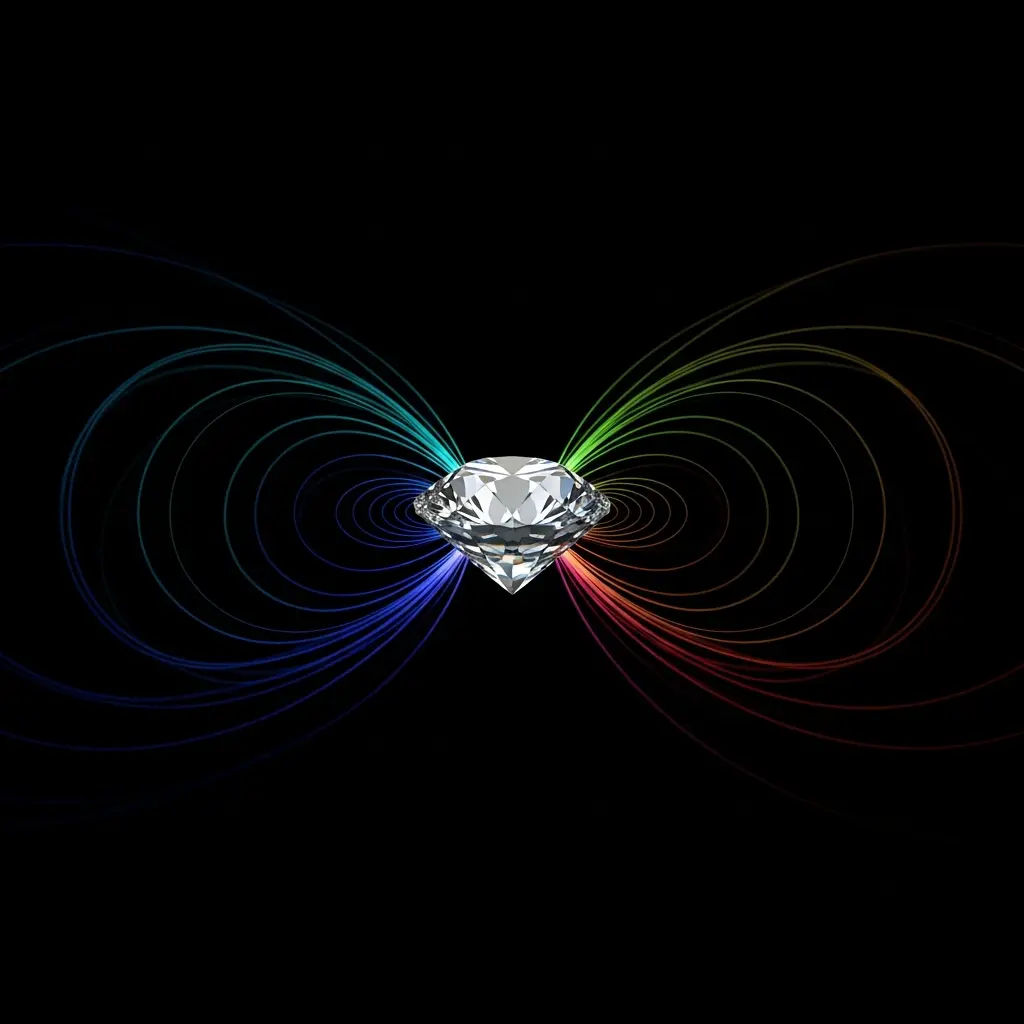
Researchers are developing a novel approach to magnetic field measurement using nitrogen vacancy (NV) centres in diamond, potentially overcoming limitations in current sensor technology. Asier Mongelos-Martinez from EHU/UPV, University of the Basque Country, Jason Tarunesh Francis from the Donostia International Physics Center, and Julia Bertero-DiTella from the Centro de Fisica de Materiales (CFM), CSIC-UPV/EHU, working with colleagues at the Donostia International Physics Center, CSIC-UPV/EHU, and EHU/UPV, University of the Basque Country, demonstrate unconditional full vector magnetometry, eliminating the need for prior knowledge of the magnetic field being measured. This represents a significant advance, as existing diamond-based magnetic sensors require such pre-calibration for optimal performance, hindering their widespread application in areas like medical diagnostics, industrial monitoring, and navigation. By exploiting spin selectivity with elliptically polarised microwave fields, the team has established a method for accurately determining both the magnitude and direction of external magnetic fields without additional assumptions or constraints.
For over a decade, NV centres, point defects in the diamond lattice exhibiting unique spin properties, have been intensely researched for their potential in creating highly sensitive magnetic sensors applicable to diverse fields including medicine, industrial monitoring, and navigation. Existing diamond-based vector magnetometry techniques typically required prior knowledge of the magnetic field being measured, restricting their versatility and full potential. This work demonstrates a technique to determine both the magnitude and direction of external magnetic fields without any prior assumptions or constraints, representing an advancement in the field of quantum magnetometry. Researchers harnessed elliptically polarized microwave fields to selectively control the spin directions within the diamond, enabling a truly unconditional measurement. This innovative approach allows for full vector magnetometry, determining the strength and direction of magnetic fields in three dimensions, solely based on the spatial arrangement of the diamond and the microwave antenna used to stimulate the NV centres. The breakthrough removes the need for pre-calibration or assumptions about the magnetic field, significantly expanding the dynamic range and simplifying the experimental setup. Researchers utilise planar resonant antennas fabricated in diamond to deliver the controlled microwave radiation, offering improved integration and signal-to-noise ratios compared to other techniques exploring light polarization for spin control. The underlying principle relies on probing the Zeeman effect, the splitting of energy levels in the presence of a magnetic field, and carefully manipulating the microwave interaction with the NV centre’s spin states to discern the field’s components. This method promises to unlock new possibilities for robust and versatile magnetic field sensing in a wide range of applications. Experimentally achieved spin selectivity forms the basis of this unconditional vector magnetometry technique, where elliptical polarizations generated in the plane of the antenna correspond to distinct electronic spin resonance (ESR) spectra. The four chosen polarizations, optimised using an automated network analyzer, demonstrate attenuation of single NV axes, enabling identification of peak distribution within the ESR spectrum. Calibration of microwave fields reveals a strong dependency of peak attenuation on microwave phase, with narrow optimal regions along the phase axis reflecting extreme sensitivity. This sensitivity allows deterministic labelling of transition lines using the proposed method. Theoretical calculations, assuming a diamond tilted −10° about the Y-axis and 1° around the X-axis, predict optimal IQ phase differences of 311°, 69°, 129°, and 248° for NV1(+), NV2(-), NV3(-), and NV4(+) respectively, closely matching values observed in the experimental data. This agreement confirms the deterministic nature of the protocol, where geometric characterisation of the setup is sufficient for full vector magnetometry and facilitates faster calibrations. Attenuation of inner peaks, occurring at frequencies close to 2.87GHz, is less pronounced, attributed to dipole coupling between NV centres and strain effects in high-NV-density diamond samples. Labelling directions starting from the outer peaks, where attenuation is optimised, allows unique identification of each axis, while the handedness of the elliptical polarization determines attenuation of the inner peaks, reflecting the sign of the field projection. Independent characterisation of the magnetic field predicted that NV2 would exhibit the largest field projection, followed by NV1, NV3, and NV4, with positive projections for NV4 and NV1 and negative projections for NV3 and NV2. Experimental results confirm this prediction, with left-handed microwave fields attenuating peaks above 2.87GHz for axes NV2 and NV3, corresponding to the |0⟩→|−1⟩ transition and a negative field projection. Although complete peak attenuation was not achieved due to the 0.5 mm³ excitation volume, the results demonstrate a significant reduction in peak visibility, with strict peak extinction observed in smaller interrogation volumes using a confocal microscope setup. This work proposes a protocol for bias-free, high-dynamic-range vector magnetometry, including a preliminary system calibration step to compensate for quadrature phase imbalances and diamond tilts. The methodology circumvents limitations inherent in existing vector magnetometry, which often require additional sensors or a pre-established bias field to constrain measurements to specific ranges. Central to the experimental setup is the utilisation of planar resonant antennas to deliver the controlled microwave radiation. The underlying principle leverages the Zeeman effect, where an external magnetic field splits the energy levels of the NV centre’s ground state spin doublet. By manipulating the microwave field’s polarization, the research team selectively excites specific spin states within the NV centre, allowing for the disentanglement of magnetic field components. The interaction between the microwave field and the NV centre’s spin states is modelled using a three-level Hamiltonian, incorporating parameters such as the zero-field splitting (D = 2.87GHz) and the electron gyromagnetic factor. This theoretical framework allows for precise prediction and interpretation of the observed ESR signals. Population transfer between spin states, induced by the resonant microwave field, directly reveals the Zeeman splitting and, consequently, the magnetic field strength along the NV centre’s orientation. By analysing signals from NV centres oriented along the four crystallographic axes within the diamond, a complete reconstruction of the three-dimensional magnetic vector field becomes possible. Scientists have long recognised existing sensors typically require prior knowledge of the magnetic field being measured. This reliance on pre-calibration has restricted their widespread adoption and limited their utility in truly unknown environments. This new approach bypasses this constraint, offering a step towards genuinely universal vector magnetometry. The breakthrough isn’t simply about improved sensitivity, but about independence from pre-existing knowledge of the magnetic field. Previous methods demanded a degree of ‘knowing what to expect’, effectively limiting the sensor’s ability to operate blindly. This work demonstrates a method for determining both the strength and direction of magnetic fields without any prior assumptions, relying instead on the clever manipulation of microwave fields and the spatial arrangement of the diamond sensor itself. It’s a subtle but crucial shift, akin to giving a compass the ability to function even when all other navigational references are lost. This advance hinges on the precise control of spin directions within the diamond using elliptically polarised microwaves. While simulations and initial experiments confirm the principle, scaling up this technique and achieving consistent performance across larger sensing volumes remains a challenge. Furthermore, the sensitivity to even slight misalignments suggests that robust, self-correcting designs will be essential for real-world deployment. Looking ahead, the implications extend beyond simply improving existing sensors. The ability to map magnetic fields without prior knowledge opens doors to entirely new applications, such as non-invasive brain imaging with greater precision, or the development of autonomous robots capable of navigating complex electromagnetic environments. The next phase will likely see efforts focused on miniaturisation, integration with other sensing modalities, and ultimately, translating this elegant laboratory demonstration into a practical, widely accessible technology.
👉 More information
🗞 Unconditional full vector magnetometry using spin selectivity in Nitrogen Vacancy centers in diamond
🧠 ArXiv: https://arxiv.org/abs/2602.12090



See today’s quantum computing news on Quantum Zeitgeist for the latest breakthroughs in qubits, hardware, algorithms, and industry deals.