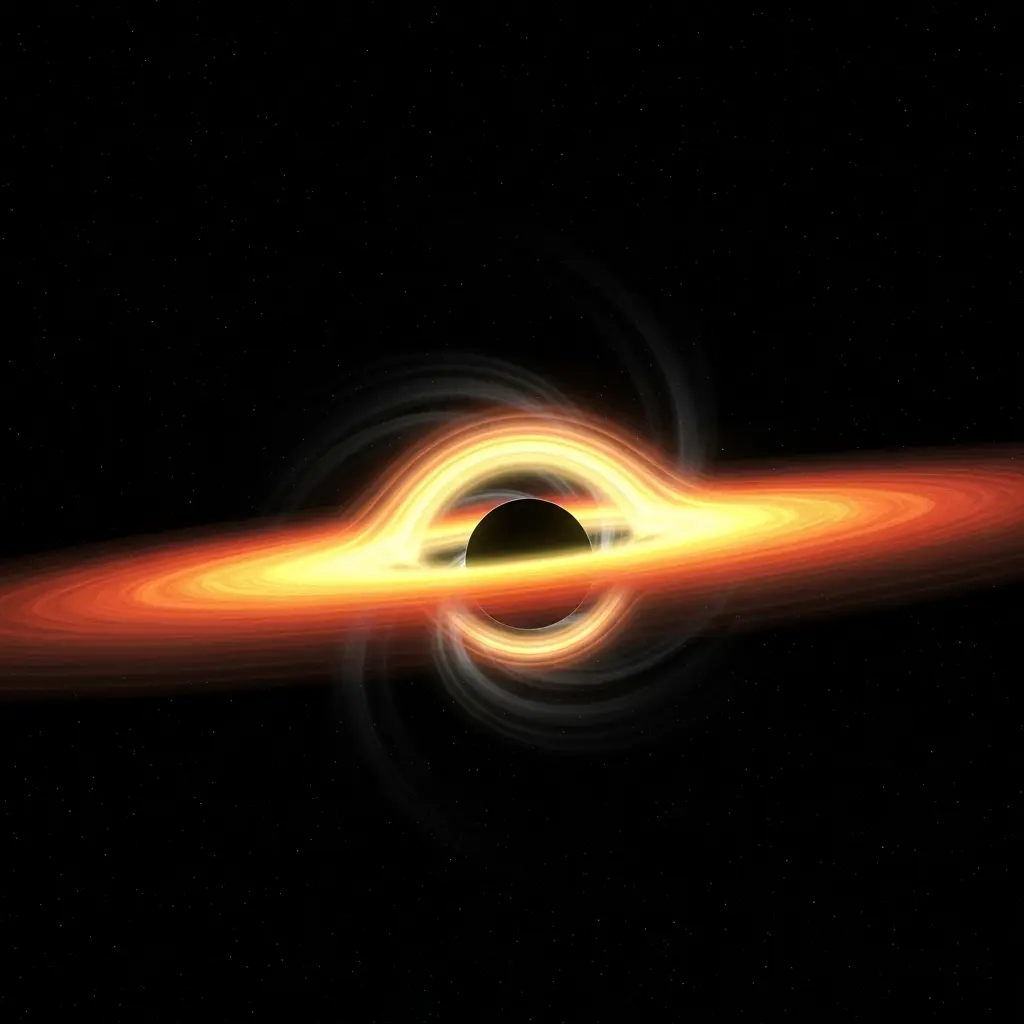
Scientists are re-examining the spectral characteristics of extended, self-gravitating accretion disks surrounding supermassive black holes. Yi-Xian Chen, Hanpu Liu, and Ruancun Li, from Princeton University and the Max-Planck-Institut f ür extraterrestrische Physik, alongside colleagues including Wang et al., demonstrate that optically thick disk solutions exhibit a universal outer effective temperature of approximately K, mirroring the properties of high-redshift sources called Little Red Dots. By modelling extended disks powered by stellar objects, this research establishes a “disk Hayashi limit” which determines the dominant optical continuum temperature, independent of accretion rate, black hole mass, or disk viscosity, and crucially resolves the parameter-tuning issues present in previous interpretations of LRDs. This work provides a quantitative link between LRDs and active galactic nuclei, offering new insights into their evolution and the role of embedded stellar populations.
This eliminates the need for precise parameter adjustments previously required when interpreting LRDs using standard disk models.
Constructing detailed global self-gravitating accretion disk models with varying accretion rates, researchers propose that the burning of embedded stellar objects efficiently powers the emission from the outer disk while simultaneously suppressing variable ultraviolet and X-ray radiation typically associated with standard quasars. The resulting emission is characterised by a strong luminous optical continuum, alongside a separate, stable ultraviolet component originating from stellar populations extending to galactic scales.
This work maps the optimal parameter space for these systems, revealing that LRD-like appearances are guaranteed for mass accretion rates exceeding 0.1 solar masses per year. Below this threshold, the system may transition towards classical, non-self-gravitating active galactic nuclei (AGN) disks, potentially representing a later stage in its evolution.
Such a transition is predicted to be accompanied by increased metallicity and the production of dust, leading to observable far-infrared emission. This research establishes a physically motivated and quantitative framework connecting LRDs with AGNs and their associated nuclear stellar populations, offering new insights into the evolution of these enigmatic objects. The study’s findings provide a robust explanation for the observed spectral properties of LRDs, resolving long-standing challenges in understanding their energy source and emission mechanisms.
Modeling Self-Gravitating Accretion Disk Systems
Spectral modelling of self-gravitating disks and Little Red Dot analogues
Modeling Self-Gravitating Disks with Stellar Power
Dust-poor opacity tables were employed to investigate the spectral appearance of extended self-gravitating accretion disks surrounding supermassive black holes. These models suggest that stellar burning efficiently powers the outer disk while simultaneously hollowing out the inner disk, thereby suppressing variable ultraviolet and X-ray radiation typically associated with standard quasars.
The resulting disk emission is primarily a luminous optical continuum, with a separate, non-variable ultraviolet component originating from stellar populations on nuclear to galactic scales. Parameter space was mapped to identify optimal conditions for these systems, revealing that LRD-like appearances are guaranteed for γ ≥ 0.4, a threshold independent of black hole mass and disk viscosity.
Below this threshold, the system may transition into classical non-self-gravitating active galactic nuclei, potentially representing a later evolutionary stage. This transition is predicted to be accompanied by increased metallicity and dust production, leading to far-infrared emission. Fiducial models with a black hole mass of 106 solar masses and an alpha viscosity of 0.1 were generated, utilising outer boundary accretion rates of 0.1 and 1 solar masses per year.
The self-consistently determined outer boundary was calculated using a method detailed in the supporting work. At a small decay slope of approximately 0.1, classical solutions were obtained, similar to those found in previous studies of optically thick, self-gravitating disks, where mass removal is modest and the scale height scales with radius to the power of 3/2.
Impact of Stellar Power on Disk Evolution
Calculating Disk Luminosity and Temperature Profiles
For radiation pressure dominated regions, the midplane temperature decreases with radius, extending to approximately 0.2 of the outer radius before transitioning into an inner alpha-disk. The luminosity of any standard AGN disk component was calculated as ε• M(Rsg)c2, where ε• is the radiative efficiency, M(Rsg) is the mass accretion rate at the self-gravitating radius, and c is the speed of light.
To suppress variable ultraviolet and X-ray emission, models with larger decay slopes were favoured, reducing the amount of mass reaching the inner disk. At a decay slope of 0.8, the disk reached an optically thin branch before the self-gravitating radius, terminating the iterative solution at a radius Rthin.
The thermal emission of the optically thick self-gravitating disk region, excluding contributions from the inner disk and optically thin zones, was quantified using a radial integration of 2πσTeff4R′dR′. This analysis demonstrated that as the decay slope increased, the standard AGN luminosity declined while the outer disk emission dominated.
Calculating Disk Luminosity and Temperature Profiles
Optically Thick Disk Temperatures and Stellar Contributions to Quasar Emission
Determining Universal Outer Effective Temperatures
Outer effective temperatures of optically thick disk solutions consistently reach K. These models revisit the spectral appearance of extended self-gravitating accretion disks surrounding supermassive black holes using dust-poor opacity tables. Assuming stellar sources primarily heat the extended disk, this “disk Hayashi limit” establishes the dominant optical continuum temperature irrespective of accretion rate, black hole mass, and disk viscosity.
Global self-gravitating accretion disk models with radially varying accretion rates demonstrate that burning of embedded stellar objects efficiently powers emission from the outer disk and hollows out the inner disk. This process strongly suppresses variable UV/X-ray emission typically associated with standard quasars.
Resulting disk emission is dominated by a luminous optical continuum, while a separate, non-variable UV component originates from stellar populations on nuclear to galaxy scales. Optimal parameter space mapping reveals that LRD-like appearances are guaranteed for, a threshold independent of black hole mass.
Below this value, the system may transition into classical non-self-gravitating AGN disks, potentially representing a later evolutionary stage. This transition is expected to coincide with enhanced metallicity and production of far infrared emission. Fiducial models with a black hole mass of 106M⊙ and outer boundary accretion rates of 0.1M⊙/year and 1M⊙/year were constructed to explore these relationships.
At a small decay slope of approximately 0.1, classical solutions similar to those in previous self-gravitating disk models are obtained, where mass removal is modest. For radiation pressure dominated regions, the midplane temperature decreases with radius, and the disk extends to approximately 0.2 of the outer boundary before transitioning to an inner α-disk.
However, at a larger decay slope of 0.4, only about half of the initial accretion rate penetrates inward to power the inner disk, further reducing with higher decay slopes. Eventually, at sufficiently large decay slopes, a qualitative transition occurs, with the disk reaching an optically thin branch before the self-gravitating radius.
This behavior is evident at a decay slope of 0.8 for an accretion rate of 0.1M⊙/year, due to depletion of mass. Any remaining accretion reaching the viscous inner disk would produce an AGN luminosity of no more than ε• M(Rthin)c2, where the actual luminosity depends on the conversion of accretion rate to stars within the region.
A Universal Disk Temperature Explains Little Red Dot Emission
Researchers have demonstrated that optically thick accretion disks surrounding supermassive black holes possess a universal outer effective temperature of approximately 4000 Kelvin. Modelling of self-gravitating accretion disks with varying accretion rates suggests that the burning of embedded stellar objects can efficiently power the outer disk emission and simultaneously suppress variable ultraviolet and X-ray radiation typically associated with standard quasars.
The resulting emission is characterised by a dominant luminous optical continuum, alongside a separate, non-variable ultraviolet component originating from stellar populations on a nuclear to galactic scale. Analysis of parameter space indicates that Little Red Dot-like appearances are expected for mass ratios of 0.01 or greater, potentially transitioning to classical non-self-gravitating active galactic nuclei disks at lower values.
This transition is predicted to coincide with increased metallicity, dust production, and subsequent far-infrared emission. The current framework is applicable to systems with moderate stellar mass to viscosity ratios, with limitations arising when the disk luminosity significantly exceeds the Eddington luminosity of the supermassive black hole.
In such cases, a more comprehensive dynamical treatment is required to accurately model the transition from star-dominated to black hole-dominated gravitational potentials. Future work will address this, potentially describing the earliest phases of Little Red Dot evolution, characterised by high stellar mass and rapid starburst activity.
🗞 Spectral Appearance of Self-gravitating AGN Disks Powered by Stellar Objects: Universal Effective Temperature in the Optical Continuum and Application to Little Red Dots
🧠 ArXiv: https://arxiv.org/abs/2602.06954



See today’s quantum computing news on Quantum Zeitgeist for the latest breakthroughs in qubits, hardware, algorithms, and industry deals.