

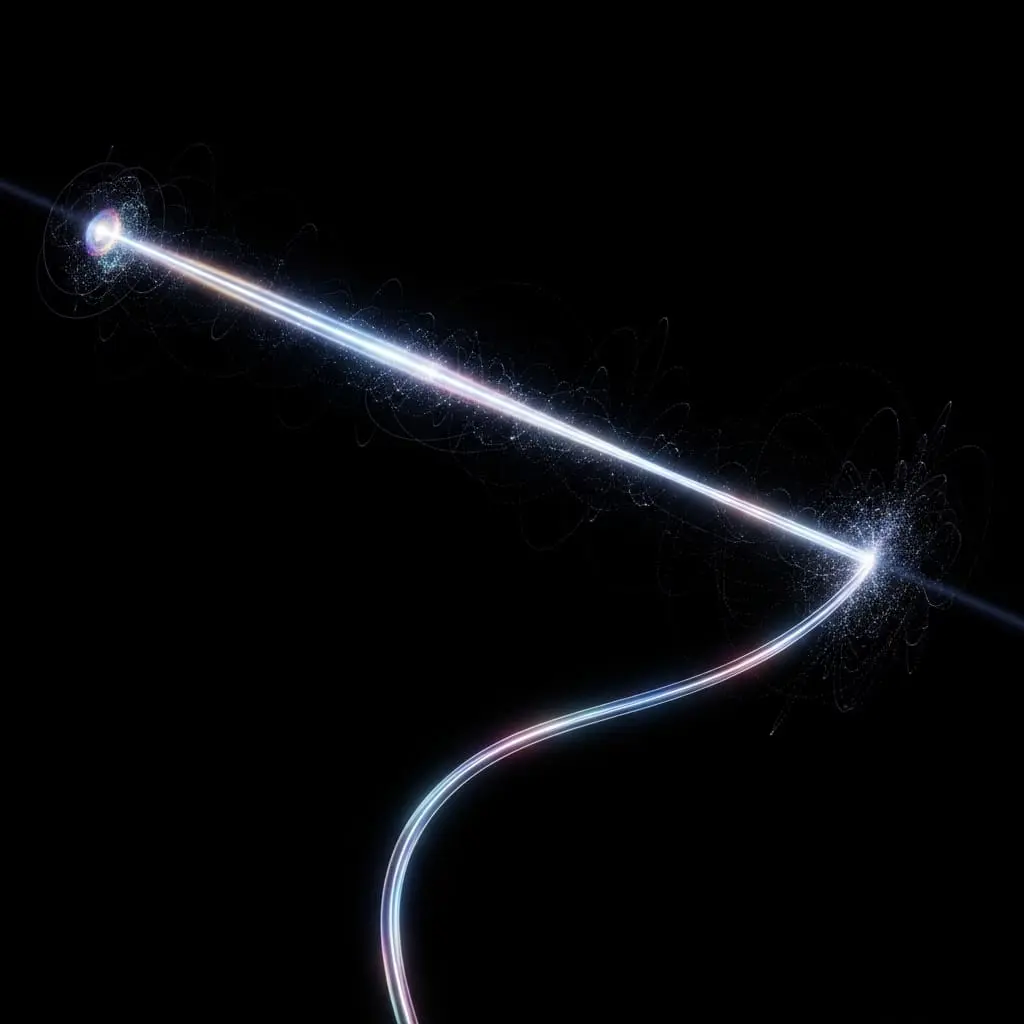
Researchers are pioneering robust communication methods for emerging space-ground networks, and a new study demonstrates a significant advance in quantum secure direct communication. Ze-Zhou Sun, Yuan-Bin Cheng, and Yu-Chen Liu, all from the Beijing Academy of Quantum Information Sciences at Tsinghua University, alongside Guo et al., have successfully implemented phase-encoded quantum key distribution over a combined 11.4km heterogeneous free-space and fibre link. This work overcomes long-held limitations regarding the suitability of phase encoding for free-space transmission, previously favoured for fibre optics, and establishes its viability for cross-medium integration. By achieving stable operation over 1400m of urban free-space with high interference visibility and low bit error rates, and seamlessly coupling this to a 10km fibre link, the team showcases a pathway towards simplified and compatible quantum networks, potentially extending to satellite-to-ground distances exceeding 30km.
Turbulence compensation enables robust free-space to fibre quantum key distribution
Overcoming Atmospheric Challenges in Free-Space Links
Overcoming Atmospheric Challenges in Free-Space Links
Scientists have demonstrated phase-encoded quantum communication over a 1.4km urban free-space channel, a feat previously considered impractical due to atmospheric disturbances. This work overcomes long-standing challenges in free-space quantum networking, establishing a viable pathway for integrating quantum signals across different transmission media.
The system maintained stable operation for nearly one hour, achieving 99.07% interference visibility and an average quantum bit error rate of 2.38%, showcasing remarkable resilience to environmental factors. Crucially, the free-space quantum states were directly coupled into a 10km optical fiber, confirming seamless interoperability between free-space and fiber networks.
This achievement hinges on effective compensation for turbulence-induced phase drifts between successive picosecond pulses, a significant technical hurdle in free-space quantum communication. Researchers developed a system utilizing a 1.25-GHz weak coherent light source with pure phase modulation to encode and transmit quantum information.
Validated Performance and Feasibility of Long-Distance Links
Validating Performance for Long-Distance Quantum Links
The successful implementation of a one-way quasi-quantum secure direct communication protocol yielded a communication rate of 4.22 kbps, demonstrating practical data transmission capabilities. This performance validates the potential of phase encoding for long-distance quantum links, particularly those involving satellite-to-ground communication.
The compatibility of this encoding scheme with existing fiber infrastructure simplifies network integration and reduces overall system complexity. By employing a patch-cord optical interface, the trusted boundary of the system is extended, enhancing both security and deployment flexibility. Furthermore, a qubit transmission model was established, providing a theoretical foundation for future space, ground quantum networks and paving the way for efficient resource utilization through multifunctional integration. Numerical simulations and a cascaded-link model indicate feasibility for free-space distances exceeding 30km, underscoring the scalability of this approach.
Architecting the Weak Coherent Pulse Encoding System
Detailed Pulse Generation and Encoding Mechanisms
Weak coherent pulse generation and four-phase quantum state encoding via cascaded phase modulation
A 1.25GHz laser generating weak coherent pulses with a 50ps pulse width and a central wavelength of 1549.32nm initiates the quantum communication process. The laser output is modulated by an intensity modulator driven by a field-programmable gate array, creating signal states with an intensity of μ= 0.71, decoy states with ν1 = 0.28, and vacuum states with ν2 = 0, in a 30:2:1 ratio.
Precise Phase Manipulation for Quantum Information Encoding
This modulation is integral to the subsequent encoding scheme and security protocols employed in the study. Following modulation, pulses enter a Faraday, Sagnac, Michelson interferometer, where encoding occurs at the transmitter. Two cascaded phase modulators randomly modulate phases of {0 or π/2} and {0 or π} respectively, enabling random four-phase modulation through their combination.
This precise phase manipulation is crucial for encoding quantum information onto the photons. Each pulse is then split into two pulses separated by 400ps and wavelength-division multiplexed with a 500kHz clock synchronization signal at 1550.92nm. The research established a 1.4km free-space channel across an urban lake in Hefei, China, linking the transmitter at (31◦53′36.4′′N, 117◦09′54.7′′E) to the receiver at (31◦54′18.6′′N, 117◦09′38.5′′E).
Photons arriving at the receiver were coupled into a 10km optical fiber using a passive telescope system featuring a 120mm entrance pupil, 27.1× magnification, a 395mm focal length, and a 330mm optical path length. A triplet fiber-optic collimator facilitated efficient free-space, fiber coupling, demonstrating seamless interoperability between media.
Experiments were conducted under varying atmospheric conditions, including evening conditions with wind level 2, 23◦C, 60% humidity, and 24.1km visibility, and early morning conditions with wind level 1, 29◦C, 40% humidity, and 14km visibility. Bob detects photons using a dual-channel InGaAs/InP single-photon detector operating at 1.25GHz with 20% detection efficiency, a dark count rate of 1 × 10⁻⁶, and an afterpulse probability of 1%.
The system maintained stable operation for nearly one hour, achieving 99.07% interference visibility and an average bit error rate of 2.38. Real-time monitoring recorded performance metrics including the quantum bit error rate, secure communication rate of 4.22 kbps, key consumption rate, key generation rate, and percentage of key recycling, calculated as Prec = 1 −Qμ/2.
High-fidelity quantum key distribution across extended urban free-space and fibre links
Interference visibility reached 99.07% during stable operation over 1400m of urban free space. The system also maintained an average bit error rate of 2.38% during this period, demonstrating robust performance in challenging atmospheric conditions. Free-space quantum states were directly coupled into fiber and transmitted over an additional 10km, confirming seamless interoperability between different transmission media.
These results establish a pathway for integrating free-space quantum communication with existing fiber-optic infrastructure. Average visibilities over a two-day experiment reached 98.38% and 99.07%, comparable to state-of-the-art fiber-based quantum communication systems. The average QBERs measured over the two days were 3.61% and 2.38%, respectively, indicating reliable data transmission.
Interference visibility significantly surpassed that of previous free-space demonstrations, despite the increased number of transmitted quantum states and the extended free-space distance. Active scanning of interference visibility during temporary QBER excursions ensured conservative lower bounds for reported values.
The 1.25-GHz phase-encoded quantum states withstood turbulence-induced phase drifts through active compensation mechanisms. Detector counts yielded interference visibility, enabling the determination of phase differences and subsequent application of voltage offsets to counteract phase drift. This dynamic feedback compensation proved effective, as the timescale of turbulence fluctuations, ranging from 0.01 to 0.1 seconds, is significantly longer than the 400ps separation between adjacent pulses.
Spatial-mode filtering via coupling into single-mode fibers further mitigated spatial perturbations, with potential for enhancement through adaptive optics. The STIKE protocol achieved communication rates of 4.22 kbps and 3.90 kbps, with corresponding key consumption rates of 21.18 kbps and 27.68 kbps.
Key generation rates reached 13.51 kbps under strong atmospheric turbulence and increased to 30.42 kbps during stable channel conditions. Average key recycling efficiencies were 99.9% and 99.97% over the two days, aligning closely with theoretical predictions of 1 −Qμ/2. Simulations, utilising a 10km fiber link, indicate that the system’s key generation rate is approaching the theoretical limit, although the communication rate remains slightly below the corresponding bound.
Successful urban deployment and fibre integration of a phase-encoded quantum communication system
Researchers have demonstrated phase-encoded quantum communication over a 1400-metre urban free-space link, representing a significant advance in space-ground networking technology. The system operated stably for nearly one hour, achieving high interference visibility of 99.07% and a low bit error rate of 2.38%.
Crucially, the free-space quantum states were successfully coupled into a fibre optic cable and transmitted over a further 10 kilometres, confirming seamless interoperability between the two media. This work establishes the viability of phase encoding for free-space quantum communication, simplifying integration with existing classical infrastructures and offering compatibility across different transmission mediums.
Numerical simulations and a cascaded-link model suggest that this approach is feasible for distances exceeding 30 kilometres, potentially enabling satellite-to-ground links. The system achieved a record transmission rate of 4.22 kbps, an eightfold improvement over previous free-space quantum key distribution implementations and a 140-fold increase in transmission distance.
The authors acknowledge that performance is affected by atmospheric turbulence, but their system effectively compensates for phase drifts between successive pulses. Future research may focus on further extending the transmission distance and exploring applications in distributed quantum computing and quantum sensing, building upon the demonstrated universal architecture for cross-medium communication.
🗞 High-speed phase-encoded quantum secure direct communication over 11.4km heterogeneous free-space and fiber links
🧠 ArXiv: https://arxiv.org/abs/2602.06624


See today’s quantum computing news on Quantum Zeitgeist for the latest breakthroughs in qubits, hardware, algorithms, and industry deals.



