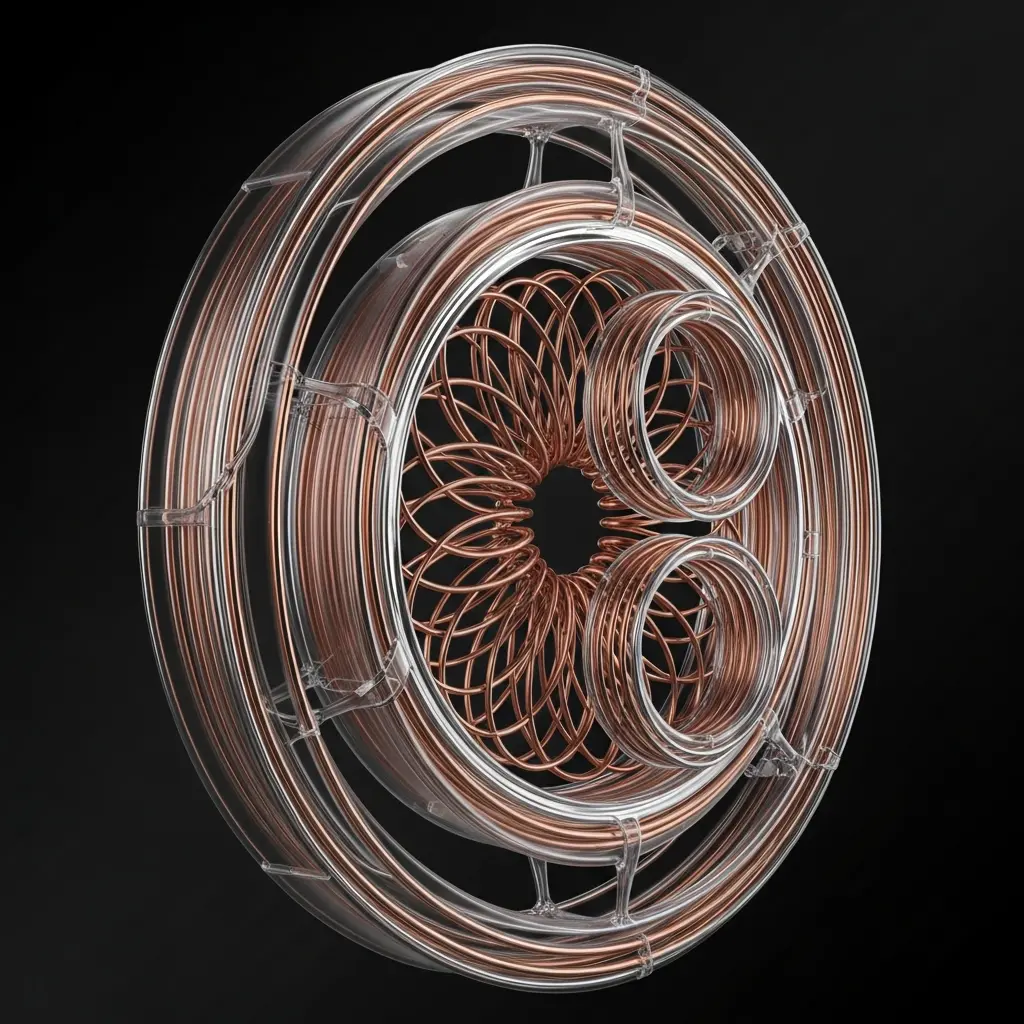
Researchers are addressing limitations in Magnetic Resonance Imaging (MRI) signal reception with a novel topological metamaterial design. Siyong Zheng, Maopeng Wu, and Zhonghai Chi, from the State Key Laboratory of New Ceramics and Fine Processing at Tsinghua University, alongside Mingze Weng and Fubei Liu et al., demonstrate a method for enhancing signal-to-noise ratio without relying solely on increased channel numbers or magnetic field strength. Their work details a metamaterial constructed from weakly coupled stacks, creating quasi-two-dimensional dual boundary states that facilitate low-loss signal transmission and locally enhanced magnetic fields. Initial evaluations reveal this new approach outperforms conventional commercial coils, representing a potentially transformative advancement in MRI coil technology and offering a pathway to more accessible and higher-performance medical imaging.
Researchers have now demonstrated a novel approach utilising a topological material to substantially improve MRI signal reception.
This innovative material, designed with a stack of weak couplings, establishes quasi-two-dimensional dual topological boundary states, facilitating high-performance characteristics through low-loss signal transmission and enhanced local magnetic fields. Initial testing reveals that this new design surpasses the performance and accessibility of currently available commercial coils, indicating considerable potential for future clinical applications.
The work introduces a transformative paradigm for all MRI coil designs by moving beyond traditional array coil limitations. This topological material achieves superior performance not through simply increasing channel count, but through the unique properties of its internal structure. Specifically, the material’s quasi-two-dimensional dual topological boundary states enable efficient, low-loss transmission of signals, effectively acting as a “movable bridge” connecting magnetic resonance signals to the receiver.
Passive Design Simplifies Integration and Enhances Signal Quality
This interface-free, passive design requires no special protocols, simplifying integration with existing MRI equipment and offering a significant advantage over complex, manufacturer-specific systems. Seamless integration with standard spine (SP) and body birdcage (BC) coils addresses common issues of weak SNR and poor field uniformity often experienced with these components.
The material directly enhances signal reception and improves image SNR, delivering clearer and more reliable images without the need for extensive post-processing. When exposed to radiofrequency pulses, the material undergoes a topological phase change, transitioning into a trivial state, analogous to a bridge opening, preventing amplification of the excitation field and ensuring patient safety.
Human Trials Demonstrate Clearer Imaging Performance
Demonstrations on ten healthy volunteers using a 1.5 Tesla MR scanner confirmed these advantages during human wrist joint imaging. The new material significantly outperformed a standard four-channel flexible coil and achieved comparable results to a specialised twelve-channel wrist coil across multiple MRI sequences, representing a substantial advancement in both performance and accessibility for magnetic resonance imaging.
Topological metamaterial fabrication and characterisation of radiofrequency magnetic field enhancement
Modeling and Fabrication of Topological Coils
A stack of topologically meta-reflective metamaterial (TMRM) sheets forms the basis of a new approach to enhance magnetic resonance imaging (MRI) signal reception. Researchers initially modelled the alternating coupling elements within the Su-Schrieffer-Heeger (SSH) model using CST Microwave Studio to analyse their impact on the near radio frequency magnetic field.
Simulation results confirmed that the TMRM sheets successfully reproduced the topological boundary states at the desired frequency of 63.8MHz. Subsequently, the TMRM unit was fabricated utilising standard commercial printed circuit board techniques, aligning with the simulation predictions. Employing a spoiled gradient echo sequence with the standard Dual-Angle Method, the team tested the B1+ field within a water phantom.
These tests successfully demonstrated the formation of one-dimensional topological boundary states by the TMRM sheets. Inspired by Weak Topological Insulator theory, the study investigated stacking approaches to construct quasi-two-dimensional dual topological boundary states. One method involved periodically and rotationally arranging the TMRM sheets along a cylindrical wall, creating strong coupling and non-degenerate energy levels, thus forming quasi-two-dimensional semi-infinite topological boundary states.
Alternatively, researchers adjusted the curvature angle of the TMRM sheets to regulate coupling strength, achieving weakly coupled stacking of one-dimensional topological boundary states. This configuration localized the magnetic field on both the inner and outer rings of the TMRM, uniformly covering a 150mm diameter circular area.
The outer ring’s proximity to the body coil (BC) , functioning as both transmit and potential receive coil, offered convenient integration, eliminating the need for additional interfaces. MRI experiments on a water phantom, conducted using a 1.5 T scanner, compared the impact of different topological boundary state configurations on image signal-to-noise ratio (SNR).
Dual topological boundary states (DTBS) increased SNR more than twofold compared to a flat layer configuration (FLC), while internal topological boundary states (ITBS) showed some improvement. External topological boundary states (ETBS) suppressed the image SNR, highlighting the importance of maintaining dual topological boundary states for efficient signal transmission and improved SNR.
Topological Metamaterial Performance Mirrors Established Coils in Human Wrist MRI
Initial human wrist joint imaging using a 1.5 T MR scanner demonstrated that the Topological Magnetic Resonance Metamaterial (TMRM) outperformed a standard four-channel flexible coil and achieved results comparable to a specialized 12-channel wrist coil across three MRI sequences. Specifically, TMRM delivered performance mirroring the 12-channel wrist coil in T1-weighted spin-echo, T2-weighted fast spin-echo, and T2-weighted multi-echo imaging.
Bone marrow signal-to-noise ratio (SNR) with TMRM was slightly lower than the 12-channel wrist coil, but muscle and cartilage SNR remained comparable between the two. Image quality scores, assessed from scans of ten healthy volunteers, were similar for TMRM and the 12-channel wrist coil and consistently exceeded those obtained with the four-channel flexible coil.
Water phantom imaging further confirmed these findings, showing comparable SNR between TMRM and the 12-channel wrist coil when used in conjunction with the spine coil. When paired with the body birdcage coil, TMRM outperformed the four-channel flexible coil but did not reach the sensitivity of the 12-channel wrist coil, indicating the spine coil’s superior performance in this configuration.
TMRM consistently exhibited superior image uniformity compared to both the four-channel flexible coil and the 12-channel wrist coil, as demonstrated in water phantom analysis. The enhanced SNR achieved with TMRM translated directly into clearer and more detailed images, improving the potential for accurate diagnosis and assessment of wrist conditions. A new topological metamaterial receiver coil, termed TMRM, demonstrates enhanced MRI signal reception through a stack of weak couplings forming quasi-two-dimensional dual boundary states.
These states facilitate low-loss signal transmission, alongside enhanced local magnetic fields and an increased effective channel count, resulting in superior performance and accessibility compared to conventional coils. The TMRM design incorporates a topological phase transition that effectively isolates the radiofrequency transmission field from the received signal, ensuring compatibility with both spin echo and gradient echo imaging sequences without requiring adjustments to standard parameters.
Simulations indicate a 9.2-fold enhancement in central magnetic field strength when the TMRM is in a topologically non-trivial state, and initial tests reveal improved signal-to-noise ratio and image uniformity exceeding that of standard four-channel flexible coils and matching the performance of specialized twelve-channel wrist coils. The TMRM functions as a complement to existing array coils, compensating for limitations in signal strength and field distribution to improve diagnostic accuracy.
The authors acknowledge a current limitation in the radial thickness of the TMRM, approximately five centimetres, which presents challenges for optimization and adaptation to constrained anatomical regions. Future research will focus on minimizing the impact of the TMRM on the spatial sensitivity of local receive coils through the application of protection theory, and further work is needed to reduce the device’s size and weight while maintaining performance. This topological metamaterial approach represents a novel paradigm for MRI coil design, offering a promising strategy to overcome existing challenges and enhance imaging capabilities.
🗞 Topological Metamaterial for Magnetic Resonance Imaging
🧠 ArXiv: https://arxiv.org/abs/2602.05256