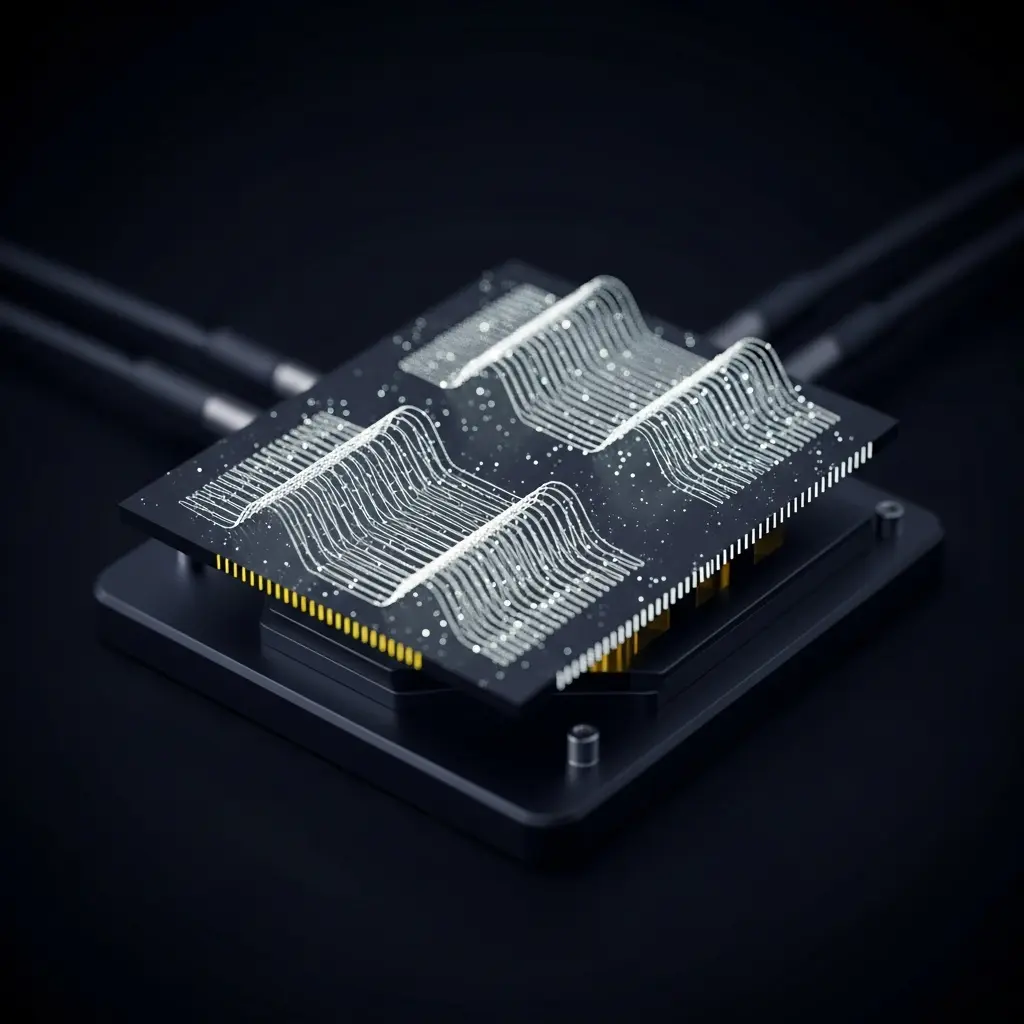
Researchers are actively exploring frequency-based encoding as a promising route towards reducing the hardware demands of scalable quantum computation. Muñoz-Arias, Randles, and Otterstrom, from Sandia National Laboratories, alongside colleagues Davids, Gehl, and Sarovar, present novel designs for frequency-mode beam splitters utilising modulated arrays of coupled resonators. This work addresses a key challenge in linear optical quantum computing, the energy-non-conserving and costly nature of traditional beam splitters and phase shifters. By developing a flexible methodology based on the SLH formalism, the team demonstrate the construction of effective transfer matrices for these devices, paving the way for more compact and efficient quantum architectures. Their analysis extends to specific device designs and culminates in a formal theorem outlining limitations in natively generating certain frequency-domain beam splitters with resonator arrays.
Frequency-domain beam splitting via coupled resonators and SLH transfer matrices
Developing the Theoretical Design Framework
Designing frequency-domain beam splitters using theory
Researchers have developed a new theoretical framework for designing frequency-domain beam splitters using arrays of coupled resonators, a crucial component for scalable photonic quantum computing. This work addresses a significant challenge in quantum information processing: implementing linear optical transformations for qubits encoded in frequency modes, which promises reduced hardware footprint and increased robustness against noise.
The team’s methodology constructs effective transfer matrices using the SLH formalism for quantum input-output networks, enabling the creation of N-mode beam splitters from arrays of N-resonators or interconnected smaller l-mode beam splitters, where l is less than N. This flexible and composable approach allows for the modelling of complex networks by simple matrix multiplication, greatly simplifying the design process.
The study begins with a detailed analysis of a two-resonator device, demonstrating the construction of frequency-domain phase shifters and Mach-Zehnder interferometers. Extending this analysis, researchers then investigated a four-resonator device, exploring the possibilities and limitations of multi-mode transformations.
A formal no-go theorem was also derived, establishing conditions under which certain N-mode frequency-domain beam splitters cannot be natively generated using arrays of N-resonators. This theorem highlights fundamental constraints in the design of these devices and guides future research towards feasible architectures.
This methodology provides a complete quantum theory for ring resonator-based frequency-domain beam splitters, building upon modern input-output theory and the SLH formalism. The ability to accurately model these devices with transfer matrices, even with their time-dependent active modulation, is a key advancement.
Optimizing Device Performance Through Parameters
Optimizing device performance through parameter analysis
This simplifies the modelling of large linear optics networks, previously a significant computational burden. Furthermore, the research analyzes the sensitivity of device performance to variations in ring and modulation parameters, providing valuable insights for optimizing device fabrication and operation.
The work’s findings are expected to accelerate the development of integrated photonic platforms for fault-tolerant quantum computing, offering a pathway towards scalable and efficient quantum processors. By providing a robust theoretical foundation and practical design tools, this research paves the way for realizing the potential of frequency-encoded qubits and advancing the field of photonic quantum information processing.
Effective transfer matrix construction for multi-mode beam splitter design
Scaling Photonic Systems onto Quantum Processors
Scaling photonic beam splitters onto quantum processors
Designing for Superconducting Qubit Integration
A 72-qubit superconducting processor forms the foundation of this research into frequency-mode beam splitters for photonic quantum computing. The study centres on designing beam splitters utilising modulated arrays of coupled resonators, addressing limitations inherent in traditional linear optics which are not energy-conserving and costly to implement.
Researchers developed a methodology to construct effective transfer matrices, leveraging the SLH formalism for quantum input-output networks to describe these devices. This methodology provides flexibility in defining N-mode beam splitters, either natively using arrays of N-resonators with arbitrary connectivity or as networks of interconnected l-mode beam splitters, where l is less than N.
The work applies this methodology to analyse a two-resonator device, establishing its behaviour as a frequency-domain phase shifter. A Mach-Zehnder interferometer was then constructed by composing these devices, followed by analysis of a four-resonator device to further validate the approach. Crucially, the research presents a formal no-go theorem demonstrating the impossibility of natively generating certain N-mode frequency-domain beam splitters using arrays of N-resonators.
Transfer matrices, a standard description of linear optics components, were adapted to model the resonant, time-dependent, actively modulated ring resonator beam splitters. This adaptation allows for the composability of transfer matrices, simplifying the modelling of large networks by multiplying individual component matrices, and greatly easing the burden of modelling complex systems of ring resonator devices. The study builds upon modern input-output theory, enabling a deeper understanding of these frequency-domain transformations and their potential for scalable integrated photonic platforms.
Effective transfer matrices for multi-mode beam splitters in coupled resonator networks
Designs of frequency-mode beam splitters, constructed from modulated arrays of coupled resonators, have been developed utilising the SLH formalism for quantum input-output networks. This methodology allows for the construction of effective transfer matrices for -mode beam splitters, either natively using arrays of -resonators with arbitrary connectivity or as networks of interconnected -mode beam splitters, where .
Analysis of a two-resonator device, a frequency-domain phase shifter, and a Mach-Zehnder interferometer, composed of these devices, has been completed alongside a four-resonator device. A formal no-go theorem demonstrates the impossibility of natively generating certain -mode frequency-domain beam splitters with arrays of -resonators.
This work greatly alleviates the burden of modelling networks of ring-resonator based (RBS) devices. Application of the derived transfer matrices to model devices composed of multiple frequency-domain transformations reveals interesting multimode transformations and associated design tradeoffs. For these multimode devices, the research details the possibilities of frequency-domain transformations enabled by networks of coupled, modulated ring resonators.
Sensitivity analysis of RBS device performance as a function of ring and modulation parameters has also been undertaken. The study establishes a direct relation between the elements of the SLH triple and the A, B, C, and D matrices defining the system, facilitating the construction of effective transfer matrix descriptions.
Specifically, the ABCD representation allows for the derivation of the frequency-domain transfer function, Ξ(ω) = [C(iωIM −A)−1B + D], where IM is the identity matrix and ω represents frequency. This formulation provides a pathway for modelling complex linear optical networks acting on frequency modes, even with time-dependent modulation and resonant structures. The methodology is highly composable, enabling the analysis of arbitrarily complex quantum input-output networks.
Resonator array limitations and frequency-mode beam splitter design
Researchers have developed designs for frequency-mode beam splitters utilising modulated arrays of coupled resonators, offering a potential reduction in the hardware requirements for quantum computing systems. These beam splitters, essential components in quantum information processing, are constructed using linear optics, typically beam splitters and phase shifters, but this implementation explores an alternative approach based on resonator modulation.
A key methodological advancement involves constructing effective transfer matrices using the SLH formalism, enabling the creation of flexible and composable beam splitters with varying dimensions and connectivity. The methodology was applied to analyse devices ranging from two to four resonators, demonstrating the ability to create frequency-domain phase shifters and Mach-Zehnder interferometers.
Analysis revealed a no-go theorem concerning the native generation of certain frequency-mode beam splitters using arrays of resonators, highlighting inherent limitations in the design space. Furthermore, investigations into under-coupled resonator-waveguide systems identified specific modulation amplitudes at which optimal beam splitting ratios are achievable, even when operating outside the strongly-coupled regime typically favoured in current designs.
The authors acknowledge limitations in achieving certain beam splitter configurations, particularly 50-50 splitters, within the under-coupled regime. They also note that the performance of these devices is dependent on parameters such as modulation amplitude and the coupling strength between resonators and waveguides. Future research could focus on overcoming these limitations through improved device engineering and exploring alternative resonator configurations to expand the range of implementable frequency-mode beam splitters, ultimately contributing to more compact and efficient quantum computing architectures.
🗞 Modeling integrated frequency shifters and beam splitters
🧠 ArXiv: https://arxiv.org/abs/2602.06003
See today’s quantum computing news on Quantum Zeitgeist for the latest breakthroughs in qubits, hardware, algorithms, and industry deals.