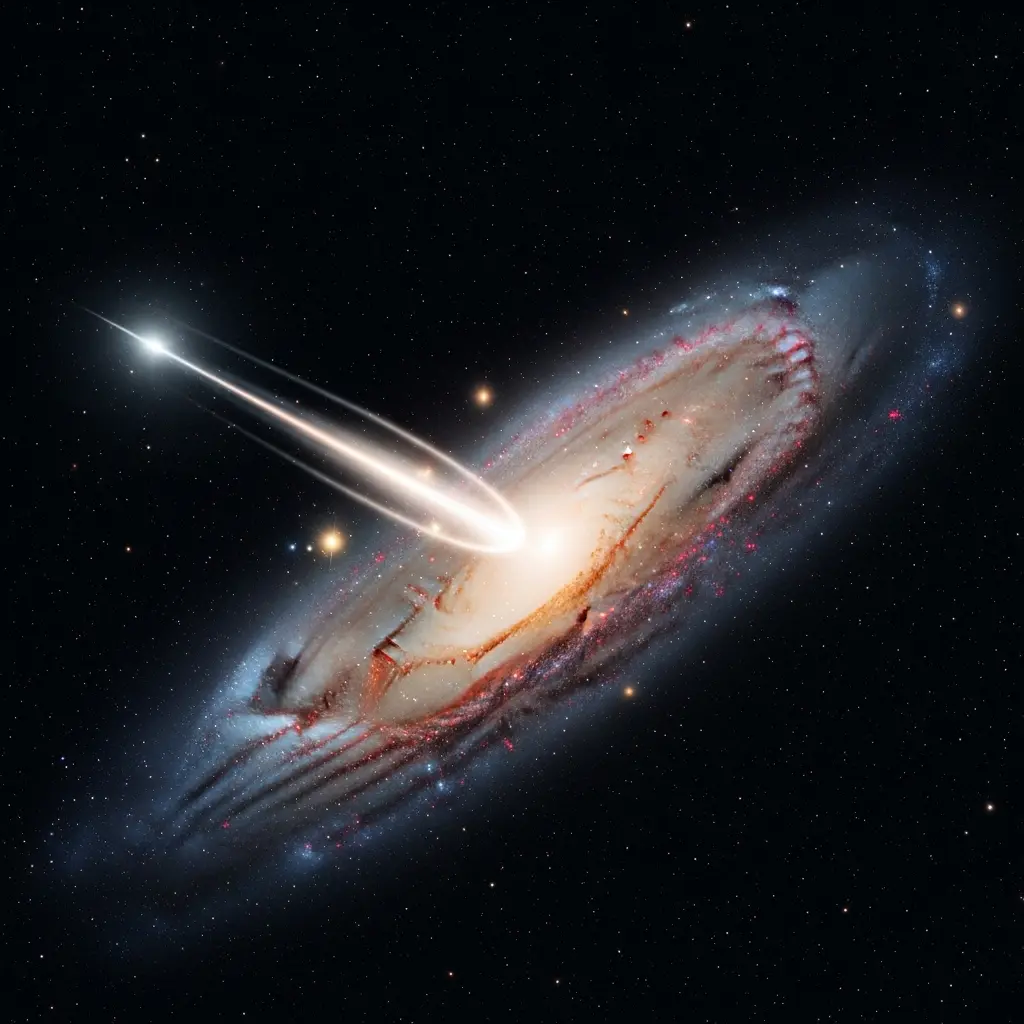
Scientists investigating stellar dynamics at the centre of the Milky Way have identified a star, IRS 9, exhibiting unusual orbital characteristics. Matthew Hosek Jr. from UCLA, alongside Tuan Do and Smadar Naoz et al., present high-precision proper motion measurements of stars near the supermassive black hole Sagittarius A*, revealing IRS 9 possesses a three-dimensional velocity of 370 ±1.2km/s. These findings, derived from 14 years of Hubble Space Telescope observations, suggest IRS 9 may have undergone a significant dynamical interaction, potentially offering crucial insights into the extreme astrophysical processes shaping galactic nuclei and challenging current models of stellar evolution in these environments.
The research team attained a median precision of 0.038 mas/yr in proper motion measurements, representing an improvement of up to ~100times over prior constraints for some sources.
Leveraging high-precision astrometry for stellar dynamics
This leap in accuracy was achieved through meticulous analysis of data collected between 2010 and 2023 using the HST WFC3-IR instrument. By combining these precise measurements of stellar positions with previously published radial velocities, researchers constructed detailed three-dimensional velocity maps of the stars orbiting SgrA*.
These maps allowed for a definitive assessment of which stars are genuinely unbound from the Galactic Center’s gravity. Orbit integrations have placed the first constraints on the orbit of IRS 9, demonstrating it is bound to the Galactic Center at larger radii, with its closest approach at ≥ 0.100 ±0.005 pc and farthest distance at ≥ 5.25 ±0.18 pc.
Interpreting the extreme velocities observed near the cluster
The high velocity of IRS 9 relative to other stars in the Nuclear Star Cluster suggests it underwent a significant dynamical event, potentially including a binary supernova disruption, two-body interactions, or stellar collisions. Understanding the mechanisms that propelled IRS 9 to its current trajectory is crucial for deciphering the complex interplay of forces within galactic nuclei and could provide insights into similar phenomena observed in other galaxies.
Cross-matching stellar data using Gaussian processes
Identifying additional stars exhibiting such unusual motions will be essential for building a comprehensive understanding of the dynamical processes shaping these extreme environments. Initially, the HST astrometry from each epoch underwent transformation into the Gaia-CRF3 reference frame, aligning it with the International Celestial Reference System.
Stars were then cross-matched across epochs, and proper motions were calculated using a sophisticated method employing Gaussian Processes to simultaneously model systematic correlations within the astrometry. This technique effectively mitigates instrumental distortions and enhances the accuracy of the derived stellar velocities.
Transforming proper motions into the SgrA frame
Transforming stellar proper motions into the SgrA frame
Finally, the proper motions were transformed into a SgrA-at-Rest frame, utilizing the ICRS position and proper motion of SgrA as determined by Xu et al. The study identified HST counterparts for 25 SiO masers, leveraging radio-based proper motion measurements to predict maser positions at 2015.5. An HST source was considered a match if its position aligned with the radio prediction within a 0.15 arcsecond radius and exhibited a reduced chi-squared statistic of less than 5, ensuring a high-quality astrometric fit. Precise orbital constraints have been placed on IRS 9, indicating it remains bound to the Galactic Center at larger radii, with a periapsis (closest approach) of ≥ 0.100 ±0.005 pc and an apoapsis (farthest distance) of ≥ 5.25 ±0.18 pc.
The study successfully matched 23 of the 25 SiO-maser emitting stars with HST sources, employing a matching radius of 0.15′′ and a reduced chi-squared statistic less than 5 to ensure data quality. Masers varied in brightness from 10.95 mag to 17.73 mag during the observations. IRS 9’s high velocity relative to other stars within the Nuclear Star Cluster suggests it may have undergone a significant dynamical event.
Confirming the rogue star’s unbound status from the core
Calculations reveal that at a projected radius of 0.33 pc, IRS 9’s velocity exceeds the maximum escape velocity by 5.9σ, confirming its unbound status. The observed velocity of IRS 9 corresponds to a velocity at infinity relative to the supermassive black hole of 134 ±18km/s, representing a lower limit as the true physical radius may be larger.
IRS 9’s Orbital Characteristics Constrain Galactic Centre Escape Rates significantly
Precise measurements of stellar motions near the centre of the Milky Way have revealed that only one out of twenty-three stars previously thought to be escaping the Galactic Centre is genuinely unbound, namely IRS 9, which travels at 370 ±1.2 kilometres per second. The unexpectedly high velocity of IRS 9 relative to other stars in the region suggests it has undergone a substantial dynamical event.
Investigations into the Hills mechanism, a process involving the disruption of binary star systems, indicate this is unlikely to be the cause within the last 0.4 million years. Alternative explanations, such as disruption from a binary supernova, two-body interactions, or stellar collisions, are considered more plausible origins for its current orbit. Further research is needed to fully understand the processes that contribute to the formation of such high-velocity stars and to identify additional examples, which will be essential for refining our understanding of galactic nuclei dynamics.
🗞 IRS 9: The Case for a Dynamically-Ejected Star from the Galactic Center
🧠 ArXiv: https://arxiv.org/abs/2602.02666




See today’s quantum computing news on Quantum Zeitgeist for the latest breakthroughs in qubits, hardware, algorithms, and industry deals.