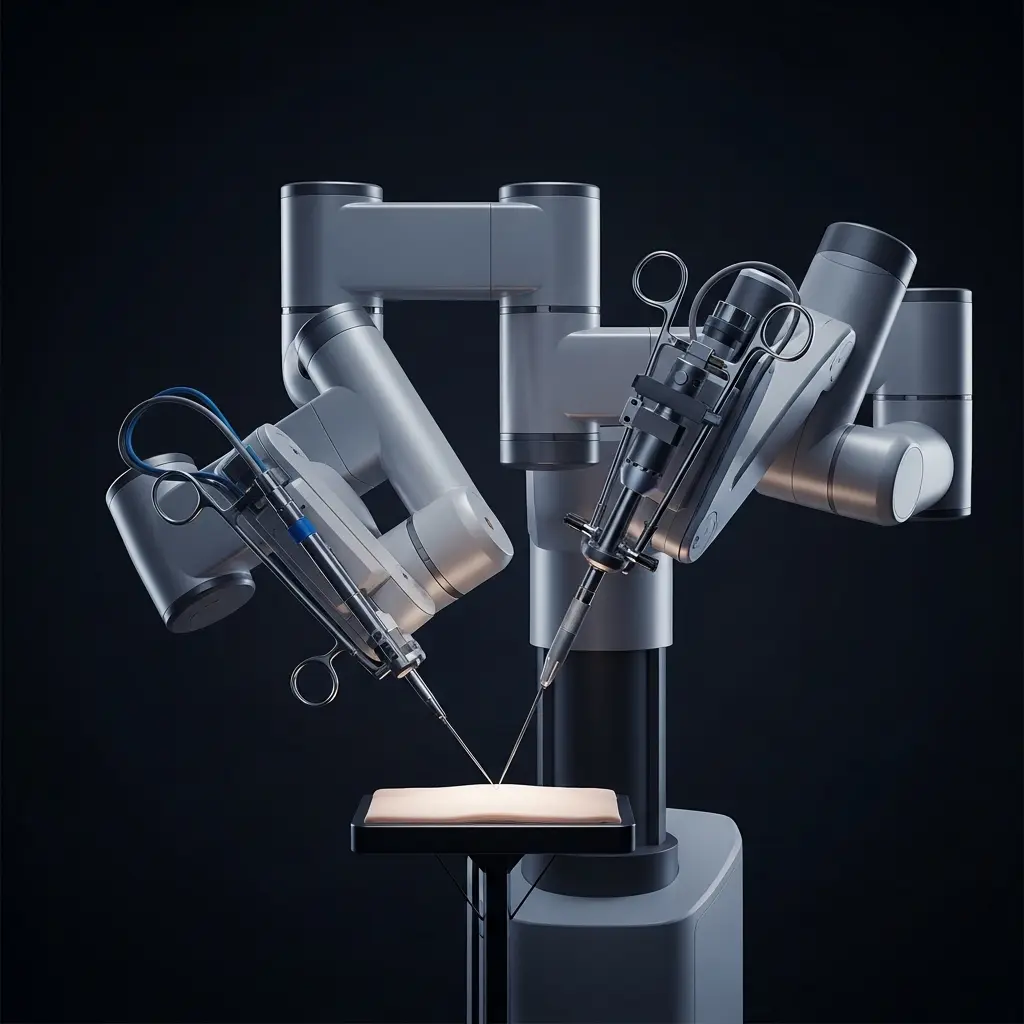
Researchers are developing advanced robotic systems to improve the precision and dexterity of endoscopic submucosal dissection, a complex surgical procedure. Yuancheng Shao from Tongji University, Yao Zhang from KU Leuven, and Jia Gu et al. present DESectBot, a novel two-segment continuum robot designed to overcome the limitations of existing single-segment tools. Their work details the implementation of deep-learning controllers, specifically gated recurrent units (GRUs), to simultaneously manage the robot’s position and orientation, effectively addressing the challenges of controlling coupled continuum segments. Demonstrating superior performance against conventional control methods in trajectory tracking and a complex peg transfer task, and validated through ex vivo ESD procedures, this research signifies a substantial advancement towards more reliable and user-friendly robotic assistance in minimally invasive surgery.
Dual-segment continuum robotics and deep learning for enhanced endoscopic submucosal dissection offer improved precision and control
Researchers have unveiled a novel dual-segment continuum robot, termed DESectBot, designed to significantly enhance the precision and effectiveness of endoscopic submucosal dissection (ESD). This minimally invasive procedure, crucial for treating early-stage gastrointestinal cancers, demands considerable technical skill and is often hampered by the limitations of existing single-segment robotic tools.
DESectBot addresses these shortcomings with a decoupled structure and integrated surgical forceps, granting it six degrees of freedom at the tip for improved lesion targeting. The development responds to the growing global burden of gastrointestinal cancers, which accounted for 26% of all cancer diagnoses and 35% of cancer fatalities worldwide in 2018.
Implementing Deep Learning Controllers for Precision
This work details the implementation of deep learning controllers, specifically gated recurrent units (GRUs), for simultaneous control of the robot’s tip position and orientation. These GRU controllers effectively manage the complex nonlinear coupling between the continuum segments, a key challenge in such robotic systems.
Benchmarking against established control methods, Jacobian-based inverse kinematics, model predictive control, feedforward neural networks, and long short-term memory networks, demonstrated the GRU’s superior performance. In nested-rectangle and Lissajous trajectory tracking tasks, the GRU achieved position/orientation root mean squared errors (RMSEs) of 1.11mm/4.62° and 0.81mm/2.59°, respectively, consistently outperforming all alternatives.
Quantifying Robotic Performance and Operational Success
Further validation involved orientation control at fixed positions, where the GRU attained a mean RMSE of 0.14mm and 0.72°. A peg transfer task showcased the GRU’s reliability, achieving a 100% success rate (120 successes from 120 attempts) with an average transfer time of 11.8 seconds, significantly exceeding the performance of novice-controlled systems.
An ex vivo demonstration confirmed DESectBot’s ability to grasp, elevate, and resect tissue, exhibiting sufficient stiffness to divide thick gastric mucosa and providing an adequate operative workspace for large lesions. These results underscore the potential of GRU-based control to enhance precision, reliability, and usability in ESD surgical training and, ultimately, improve patient outcomes.
Gated recurrent unit control benchmarking for a dual-segment continuum robot demonstrates improved performance in challenging environments
Advanced Design of the Dual-Segment Continuum Robot
DESectBot, a novel dual-segment continuum robot integrating surgical forceps, was developed to enhance dexterity during endoscopic submucosal dissection (ESD). This robot features a decoupled structure enabling six degrees of freedom (DoFs) at the tip for improved lesion targeting. Deep learning controllers, specifically gated recurrent units (GRUs), were proposed for simultaneous control of tip position and orientation, effectively managing the nonlinear coupling between the continuum segments.
The GRU controller’s performance was rigorously benchmarked against Jacobian-based inverse kinematics, model predictive control, a feedforward neural network (FNN), and a long short-term memory (LSTM) network. Nested-rectangle and Lissajous trajectory tracking tasks were employed to evaluate the GRU controller’s precision.
The GRU achieved the lowest root mean square errors (RMSEs) in both tasks, registering 1.11mm/4.62° and 0.81mm/2.59° respectively, demonstrating superior tracking accuracy. Further assessment involved orientation control at a fixed position using four target poses. Here, the GRU attained a mean RMSE of 0.14mm and 0.72°, consistently outperforming all alternative control methods.
A peg transfer task was then conducted to assess the GRU’s reliability and speed. The GRU achieved a 100% success rate, completing 120 successful transfers from 120 attempts, with an average transfer time of 11.8 seconds, significantly exceeding the performance of novice-controlled systems. To validate the robot’s surgical capabilities, an ex vivo ESD demonstration was performed.
The DESectBot successfully grasped, elevated, and resected tissue, confirming sufficient stiffness for dividing thick gastric mucosa and providing an adequate operative workspace for large lesions. These results demonstrate that GRU-based control substantially improves precision, reliability, and usability in ESD surgical training and potentially clinical applications.
Precise robotic control facilitates accurate trajectory tracking and surgical manipulation, enhancing surgical outcomes
Researchers developed DESectBot, a dual-segment continuum robot with integrated surgical forceps, achieving 6 degrees of freedom for improved lesion targeting during endoscopic submucosal dissection (ESD). The GRU controller attained the lowest position/orientation root mean square errors (RMSEs) in nested-rectangle and Lissajous trajectory tracking tasks, recording values of 1.11mm/4.62° and 0.81mm/2.59°, respectively.
For orientation control at a fixed position across four target poses, the GRU achieved a mean RMSE of 0.14mm and 0.72°, demonstrating superior performance compared to all alternative control methods tested. In a peg transfer task, the GRU-controlled DESectBot achieved a 100% success rate, completing 120 successful attempts out of 120 trials, with an average transfer time of 11.8 seconds.
The standard deviation of this transfer time significantly outperformed systems controlled by novice users. Ex vivo ESD demonstrations confirmed the robot’s ability to grasp, elevate, and resect tissue, with the scalpel completing the cut, indicating sufficient stiffness for dividing thick gastric mucosa and an adequate operative workspace for large lesions.
These results demonstrate that GRU-based control substantially enhances precision and reliability in ESD surgical training scenarios. The DESectBot’s dual-segment design provides increased dexterity compared to single-segment robotic tools, facilitating access to complex anatomical regions like the esophago-gastric junction.
The robot’s performance in trajectory tracking and orientation control highlights the effectiveness of the GRU controller in managing the nonlinear coupling between continuum segments. The 100% success rate in the peg transfer task and the successful ex vivo ESD procedure validate the potential of this robotic system for clinical application.
Gated recurrent units enhance precision in continuum robot trajectory tracking by learning complex dynamics
A novel dual-segment continuum robot, named DESectBot, has been developed to improve the precision and dexterity of endoscopic submucosal dissection (ESD). This robot features a decoupled structure and integrated surgical forceps, providing six degrees of freedom at the tip for enhanced lesion targeting.
A deep learning controller, based on gated recurrent units (GRUs), was designed to simultaneously manage the robot’s position and orientation, effectively addressing the nonlinear coupling inherent in continuum segment control. Benchmarking against Jacobian-based inverse kinematics, model predictive control, a feedforward neural network, and a long short-term memory network, the GRU controller consistently demonstrated superior performance in trajectory tracking and orientation control tasks.
Specifically, the GRU achieved the lowest root mean squared errors (RMSEs) in both nested-rectangle and Lissajous trajectory tracking, and outperformed all alternatives in maintaining precise orientation at fixed positions. A peg transfer task yielded a 100% success rate, and an ex vivo demonstration on porcine gastric mucosa confirmed the robot’s ability to grasp, elevate, and resect tissue with sufficient stiffness and within clinically relevant timeframes.
The authors acknowledge a limitation in the control update rate, constrained by the equipment used for ground-truth measurement during experiments. Future research will focus on increasing control frequencies through faster pose-sensing technologies and pipeline optimization. Further development will also include integrating haptic and shape sensing for improved feedback, real-time self-calibration, and standardized comparative studies with professional surgeons, alongside investigations into workspace coordination and collision avoidance with endoscopes. These advancements aim to establish DESectBot as a valuable tool for standardized ESD skills training and potentially enhance surgical outcomes.
🗞 Deep-Learning-Based Control of a Decoupled Two-Segment Continuum Robot for Endoscopic Submucosal Dissection
🧠 ArXiv: https://arxiv.org/abs/2602.03406
See today’s quantum computing news on Quantum Zeitgeist for the latest breakthroughs in qubits, hardware, algorithms, and industry deals.