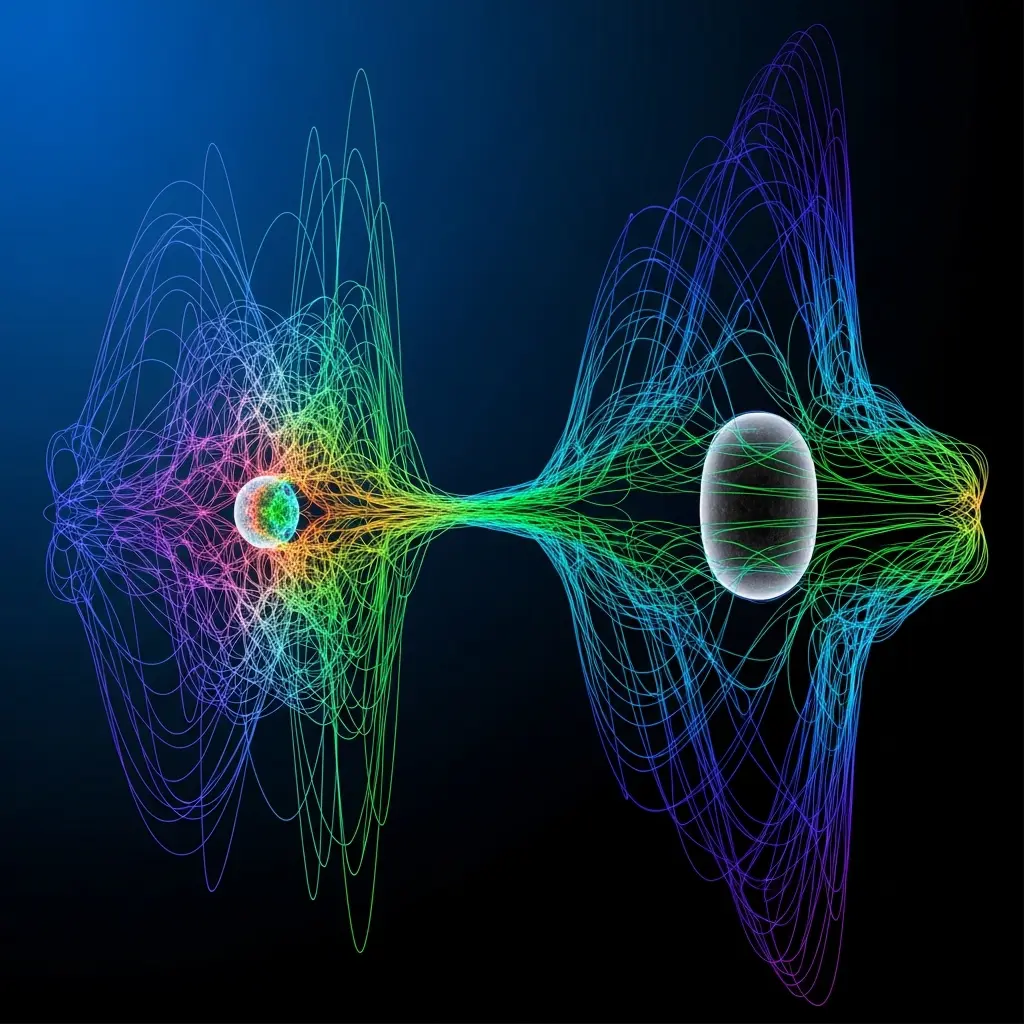
Surface plasmon resonances (SPRs), crucial to technologies including bio-sensing and cloaking, rely on non-radiative electromagnetic phenomena at material interfaces. Researchers Bochao Chen (National NSFC & NSF of Jilin Province), Yixian Gao (NSFC & NSF of Jilin Province), and Hongyu Liu (Hong Kong RGC & NSFC-RGC Joint Research Grant) et al. address the limited understanding of vectorial surface plasmon resonances within the Maxwell framework. Their work introduces a new symmetrization technique for the Maxwell Neumann, Poincaré (MNP) operator, facilitating spectral decomposition and providing a foundational advance for electromagnetic theory. Consequently, this research rigorously defines the ergodic localisation of weak SPRs at material boundaries, resolving a significant challenge in their quantitative description.
Symmetrization of the Maxwell Neumann Poincaré operator and weak surface plasmon resonance localisation provide a novel spectral approach
Developing a Novel Mathematical Framework for SPRs
Scientists have developed a novel mathematical framework for understanding surface plasmon resonances, electromagnetic waves trapped at material interfaces, with potential implications for biosensing and cloaking technologies. Furthermore, the adjoint operator also exhibits analogous properties, confirmed through a separate set of theorems detailing its Calderon identity and self-adjointness.
Building upon this framework, the study reveals that the MNP operator possesses a sequence of eigenvalues that approach zero, alongside corresponding eigenfunctions directly linked to the spectral decomposition of the operator. Specifically, the research demonstrates that these eigenfunctions can be expressed in terms of single-layer potentials, providing a concrete mathematical connection between the operator and its solutions.
This decomposition is further extended to the adjoint operator, establishing a similar relationship between its eigenfunctions and the single-layer potential. Leveraging these spectral properties, the team has proven a surface localization theorem for SPRs, valid under conditions of quantum ergodicity, and demonstrated strict surface concentration of SPRs for spherical nanoparticles.
For nanoparticles illuminated by appropriate incident fields, the associated weak plasmon sequences exhibit a specific decay rate, indicating their confinement to the material surface. Spectral analysis was then performed by determining the eigenvalue distribution through a novel Helmholtz decomposition. Boundary localization was rigorously established through spectral decomposition methods, unifying abstract operator theory with layer potential techniques.
These techniques were applied to both general smooth domains and explicit spherical cases, demonstrating the boundary concentration of plasmonic modes. The work employs layer potential formulations, beginning with the definition of Hilbert spaces such as Hs(∂D)3 for Sobolev spaces of order s on the boundary ∂D, and Hs ⋆(∂D) for functions with zero mean.
Rigorous Definition of Boundary Electromagnetic Operators
Vectorial and scalar surface curl operators were defined to facilitate the analysis of electromagnetic fields on the boundary, utilizing established relationships between surface gradients, divergences, and the Laplace-Beltrami operator. This work rigorously characterizes the quantum-ergodic localization of weak surface plasmon resonances at material boundaries within the full Maxwell system, resolving a long-standing quantitative description challenge.
The static MNP operator, denoted as M∂D, is defined for a bounded domain D with a class C1,γ boundary, acting on functions φ to produce M∂Dφ, an integral over the boundary involving the exterior normal vector and the Laplacian’s fundamental solution. Theorem 1.1 establishes a Calderon Identity, stating the commutation relation N∂DM∗ ∂D = M∂DN∂D holds on −→ curl∂D(H 3 2⋆(∂D)).
Proving Self-Adjoint Properties and Calderon Identities
Furthermore, the operator M∂D, acting on −→ curl∂D(H 1 2(∂D)), is proven to be self-adjoint with respect to a specific inner product ⟨·, ·⟩ N −1 ∂D. Theorem 1.2 mirrors these findings for the adjoint operator M∗ ∂D, demonstrating a corresponding Calderon Identity M∗ ∂DQ∂D = Q∂DM∂D on ∇∂D(H 3 2⋆(∂D)) and self-adjointness on ∇∂D(H 1 2(∂D)) with respect to the inner product ⟨·, ·⟩Q−1 ∂D.
Theorem 1.3 reveals that the MNP operator M∂D admits a sequence of eigenvalues {λj}j∈Z+ where λj approaches zero as j tends to infinity. The eigenfunctions φj are expressed as φj = −→ curl∂DS∂D[θj], where θj are eigenfunctions of the adjoint NP operator K∗ ∂D, normalized with respect to the inner product ⟨u, v⟩S∂D.
Normalized functions N −1 ∂D[φj] are then established as eigenfunctions of a composite operator acting on −→ curl∂D(H 3 2⋆(∂D)). Theorem 1.4 presents analogous spectral properties for the adjoint operator M∗ ∂D, with eigenvalues λ∗ j also approaching zero as j increases and eigenfunctions ψj defined as ψj = ∇∂DS∂D[θj].
The functions Q−1 ∂D[ψj] are normalized eigenfunctions of another composite operator acting on ∇∂D(H 3 2⋆(∂D)). Finally, leveraging these spectral decompositions, the study demonstrates that weak surface plasmon resonances, occurring in the space −→ curl∂D(H 1 2(∂D)) for the Maxwell system, exhibit a strict surface concentration. Specifically, for a nanoparticle D and a sufficiently small δ, the associated weak plasmon sequence {(Ej, Hj)}j∈Z+ satisfies ∥Ej∥L2 loc(R3\Tε(∂D)) = o(j−1/2) and ∥Hj∥L2 loc(R3\Tε(∂D)) = o(j−1/2) almost surely, where Tε(∂D) denotes the ε-tubular neighbourhood of the boundary ∂D.
Ergodic behaviour of weak surface plasmon resonances via operator symmetrization reveals novel insights into light-matter interactions
Scientists have developed a novel symmetrization principle for the Maxwell Neumann–Poincaré operator, a key component in understanding surface plasmon resonances. Surface plasmon resonances are non-radiative electromagnetic waves that occur at material interfaces and are crucial for technologies including biosensing and cloaking.
While the behaviour of scalar versions of this operator and related dynamics are well understood, its full vectorial counterpart within Maxwell’s equations has remained largely unexplored until now. This work introduces a method for spectrally decomposing traces within the space defined by the Maxwell Neumann–Poincaré operator, representing a foundational advancement in electromagnetic theory.
Consequently, the ergodic localization of weak surface plasmon resonances at material boundaries within the complete Maxwell system has been rigorously characterised, resolving a long-standing question regarding their quantitative description. The research establishes equivalence between different norms used to measure these resonances, confirming the validity of the spectral decomposition.
The authors acknowledge a limitation in that the current framework primarily focuses on the mathematical characterisation of these resonances and does not directly address the complexities of real-world material properties or fabrication processes. Future research directions include extending this theoretical framework to investigate the influence of material losses and inhomogeneities on the behaviour of surface plasmon resonances. This could facilitate the design of more efficient and robust plasmonic devices for a range of applications, potentially leading to improvements in sensing technologies and novel optical materials.
🗞 Symmetrization of the Maxwell–Neumann–Poincar’e operator, spectral decomposition in H(curl,D)H(curl,D) traces, and boundary localisation of SPRs
🧠 ArXiv: https://arxiv.org/abs/2602.02998


See today’s quantum computing news on Quantum Zeitgeist for the latest breakthroughs in qubits, hardware, algorithms, and industry deals.