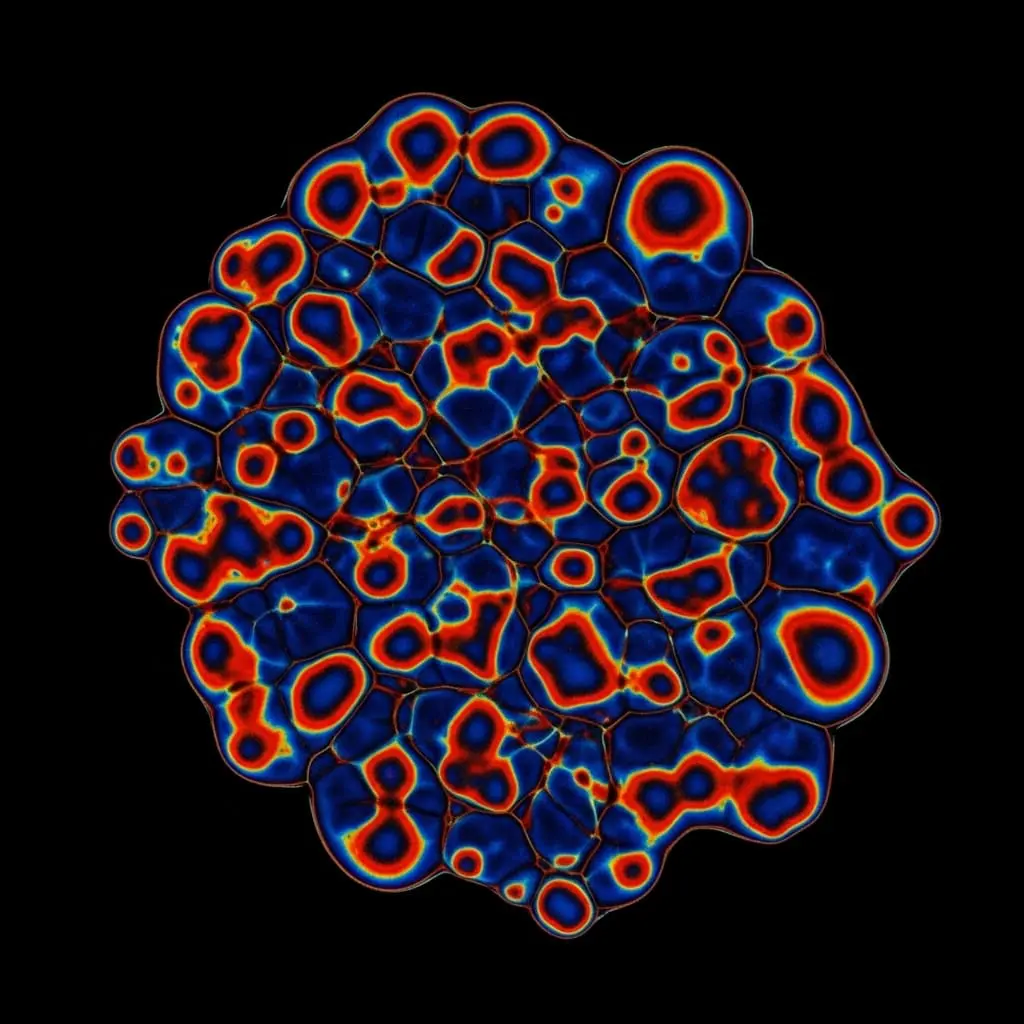
Magnetic skyrmions represent promising candidates for next-generation spintronic devices, and researchers continue to explore their behaviour in diverse magnetic materials. Mathews Benny, Moinak Ghosh, and Moritz A. Goerzen, along with colleagues including Bjarne Beyer, Hendrik Schrautzer, and Stefan Heinze, now report the discovery of unconventional skyrmions stabilised within noncollinear magnets. Their work, conducted at the Indian Institute of Science Education and Research Thiruvananthapuram and CEMES, Université de Toulouse, demonstrates that these skyrmions emerge from a noncollinear ground state in Rh/Co and Pd/Co bilayers, driven by higher-order spin interactions despite the ferromagnetic nature of cobalt. Significantly, the team’s calculations reveal substantial energy barriers protecting these metastable skyrmions, indicating potential for experimental observation and opening avenues for novel spin transport phenomena and magnet-superconductor hybrid technologies.
Noncollinear magnetism enables emergent skyrmion formation in Rh/Co and Pd/Co bilayers at room temperature
Researchers have uncovered a new type of magnetic skyrmion stabilized within noncollinear magnets, potentially revolutionizing spintronic device development. These unconventional skyrmions emerge in Rh/Co and Pd/Co atomic bilayers deposited on a Re(0001) surface, a system where a noncollinear ground state is surprisingly stabilized by four spin exchange interactions despite cobalt typically exhibiting strong pairwise exchange interactions.
This work demonstrates that unconventional skyrmion lattices and isolated skyrmions can arise on this unique magnetic background, offering a pathway to manipulate spin textures in novel ways. First-principles calculations and atomistic spin simulations were employed to reveal the underlying mechanisms driving the formation of these skyrmions.
Understanding noncollinear skyrmion stabilization mechanisms
Understanding Noncollinear Skyrmion Stabilization Mechanisms
The research highlights that the observed noncollinear ground state is sustained by a delicate balance of four spin exchange interactions, differing significantly from conventional skyrmion systems reliant on ferromagnetic backgrounds and Dzyaloshinskii-Moriya interactions. Transition-state theory calculations further indicate that these metastable skyrmions are protected by substantial energy barriers, suggesting their potential observability in experimental settings using techniques like spin-polarized scanning tunneling microscopy.
The discovery extends the range of materials hosting skyrmions beyond ferromagnets, antiferromagnets, and ferrimagnets, opening new avenues for exploring topological spin transport. These unconventional skyrmions, stabilized by higher-order interactions, could prove crucial in designing advanced magnet-superconductor hybrid systems.
Predicting novel skyrmion sizes and stability limits
The simulations predict that isolated skyrmions can achieve diameters on the order of 10 nanometers, exhibiting stability comparable to those previously observed at transition-metal interfaces. This research introduces a novel class of skyrmions emerging on complex magnetic ground states, challenging conventional understanding of skyrmion stabilization.
The findings demonstrate that multi-spin interactions, specifically four-site and three-site four spin interactions, can destabilize ferromagnetic states and promote the formation of noncollinear arrangements. By revealing the crucial role of these interactions, the study provides a new framework for designing materials with tailored magnetic properties and exploring innovative spintronic functionalities.
Modeling complex magnetic bilayer systems
Exploring Higher-Order Interactions in Magnetic Systems
Atomistic spin modelling incorporating higher-order exchange interactions for bilayer magnetic systems reveals complex interfacial effects
Modeling Interfacial Effects in Magnetic Bilayers
First-principles calculations and atomistic spin simulations underpinned this work, revealing unconventional skyrmions stabilised in noncollinear magnets. The researchers employed a comprehensive atomistic spin Hamiltonian to model the magnetic interactions within Rh/Co and Pd/Co bilayers deposited on a Re(0001) surface.
This Hamiltonian incorporated pairwise exchange interactions, Dzyaloshinskii-Moriya interaction vectors, magnetocrystalline anisotropy, external magnetic fields, and crucially, higher-order interactions including biquadratic, three-site, and four-site four-spin constants. These higher-order interactions, arising from fourth-order perturbation theory, were approximated using minimal neighbour distances, a technique detailed in previous studies.
All interaction constants were determined via density functional theory calculations for the specific bilayer systems, with supplementary materials providing detailed computational parameters and resulting values. To map the magnetic phase diagram, the team relaxed three initial spin configurations, homogeneous spin spirals, skyrmion lattices, and the ferromagnetic state, using atomistic spin simulations.
Energies were calculated relative to the unrelaxed spin spiral at zero magnetic field, allowing for identification of the most stable magnetic order as a function of applied field. Around 1.2 Tesla, the energy of the skyrmion lattice dropped below that of the spin spiral, becoming the minimum energy state, while the ferromagnetic state became energetically favourable at approximately 4.1 Tesla.
Methodological innovation lay in the inclusion of these higher-order interactions, which destabilise the ferromagnetic state and promote a novel noncollinear ground state. Isolated skyrmions were then stabilised on this noncollinear background, with their stability assessed using minimum energy path calculations performed via the geodesic nudged elastic band method.
These calculations revealed large energy barriers for isolated skyrmions with diameters around 10 nanometres, suggesting a stability comparable to skyrmions observed on conventional ferromagnetic backgrounds. The resulting spin structures and their Fourier transforms were analysed to confirm the emergence of these unconventional skyrmions and their unique magnetic properties.
Stabilised skyrmions emerge from four-spin interactions in Rh/Co and Pd/Co bilayers at zero magnetic field
Scientists have demonstrated the stabilization of unconventional skyrmions in noncollinear magnets, specifically Rh/Co and Pd/Co atomic bilayers deposited on a Re(0001) surface. Atomistic spin simulations, informed by first-principles calculations, reveal that a noncollinear ground state arises due to four-spin exchange interactions.
These interactions, though present in a prototypical ferromagnet like cobalt, facilitate the emergence of both skyrmion lattices and isolated skyrmions on this unique magnetic background. Transition-state theory calculations indicate that these metastable skyrmions are protected by substantial energy barriers, suggesting potential observability in experimental settings.
The magnetic phase diagram for Rh/Co bilayers, excluding higher-order interactions, shows a spin spiral state favored at zero and low magnetic fields. Around a magnetic field of 1.2 Tesla, the energy of the skyrmion lattice decreases, becoming the minimum energy state, while the ferromagnetic state becomes energetically favorable at approximately 4.1 Tesla.
Detailed analysis of the atomistic spin Hamiltonian reveals the crucial role of the biquadratic constant, B1, and the three-site and four-site four-spin constants, Y1 and K1, respectively. These higher-order interactions, arising from fourth-order perturbation theory, destabilize the ferromagnetic state and promote the novel noncollinear ground state.
Isolated skyrmions, with diameters on the order of 10 nanometers, are stabilized by a combination of Dzyaloshinskii-Moriya interaction and frustrated exchange interactions, as confirmed by minimum energy path calculations using the geodesic nudged elastic band method. The resulting energy barriers for these isolated skyrmions are comparable to those observed in skyrmions on collinear ferromagnetic backgrounds at transition-metal interfaces.
Unconventional Skyrmion Stabilisation via Interplay of Multipolar Exchange Interactions offers novel topological textures
Researchers have identified a new type of unconventional magnetic skyrmion stabilised within noncollinear magnets. Investigations utilising both first-principles calculations and atomistic spin simulations demonstrate that a noncollinear ground state can be achieved in Rh/Co and Pd/Co bilayers deposited on a Re(0001) surface, despite cobalt typically exhibiting strong ferromagnetic behaviour.
This stabilisation arises from the interplay of four spin exchange interactions, leading to the emergence of both skyrmion lattices and isolated skyrmions. Calculations of transition states reveal substantial energy barriers protecting these skyrmions, indicating their potential observability in experimental settings.
The research details how the annihilation barrier is positively influenced by DMI and exchange interactions, while the noncollinear ground state is favoured by negative contributions from three-site and four-site four-spin interactions, magnetocrystalline anisotropy, and the Zeeman term. The creation barrier exhibits a similar pattern, with the exchange interaction remaining positive.
These unconventional skyrmions, formed on a noncollinear magnetic background, could facilitate advancements in spin transport technologies and magnet-superconductor hybrid systems. The authors acknowledge that the behaviour observed is dependent on higher-order interactions, and that the relative contributions of these interactions are crucial for stabilising the noncollinear ground state.
Specifically, the dominance of certain four-spin interaction terms, exhibiting a negative sign in contrast to previously studied systems, is highlighted as a key factor. Future research may focus on identifying the primary higher-order interaction responsible for stabilising the noncollinear state and exploring the broader implications of these findings for the design of novel spintronic devices.
🗞 Skyrmions in 2D chiral magnets with noncollinear ground states stabilized by higher-order interactions
🧠 ArXiv: https://arxiv.org/abs/2602.03487