

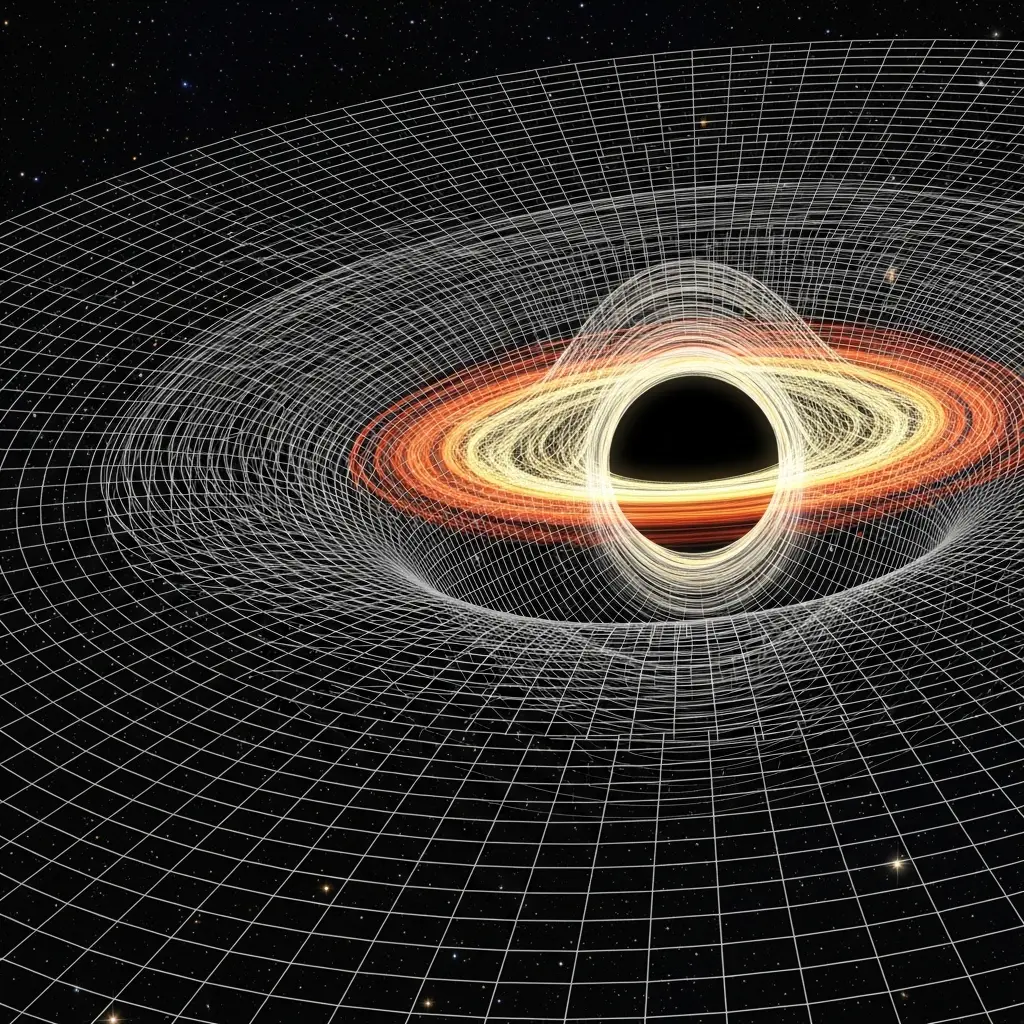
Scientists are increasingly focused on quantifying the Hilbert space dimension of black holes as a crucial step towards a complete theory of gravity. Vijay Balasubramanian (University of Pennsylvania, Santa Fe Institute, Vrije Universiteit Brussel), Rathindra Nath Das (Institute for Theoretical Physics and Astrophysics, Julius-Maximilians-Universit at W urzburg, Weizmann Institute of Science, MIT) and Johanna Erdmenger (Institute for Theoretical Physics and Astrophysics, Julius-Maximilians-Universit at W urzburg) et al. present a novel calculation of this dimension for a black hole within 2+1-dimensional Anti-de Sitter space, utilising a dynamical Krylov complexity approach. Their research demonstrates that the spread of an initial state, measured through a Krylov basis, saturates at a value directly linked to the Bekenstein-Hawking entropy, offering a new method for determining the Hilbert space dimension of complex interacting systems and providing significant insight into the fundamental structure of quantum gravity.
Krylov complexity reveals Hilbert space dimensionality in Anti-de Sitter black holes and its relation to volume
Using Krylov Complexity to Probe Gravity Theory
Applying Krylov Complexity to Black Hole Systems
Scientists have calculated the Hilbert space dimension of a black hole using a novel application of Krylov complexity, a technique measuring the spread of quantum information. This work establishes a new method for determining the dimensionality of the Hilbert space in complex interacting systems, bypassing traditional approaches reliant on string theory or high-energy completions.
Researchers achieved this breakthrough by tracking the evolution of an initial thermofield double state within a Krylov basis, effectively mapping the growth of quantum complexity over time. The associated Lanczos coefficients, crucial to the calculation, remarkably align with those expected from chaotic motion on the SL(2, R) group, indicating a deep connection between complexity and underlying dynamics.
This study focuses on a black hole existing within 2+1-dimensional Anti-de Sitter space, employing a dynamical approach to quantify its Hilbert space. By incorporating non-perturbative effects into the path integral, a method for calculating ensemble averages, the team discovered that complexity does not continue to grow indefinitely, but instead saturates at late times.
Significantly, the saturation value precisely corresponds to the exponential of the Bekenstein-Hawking entropy, a fundamental quantity describing the black hole’s information content. This finding establishes a direct link between the growth of complexity and the black hole’s entropy, suggesting that complexity can serve as a measure of the accessible degrees of freedom within the black hole’s Hilbert space.
The research introduces a powerful new technique for probing the structure of quantum gravity, moving beyond established methods. By analysing the spread of quantum states, scientists can now estimate the Hilbert space dimension without relying on assumptions about ultraviolet completeness or specific high-energy physics.
Connecting Complexity to Quantum Entropies
Quantifying Information Linkages with Entropy
This approach leverages the concept of spread complexity, computed from the support of quantum states on the Krylov basis, and connects it to the spectral density of the system. The identification of orthogonal polynomials, mirroring those found in random matrix theory, further solidifies the connection between complexity and the statistical properties of the underlying Hamiltonian.
Furthermore, the study demonstrates that the calculated complexity saturates at a value directly proportional to the exponential of the Bekenstein-Hawking entropy, revealing a fundamental relationship between information content and the dimensionality of the black hole’s Hilbert space. This result not only provides a new way to understand black hole entropy but also opens avenues for exploring the quantum structure of gravity and the potential for a finite-dimensional description of black hole microstates. The implications extend beyond black holes, offering a potential framework for analysing the complexity of other complex quantum systems and furthering our understanding of quantum chaos.
Lanczos coefficient calculation and late-time complexity saturation in Anti-de Sitter space reveal interesting connections to quantum chaos
Dynamical Approach to AdS Spacetime Calculations
Dynamical Calculation in AdS Spacetime Background
A dynamical Krylov complexity approach underpins this work, used to calculate the Hilbert space dimension of a black hole within 2+1-dimensional Anti-de Sitter space. The research begins by determining the spread of an initial thermofield double state across the Krylov basis, a sequence of vectors generated through recursive orthogonalization of states acted upon by the Hamiltonian.
This process yields Lanczos coefficients, representing hopping amplitudes between consecutive Krylov basis states, which remarkably align with those observed in chaotic motion on a group manifold. The study incorporates non-perturbative effects into the path integral, enabling the computation of coarse-grained ensemble averages and revealing that complexity saturates at late times.
This saturation value corresponds directly to the exponential of the Bekenstein-Hawking entropy, establishing a novel method for computing the Hilbert space dimension of complex interacting systems from the saturating value of spread complexity. Identifying orthogonal polynomials within the Krylov basis as those of a random matrix ensemble introduces a physical interpretation of Hamiltonian eigenvalue statistics via random matrix theory, specified by the reference state and microscopic spectral density.
Applying this procedure to 3d gravity in a near-extremal limit leverages a known spectral density derived from the Euclidean gravity path integral. The Lanczos coefficients obtained match those for quantum particles moving on the SL(2, R) manifold, resulting in monotonically increasing spread complexity.
Spread complexity itself is quantified by tracking the wavefunction’s evolution, expressed as an expansion in the Krylov basis and subsequently related to the spectral density and orthogonal polynomials constructed from the Lanczos coefficients. Early time complexity growth is investigated using an eternal black hole in AdSd+1, constructing a vacuum wavefunction in the thermofield double form via the Hartle-Hawking no-boundary Euclidean path integral.
The Lanczos coefficients are then extracted from moments of the return amplitude, calculated as the ratio of partition functions, Z(β + it) over Z(β). For the specific case of d+1 = 3 dimensions, the Maloney, Witten, Keller evaluation of classical solutions to Einstein’s equations with torus boundary conditions provides the leading contribution to the density of states, particularly in the near-extremal regime where angular momentum significantly exceeds the AdS radius multiplied by Newton’s constant.
Krylov complexity links black hole entropy to Hilbert space dimensionality in a surprising way
Researchers determined the dimension of a black hole’s Hilbert space in 2+1-dimensional Anti-de Sitter space using a dynamical Krylov complexity approach. Calculations reveal that complexity saturates at late times, reaching a value equivalent to the exponential of the Bekenstein-Hawking entropy. This saturation value introduces a novel method for computing the Hilbert space dimension of complex interacting systems by analysing the saturating value of spread complexity.
The study obtained the spread of an initial thermofield double state across the Krylov basis, finding that the resulting Lanczos coefficients align with those observed in chaotic motion on the SL(2, R) group. Spectral density ρ(E), derived from the Euclidean gravity path integral, was incorporated to account for coarse-grained ensemble averages and spectral correlators.
This inclusion suggests that products like ρ(E)ρ(E′) represent spectral correlators within an ensemble, reflecting the influence of wormholes on the product of partition sums in both 2D and 3D gravity. Analysis of orthogonal polynomials demonstrated that spread complexity quantifies the spread of a wavefunction within the Hilbert space as it evolves over time.
The research established a recursion relation for the coefficients of the Krylov basis, revealing that the polynomials satisfy conditions determined by the Lanczos coefficients. Furthermore, the study showed that the dimension of the accessible part of the Hilbert space can be measured by quantifying the spread of states in the Krylov basis, particularly in chaotic theories where initial states become fully delocalized.
Complexity saturation reveals finite dimensionality of extremal black hole Hilbert spaces, consistent with recent conjectures
Researchers have calculated the Hilbert space dimension of a black hole in 2+1-dimensional Anti-de Sitter space using a dynamical Krylov complexity approach. This was achieved by examining the spread of an initial thermofield double state within a Krylov basis, revealing Lanczos coefficients consistent with chaotic motion.
By incorporating non-perturbative effects into the path integral, the study demonstrates that complexity saturates at late times, reaching a value proportional to the exponential of the Bekenstein-Hawking entropy. This finding establishes a novel method for determining the Hilbert space dimension of complex interacting systems from the saturation value of spread complexity.
The results indicate that the Hilbert space of three-dimensional gravity near extremality possesses a finite dimension, scaling exponentially with black hole entropy. The authors acknowledge a limitation stemming from the continuous and unbounded spectrum inherent in the effective gravitational path integral, which was addressed by extracting information about the discrete spectrum from the density-density correlator.
Future research may explore the connection between this complexity measure and geometric interpretations, such as the volume of Einstein-Rosen bridges, or other diffeomorphism-invariant quantities. Recent work demonstrates that this specific measure of spread complexity, when applied to the Double-Scaled SYK model, accurately reproduces the growth of classical wormhole length in dual two-dimensional gravity, suggesting a link between quantum corrections and classical geometry.
🗞 Complexity and the Hilbert space dimension of 3D gravity
🧠 ArXiv: https://arxiv.org/abs/2602.02645




See today’s quantum computing news on Quantum Zeitgeist for the latest breakthroughs in qubits, hardware, algorithms, and industry deals.



